wayground logo

Free Printable Worksheets

NEW

Font size

S
M
L
XL
Worksheets

elements, compounds, mixtures, bonding

Total questions: 40

Worksheet time: 1hrs 19mins

Name
Class
Date
1.

Structural differences between different chemicals can be represented in models of the particles. Which drawing BEST represents a compound?

a)

Picture A

b)

Picture B

c)

Picture C

d)

Picture D

2.

Groups of atoms held together by covalent bonds are called:

a)

elements

b)

molecules

c)

mixtures

d)

alloys

3.

Atoms that gain or lose electrons are called

a)

alloys

b)

mixtures

c)

ions

d)

elements

4.

Covalent bonding occurs:

a)

in salts like NaCl.

b)

when electrons are shared between two atoms.

c)

only when electrons are shared between two identical atoms.

d)

when electrons are transferred from one atom to another.

5.

Bonding between atoms produces an outermost energy level for each atom filled with:

a)

1 electron

b)

8 electrons

c)

16 electrons

d)

32 electrons

6.

Which of the following is the LEAST reactive group?

a)

Alkali Metals

b)

Group 2 Metals

c)

Halogens

d)

Noble Gases

7.

An atom that acquires an electrical charge by gaining or losing electrons is known as:

a)

ion

b)

a free radical

c)

a hydrate

d)

a monatomic molecule

8.

In the atom represented below, the small dark circles represent electrons. The number of valence electrons in the atom pictured is:

a)

2

b)

3

c)

5

d)

7

9.

The diagram that best represents the Lewis dot diagram of a chlorine atom is:

a)
b)
c)
d)
10.

Which statement best explains why atoms form chemical bonds with other atoms?

a)

Most atoms are less stable when they combine with other atoms.

b)

When atoms collide with other atoms, they bond automatically.

c)

Atoms are always attracted to other atoms.

d)

Most atoms are unstable unless they are combined with other atoms.

11.
A substance made of only one type of atom is called —
a)
an element
b)
a mixture
c)
a compound
d)
a salt
12.
Two or more substances in the same place but NOT chemically combined or in a specific ratio is called —
a)
a compound 
b)
a pure substance
c)
an element
d)
a mixture
13.
Can a mixture be separated? 
a)
No
b)
Yes
c)
Only sometimes
14.

What does this illustrate

a)

Elements

b)

Compunds

c)

Mixture of Elements and Compunds

d)

Mixture of Compounds

15.

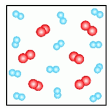
What does this pic illustrate?

a)

Element

b)

Mixture of Compunds

c)

Mixture of elemets

d)

Compounds

16.

contains only 1 type of atom

a)

element

b)

compound

c)

mixture

17.

diagram "a" is an example of a(n)

a)

element

b)

compound

c)

mixture

18.

diagram "b" is an example of a(n)

a)

element

b)

compound

c)

mixture

19.

diagram "c" is an example of a(n)

a)

element

b)

compound

c)

mixture

20.
This picture represents which of the following?
a)
element
b)
compound
c)
mixture of elements
d)
mixture of compounds
21.
Classify the picture with the correct label.
a)
Element
b)
Compound
c)
Mixture of Elements
d)
Mixture of Compounds
22.
Classify the picture with the correct label.
a)
Element
b)
Compound
c)
Mixture of Elements and Compounds
d)
Mixture of Elements
23.
Classify the picture with the correct label.
a)
Compounds
b)
Mixture of Elements
c)
Mixture of Compounds
d)
Mixture of Elements & Compounds
24.
Classify the picture with the correct label.
a)
Element
b)
Compound
c)
Mixture of Compounds
d)
Mixture of Elements
25.
Classify the picture with the correct label.
a)
Mixture of Elements
b)
Mixture of Elements & Compounds
c)
Mixture of Compounds
d)
Compounds
26.
Classify the picture with the correct label.
a)
Mixture of Elements
b)
Mixture of Elements & Compounds
c)
Mixture of Compounds
d)
Compounds
27.
Classify the picture with the correct label.
a)
Mixture of Elements
b)
Mixture of Elements & Compounds
c)
Mixture of Compounds
d)
Compounds
28.
Which one has more than one type of atom in it
a)
Element
b)
Compound 
29.
This diagram represents a _____.
a)
pure substance that is a compound
b)
mixture of elements
c)
pure substance that is an element
d)
mixture of compounds
30.
Which of the following has a full valence shell?
a)
Oxygen
b)
Neon
c)
Barium
d)
Carbon
31.
An ionic bond forms when atoms ___________ electrons.
a)
gain
b)
share
c)
increase
d)
transfer
32.

Chemical bonds involve two atoms sharing valence electrons or the transfer of valence electrons.

a)

True

b)

False

33.
The type of bond where valence electrons are TRANSFERRED is called: 
a)
Covalent
b)
Ionic
c)
Hydrogen
d)
Isotope
34.
Gain or lose electrons
a)
Ionic Bonds
b)
Covalent Bonds
c)
Both bonds
d)
Neither bond
35.
Share electrons
a)
Ionic Bonds
b)
Covalent Bonds
c)
Both bonds
d)
Neither bond
36.
Between metals and nometals
a)
Ionic Bonds
b)
Covalent Bonds
c)
Both bonds
d)
Neither bond
37.
Between  nonmetals
a)
Ionic Bonds
b)
Covalent Bonds
c)
Both bonds
d)
Neither bond
38.
This picture shows a...
a)
Ionic Bond
b)
Covalent Bond
c)
Both bonds
d)
Neither bond
39.
This picture shows a...
a)
Ionic Bond
b)
Covalent Bond
c)
Both bonds
d)
Neither bond
40.
This picture shows a...
a)
Ionic Bond
b)
Covalent Bond
c)
Both bonds
d)
Neither bond