
 Worksheets
Quizziz #16 (Due Sunday, 3/10 @ 11pm)
Total questions: 55
Worksheet time: 1hrs 26mins
Name
Class
Date
1.
Which significance level
(column) do you look at when finding the critical value?
(column) do you look at when finding the critical value?
a)
.50
b)
.10
c)
.05
d)
.01
2.
How do you find degrees of freedom?
a)
one less than the possible genotypes
b)
one less than the possible phenotypes
c)
total number divided 2
d)
total number times 2
3.
How do you find critical value?
a)
where degrees of freedom lines up with significance level
b)
where significance level lines up with chi-square
c)
the difference between total and chi-square
d)
degrees of freedom minus significance level
4.
Observed in the wild are 10 circles, 20 squares and 30 triangles. The ratio for this particular population is 2:3:5
observed: 10 circles expected: 12
observed 20 squares expected : 18
observed 30 triangles expected: 30
What is the degrees of freedom?
observed: 10 circles expected: 12
observed 20 squares expected : 18
observed 30 triangles expected: 30
What is the degrees of freedom?
a)
1
b)
2
c)
3
d)
4
5.

What are the degrees of freedom for the following χ² test?
a)
6
b)
2
c)
5
d)
36
6.
How do you find the expected number?
a)
ratio from punnett square multiplied to total
b)
ratio from punnett square divided by total
c)
ratio from punnett square multiplied by observed number
d)
ratio from punnett square minus observed number
7.

What are the degrees of freedom?
a)
3
b)
2
c)
1
d)
9.488
8.

Observed in the wild are 10 circles, 20 squares and 30 triangles. The ratio for this particular population is 2:3:5
observed: 10 circles expected: 12
observed 20 squares expected : 18
observed 30 triangles expected: 30
Chi square + 5.96
Would you accept or reject?
observed: 10 circles expected: 12
observed 20 squares expected : 18
observed 30 triangles expected: 30
Chi square + 5.96
Would you accept or reject?
a)
accept
b)
reject
9.

How many degrees of freedom will be present?
a)
4
b)
5
c)
6
d)
7
10.
Hemophilia is a recessive x-linked disorder.
Which genotype represents a female who is a carrier for hemophilia?
Which genotype represents a female who is a carrier for hemophilia?
a)
XHXh
b)
XhXh
c)
XHXH
d)
XhY
11.
Hemophilia is a recessive x-linked disorder.
Which genotype represents a male with hemophilia?
Which genotype represents a male with hemophilia?
a)
XHXh
b)
XhXh
c)
XHY
d)
XhY
12.
Colorblindness is a recessive x-linked disorder.
Which genotype represents a male with normal vision?
Which genotype represents a male with normal vision?
a)
XNXN
b)
XnXn
c)
XNY
d)
XnY
13.
Colorblindness is a recessive x-linked disorder.
Which genotype represents a female who is colorblind?
Which genotype represents a female who is colorblind?
a)
XNXn
b)
XnXn
c)
XNXN
d)
XnY
14.

Which of the following genotypes belongs in the red box in the Punnett square?
a)
XBXb
b)
XbXb
c)
XbY
d)
XBY
15.

Which of the following genotypes belongs in the red box in the Punnett square?
a)
XBXb
b)
XbXb
c)
XBXB
d)
XbY
16.

In fruit flies, red eye color (R) is a sex-linked trait that is dominant over white eye color (r).
According to the Punnett square, what percentage of female offspring will have red eyes?
According to the Punnett square, what percentage of female offspring will have red eyes?
a)
0%
b)
25%
c)
50%
d)
100%
17.

In fruit flies, red eye color (R) is a sex-linked trait that is dominant over white eye color (r).
According to the Punnett square, what percentage of offspring will have white eyes?
According to the Punnett square, what percentage of offspring will have white eyes?
a)
0%
b)
25%
c)
50%
d)
100%
18.

Duchenne muscular dystrophy is a recessive x-linked disorder.
According to the Punnett square, what percentage of male offspring will have the disorder?
According to the Punnett square, what percentage of male offspring will have the disorder?
a)
0%
b)
25%
c)
50%
d)
100%
19.

Duchenne muscular dystrophy is a recessive x-linked disorder.
According to the Punnett square, what percentage of offspring will have the disorder?
According to the Punnett square, what percentage of offspring will have the disorder?
a)
0%
b)
25%
c)
50%
d)
100%
20.

Hemophilia is a recessive x-linked disorder. According to the Punnett square, what percentage of offspring will have the disorder?
a)
0%
b)
25%
c)
50%
d)
100%
21.

Hemophilia is a recessive x-linked disorder. According to the Punnett square, what percentage of offspring will have the disorder?
a)
0%
b)
25%
c)
50%
d)
100%
22.

The proteins found on the surface of RBCs that allow us to type blood as A, B, O or AB are called
a)
antigens
b)
antibodies
c)
aggluntates
d)
Rh factors
23.
If a father is AA and a mother is AB, what is the probability for a child with AB blood?
a)
0%
b)
25%
c)
50%
d)
75%
24.
If two parents have type AB blood, what is the probability that their child will have type O blood?
a)
0%
b)
25%
c)
50%
d)
100%
25.
A woman has type B blood and her husband has type O blood. What must be the woman's genotype, if they have a child with type O blood?
a)
IB i
b)
IB IB
c)
ii
d)
type B blood
26.
If a red blood cell has no antigens on its surface, what is its blood type?
a)
A
b)
B
c)
AB
d)
O
27.
If one of your parents is blood type A and the other is type B, which of the following blood types would you likely be?
a)
O
b)
AB
c)
A or B
d)
Any
28.
Universal blood donors have type ______ blood.
a)
A
b)
AB
c)
B
d)
O
29.
If two parents are heterozygous for type A blood, what is the probability that their offspring would have type O blood?
a)
100 %
b)
75%
c)
50%
d)
25%
30.
Cross Two Homozygous plants
(RRYY x rryy)
R = round seeds, r = wrinkled seeds Y = yellow seeds, y = green seeds
What percent will have Round and Yellow seeds?
(RRYY x rryy)
R = round seeds, r = wrinkled seeds Y = yellow seeds, y = green seeds
What percent will have Round and Yellow seeds?
a)
0%
b)
25%
c)
50%
d)
100%
31.
Phenotypic dihybrid ratio of F2 generation is
a)
3:1
b)
9:3:3:1
c)
9:3:1
d)
9:1
32.
Crossing of F1 to recessive parent is called
a)
Back cross
b)
test cross
c)
F1
d)
Both 1 and 2
33.
A male beetle has the genotype Ttbb. If this beetle mates with a female with genotype TTBb, what is the chance their offspring will have the genotype TtBb?
a)
12.5%
b)
25%
c)
50%
d)
75%
34.
A vampire bat mom is homozygous dominant for red eyes (RR) and heterozygous for fluffy ears (Ff).
The vampire bat father is homozygous recessive for black eyes (rr) and has fluffy ears.
If some of the vampire bat babies have smooth ears, what percentage of babies will have the same eyes and ears as their mom?
The vampire bat father is homozygous recessive for black eyes (rr) and has fluffy ears.
If some of the vampire bat babies have smooth ears, what percentage of babies will have the same eyes and ears as their mom?
a)
25%
b)
50%
c)
75%
d)
100%
35.
A speckled hen has black and white spots. The chicken mates with a black rooster with no white spots. If feather color is a co-dominant trait, which of the following are the most likely traits for their offspring?
a)
21 chicks with black and white spots
b)
9 chicks with black and white spots, 11 chicks solid black
c)
30 chicks with black and white spots, 7 chicks all black
d)
12 chicks all white, 14 chicks all black
36.
What is the genotype for a pea plant heterozygous for round seeds (R), and homozygous recessive for green seeds (y)?
a)
Ry
b)
RRyy
c)
RrYy
d)
Rryy
37.
How many alleles (letters) does a child get from each parent for each trait?
a)
1
b)
2
c)
3
d)
4
38.
What fraction of offspring from the cross AaBB x Aabb will be heterozygous for both traits?
a)
1/16
b)
4/16
c)
8/16
d)
3/16
39.

A red flowered plant (RR) is crossed with a white flowered plant (WW). The gene for petal color in these plants expresses incomplete dominance. What percentage of the offspring will have pink (RW) flowers?
a)
0%
b)
25%
c)
50%
d)
100%
40.

A roan cow shows co-dominance in fur color (orange and white). What is the phenotype ratio expected if a roan cow and a roan steer mate together?
a)
4: Orange and White
b)
1: Orange : 1 White
c)
2 Orange: 2 Orange and White: 0 White
d)
1: Orange: 2 Orange and White: 1 White
41.

Who was the naturalist that traveled the world to study plants and animals?
a)
Albert Einstein
b)
Charles Darwin
c)
Charles Barkley
d)
Isaac Newton
42.
Which term refers to the process by which individuals that are better suited to the environment survive and reproduce therefore passing down their genes to their offspring?
a)
Evolution
b)
Variation
c)
Adaptation
d)
Natural Selection
43.
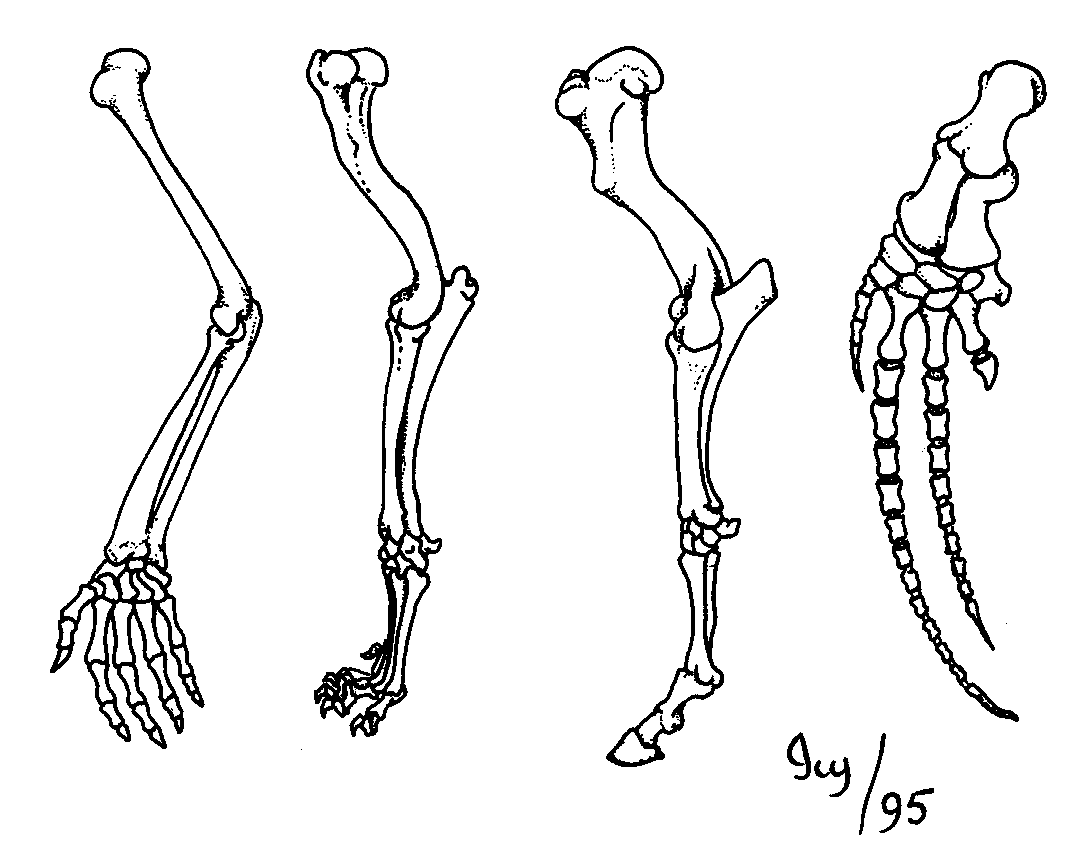
Structures with the same parts have different functions; suggests that organisms share a common ancestry
a)
vestigial structures
b)
homologous structures
c)
adaptive radiation
d)
fossil
44.

Study of embryos of various organisms to show a common ancestor because of similarities in development
a)
natural selection
b)
embryology
c)
speciation
d)
evolution
45.
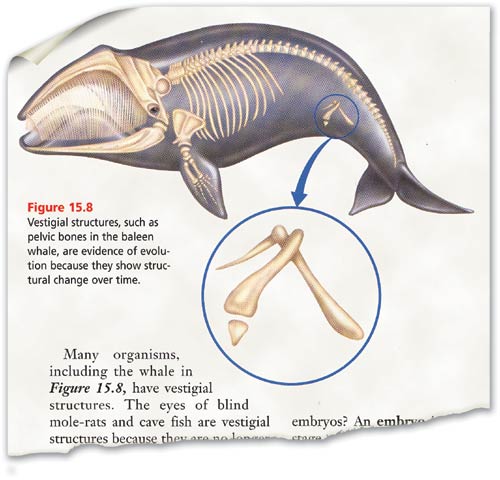
Which of the following is an example of a vestigial structure?
a)
the wings of a red-tailed hawk
b)
the hind limbs of a house cat
c)
the fins of sharks
d)
the tailbone of a human
46.
Structures that have the same function but different structures are...
a)
homologous structures
b)
analogous structures
c)
vestigial structures
d)
embryology
47.

Two organisms that are closely related would have
a)
very similar DNA sequence
b)
exactly the same DNA sequences
c)
no proteins in common
d)
completely different DNA sequence
48.

Which layer is the oldest
a)
B
b)
A
c)
E
d)
C
49.

The diagram shows fossils in different rock layers. Which of these statements about the age of these fossils is most likely correct?
a)
Fossil A and C are the same age
b)
Fossil B is older than fossil C
c)
Fossils A is older than fossil B
d)
Fossil D is older than fossil C
50.
Whales are aquatic mammals that contain a pelvis bone. Even though it does not aid in its movement, the function must have been used by a common ancestor of the whale. Thus, the pelvis is referred to as a(n)
a)
vestigial structure
b)
analogous structure
c)
homologous structure
51.
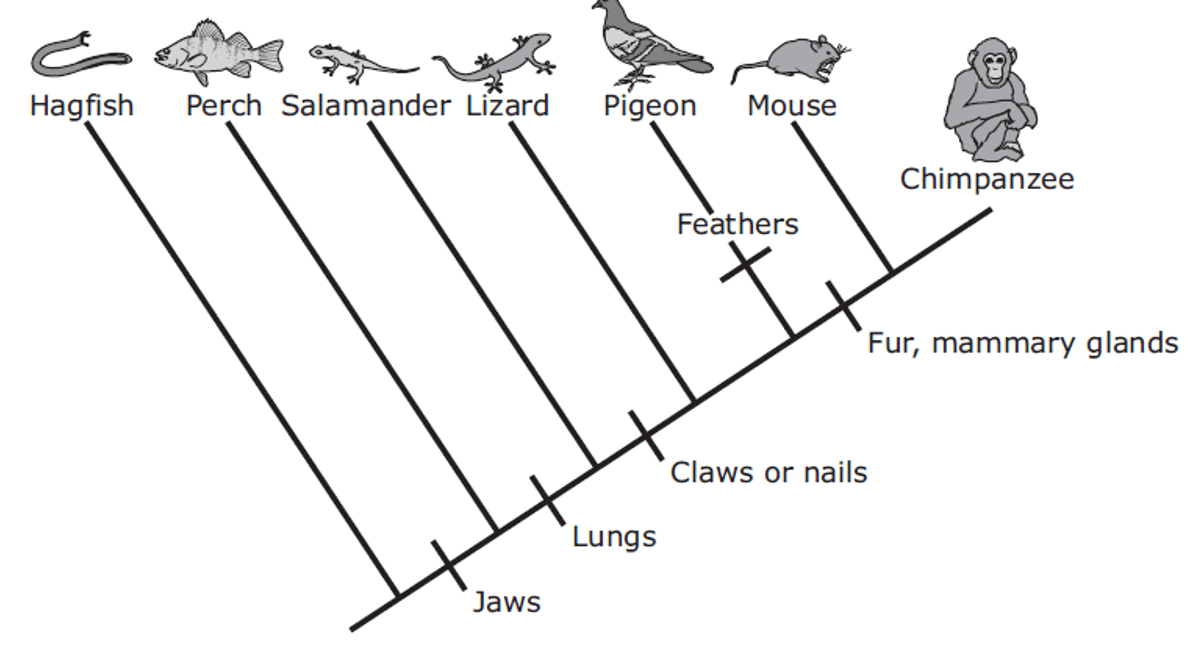
All the animals to the right of the hagfish would have the common characteristic of -
a)
Fur
b)
Claws or nails
c)
Lungs
d)
Jaws
52.

According to this cladogram, birds are LEAST related to -
a)
Amphibians
b)
Sharks
c)
Ray Finned Fish
d)
Crocodiles
53.
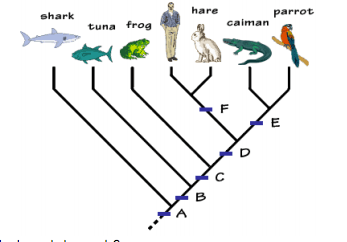
On the cladogram, which organism is the closest relative of the human?
a)
Frog
b)
Hare
c)
Caiman
d)
Parrot
54.

According to the diagram, which bird has the most similar DNA to a large tree finch?
a)
small tree finch
b)
medium tree finch
c)
large ground finch
d)
green warbler finch
55.

According to the diagram, which organism is older: the ammonite or the coral?
a)
ammonite
b)
coral
100 %

