wayground logo

Free Printable Worksheets

NEW

Font size

S
M
L
XL
Worksheets

DNA Structure and Replication (BIO)

Total questions: 34

Worksheet time: 37mins

Name
Class
Date
1.
What are the nucleotides made of?
a)
Sugar, Phosphate, nitrogen base
b)
Phosphate, Adenine, nitrogen base
c)
Thymine, Adenine, Cytomine
d)
Phosphate, Nitrogen, Adenine
2.
Which of the following best describes a DNA molecule?
a)
double helix
b)
contains ribose
c)
made of amino acids
d)
contains Uracil
3.
Which of the following units are repeatedly joined together to form a strand of DNA? (This is the MONOMER of DNA.) 
a)
amino acids
b)
nucleotides
c)
fatty acids
d)
polysaccharides
4.
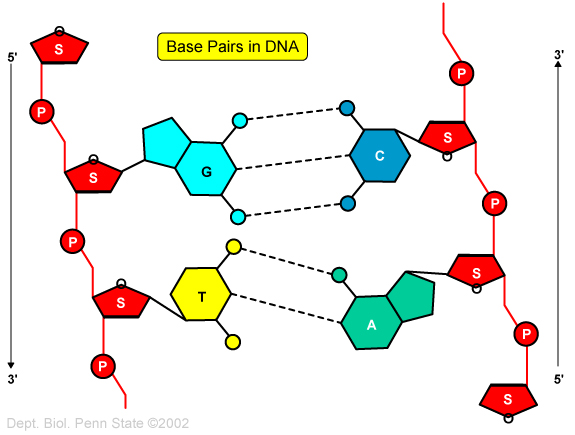
Adenine bonds with ______________.
a)
Guanine
b)
Thymine
c)
Cytosine
d)
Adenine
5.
Guanine bonds with ______________.
a)
Adenine
b)
Guanine
c)
Cytosine
d)
Thymine
6.
What are the 4 nitrogen bases?
a)
adenine, thymine, cytoplasm, and guanine
b)
adenine, thymine cytosine, and guanine
c)
adenine, thymine, cytosine, and gylcerol
d)
adenine, thymine, cytosine, and glucose
7.
Which 2 molecules forms the sides (backbone) of the DNA ladder?
a)
deoxyribose and adenine
b)
deoxyribose and a hydrogen bond
c)
sugar and the nucleus
d)
deoxyribose (sugar) and phosphate
8.
Which organelle is DNA usually found in?
a)
cell membrane
b)
vacuole
c)
chloroplast
d)
nucleus
9.
Which sequence of DNA bases would pair with this partial strand
ATG TGA CAG
a)
ATG TGA CAG
b)
TAC ACT GTC
c)
GTA AGT GAC
d)
CAT TCA CTG
10.
Which enzyme is responsible for adding nucleotides?
a)
Topoisomerase
b)
DNA Polymerase
c)
Ligase
d)
Primase
11.
A process in which DNA has the unique ability to make an exact copy of itself.
a)
Replication
b)
Translation
c)
Transcription
12.
Nitrogenous bases are joined by which type of bond?
a)
polar bonds
b)
ionic bonds
c)
covalent bonds
d)
hydrogen bonds
13.
The drawing shows the structure of what molecule?
a)
A DNA molecule
b)
A lipid molecule
c)
A carbohydrate molecule
d)
A protein molecule
14.
In what phase of the cell cycle does DNA replication take place?
a)
G1
b)
S
c)
G2
d)
M
15.
What does DNA stand for?
a)
Deoxyribonucleic acid
b)
Denitrogenous acid
c)
Deribonucleic acid
d)
Diribonucleic acid
16.
Name this structure
a)
double helix
b)
nucelotide
c)
twisted ladder
d)
hydrogen bond
17.
How do the leading, and the lagging strands differ?
a)
The leading strand is synthesized in the same direction as the movement of the replication fork, and the lagging strand is synthesized in the opposite direction.
b)
The leading strand is synthesized at twice the rate of the lagging strand.
c)
The leading strand is synthesized in short fragments that are ultimately stitched together, whereas the lagging strand is synthesized continuously. 
d)
The leading strand is synthesized by adding nucleotides to the 3' end of the growing strand, and the lagging strand is synthesized by adding nucleotides to the 5? end. 
18.
Suppose a double-stranded DNA molecule was shown to have 15% adenine bases. What would be the expected percentage of guanine bases in that molecule?
a)
15%
b)
35%
c)
85%
d)
Not enough information
19.
Consider the replication bubble diagrammed at the right. Which letters represent leading strands? 
a)
W and X
b)
Y and Z
c)
W and Z
d)
X and Y
20.
Consider the replication bubble diagrammed at the right. Which letters represent leading strands? 
a)
A
b)
B
c)
C
d)
D
21.
Which enyzme would be found only on the lagging strand?
a)
DNA polymerase
b)
Primase
c)
Ligase
d)
Topoisomerase
22.

Which enzyme is needed to start DNA replication by adding an RNA primer where the replication should begin?

a)

DNA Polymerase

b)

Topoisomerase

c)

Ligase

d)

Primase

23.
In DNA , the amount of A is equal to the amount of 
a)
C
b)
G
c)
T
d)
U
24.
Which enzyme is not working correctly if new DNA bases are not added to the template strand?
a)
DNA Polymerase
b)
Topoisomerase
c)
Ligase
d)
Primase
25.

Which of the following help(s) to stabilize and hold the DNA strands apart while they are being replicated?

a)

RNA primase

b)

single–strand binding proteins

c)

DNA polymerase I

d)

DNA ligase

26.
What is meant by the description "antiparallel" regarding the strands that make up DNA?
a)
The twisting nature of DNA creates nonparallel strands.
b)
One strand is positively charged and the other is negatively charged.
c)
The 5' to 3' direction of one strand runs counter to the 5' to 3' direction of the other strand.
d)
Base pairings create unequal spacing between the two DNA strands
27.
What is meant that DNA replication follows a “semi-conservative” model?
a)
After DNA replication, each strand contains one side that is a parental strand and the other side is a daughter strand.
b)
After DNA replication, one completed strand contains only parental DNA while the other contains only daughter DNA.
c)
None of these identify the “semi-conservative” model.
d)
After DNA replication, one completed strand contains a mixture of both parental DNA and daughter DNA dispersed throughout the strand.
28.
What determines the nucleotide sequence of the newly synthesized strand during DNA replication? 
a)
 the particular DNA polymerase catalyzing the reaction
b)
the relative amounts of the four nucleoside triphosphates in the cell
c)
the nucleotide sequence of the template strand 
d)
the primase used in the reaction e. the arrangement of histones in the sugar phosphate backbone
29.

In DNA replication , DNA is synthesized in the ____________ on both sides.

a)

5' to 3' direction

b)

2' to 4' direction

c)

3' to 5' direction

d)

4' to 2' direction

30.

A sample of DNA has 35% thymine. What is the percentage of cytosine in the sample?

a)

35%

b)

15%

c)

70%

d)

30%

31.

A sample of DNA has 20% guanine. What percentage of adenine is in the sample?

a)

30%

b)

20%

c)

40%

d)

60%

32.

This graph represents the rate of DNA replication in a sample. What is the rate of replication in this sample?

a)

Undefined

b)

0

c)

1

d)

-1

33.

This graph represents the rate of DNA replication in a sample. Is this sample of DNA actively dividing?

a)

Yes

b)

No

c)

There is not enough information to answer the question.

34.

The relative concentration of DNA in an E coli sample is seen in this graph. Judging by the change in the DNA concentration, is the rate of DNA replication getting faster, slowing down, or staying the same in the sample?

a)

The rate of DNA replication is slowing down.

b)

The rate of DNA replication is increasing.

c)

The rate of DNA replication is staying the same.

d)

There is not enough information to answer this question.