wayground logo

Free Printable Worksheets

Font size

S
M
L
XL
Worksheets

Science 8 Unit C Sec 1.0

Total questions: 46

Worksheet time: 50mins

Name
Class
Date
1.
Light travels
a)
around corners
b)
in a straight line
2.
Light bounces when it is 
a)
reflected
b)
absorbed
c)
refracted
3.
Light bends when it is 
a)
refracted
b)
reflected
c)
absorbed
4.
This is an example of...
a)
Reflection
b)
Refraction
c)
Polarization
d)
Spectrum
5.
Which explains why the fork looks different under water?
a)
light can't pass through the glass
b)
the wavelength of light lengthens
c)
the amount of light increases when going through water
d)
light is refracted at an angle
6.
Another name for light bending is ....
a)
Reflaction
b)
Absorbing
c)
Refraction
d)
mirror
7.
What does reflection mean?
a)
is the process in which light is bent, when it travels from one medium to another. 
b)
is the process in which light strikes a surface and bounces back off that surface. 
c)
is the process in which the light creates a shadow
8.
TRUE or FALSE
Light travels slower in materials that are more dense. (i.e. Water)
a)
False
b)
True
9.
What instruments use lenses or mirrors to collect and focus light from distant objects?
a)
microscopes
b)
optical fibers
c)
telescopes
d)
lasers
10.

The primary colors of light are

a)

red, yellow, and blue

b)

yellow, cyan, and magenta

c)

red, green, and blue

d)

red, orange, yellow, green, blue, and violet

11.
A(n) _____ uses a combination of lenses to form enlarged images of very small  objects.
a)
microscope
b)
optical fiber
c)
telescope
d)
laser
12.
Light is a form of 
a)
energy
b)
radiation
c)
reflection
13.
Light travels in a straight line
a)
True
b)
False
14.
What does refract mean?
a)
To shrink
b)
To bend
c)
To widen
d)
To enlarge
15.

Who was the first to observe bacteria using a magnifying lens?

a)

Anton van Leuwenhoek

b)

Matthais Schleiden

c)

Robert Hooke

d)

Theodor Schwann

16.

What does a Reflecting Telescope have?

a)

Lens

b)

Mirrors

c)

Bat ears

17.

In ancient times, Pythagoras’ contribution to light theory was …

a)

Thinking light was beams coming from our eyes

b)

Using mirrors during warfare

c)

The Law of Reflection

d)

That white light is a mixture of different colours

18.

Sir Isaac Newton’s contribution to today’s knowledge of light is …

a)

That white light is a mixture of different colours

b)

The Law of Reflection

c)

Thinking light was beams coming from our eyes

d)

Using mirrors during warfare

19.

The first person to determine the speed of light was …

a)

Archimedes

b)

Euclid

c)

Ole Romer

d)

Albert Michelson

20.

The scientist(s) credited with building the first microscope is …

a)

Hans and Zacharias Jansen

b)

Antonie van Leeuwenhoek

c)

Galileo Galilei

d)

Sir Isaac Newton

21.

The scientist(s) credited with first viewing bacteria, or “little animalcules”, is …

a)

Hans and Zacharias Jansen

b)

Antonie van Leeuwenhoek

c)

Galileo Galilei

d)

Sir Isaac Newton

22.

The type of telescope that collects and focuses light through lenses only is called a/the…

a)

Reflecting telescope

b)

Refracting telescope

c)

Hubble Space Telescope

d)

Compound light telescope

23.

The properties of light include all except the following:

a)

Light can bend

b)

Light can be reflected

c)

Light is a form of energy

d)

Light can go around corners without assistance

24.

You are on a hiking trip and you notice something moving on a nearby mountain. You wish to see what this moving object is. Which optical device would you use to view the object from the scenario above?

a)

Binoculars

b)

Telescope

c)

Microscope

d)

A prism

25.
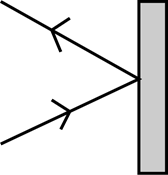
The illustration shows a light ray striking an object.
In the illustration, the light ray striking the object is-
a)
absorbed
b)
stopped
c)
reflected
d)
refracted
26.
A student placed a pencil in a cup of water.  The pencil appears broken because light-
a)
always travels in a straight line
b)
bends when it passes through water
c)
makes the water in the glass evaporate
d)
reflects the pencil on the water's surface
27.
What happens when light passes from air into water?
a)
The light speeds up
b)
The light continues at the same speed
c)
The light slows down
d)
The light forms a mirage
28.
What instruments use lenses or mirrors to collect and focus light from distant objects?
a)
Microscopes
b)
Optical fibers
c)
Telescopes
d)
Lasers
29.
Light bouncing off a mirror is an example of...
a)
Refraction
b)
Reflection
c)
Diffraction
d)
Interference
30.
Light changing direction as it passes from one medium to another is...
a)
Refraction
b)
Reflection
c)
Diffraction
d)
Interference
31.
Refraction is when light__________.
a)
bounces off an object or material.
b)
changes speed in different media, causing bending.
c)
when light travels faster than 300,000 km/s
d)
is absorbed by a material.
32.
According to the Law of Reflection, a light ray striking a mirror
a)
continues moving through the mirror in the same direction
b)
moves into the mirror at a slightly different angle
c)
bounces off the mirror toward the direction it came from
d)
bounces off the mirror at the same angle it hits.
33.
What is refraction? 
a)
A type of bending
b)
A type of lens 
c)
A type of matter
d)
A type of reflection
34.
What is the incident ray?
a)
The ray of light leaving the normal
b)
The ray of light approaching the normal
35.
Which is the angle of refraction?
a)
ϴ 1
b)
ϴ 2
36.
How does light travel from a source?
a)
Around corners
b)
In circles
c)
Very slowly
d)
In a straight line
37.
If the angle of incidence is 60 degrees from the normal line, what is the angle of reflection?
a)
Angle of reflection = 30
b)
Angle of reflection = 60
c)
Angle of reflection = 120
d)
Angle of reflection = 0
38.
The point at which the light rays meet is called the focal point.
a)
true
b)
False
39.
This picture shows ....
a)
reflection
b)
refraction
c)
mirrors
d)
focal point
40.
What type of telescope is displayed in this diagram?
a)
Reflector
b)
Refractor
c)
Photographic
d)
Eye lensic
41.
Which telescope use lenses to collect light?
a)
Refractor
b)
Reflector
c)
Compund
42.
Which telescope collects light with JUST a mirror?
a)
Reflector
b)
Refractor
c)
Comound
43.
When all 3 primary light colors are mixed which color is produced?
a)
black
b)
magenta
c)
white
d)
cyan
44.
The scientist that thought light rays are produced from our eyes was
a)
Archimedes
b)
Pythagoras
c)
Euclid
d)
al-Haytham
45.
The scientist that correctly discovered how eyes work was
a)
Archimedes
b)
Pythagoras
c)
Euclid
d)
al-Haytham
46.
The scientist that correctly measured the speed of light was
a)
Michelson
b)
Ptolemy
c)
Newton
d)
al-Haytham