
 Worksheets
Evolution of Landforms
Total questions: 61
Worksheet time: 35mins

a model scientists use to describe the timing of events and the relationships between those events in earth’s history.
geologic time scale
era
period
epoch
when minerals replace the remains and they become rock; things like wood.
Petrified
Mold
Cast
Index
Trace Fossil
when the shell remains and the contents dissolve
Petrified
Mold
Cast
Index
Trace Fossil
when the mold becomes filled with minerals that are not a part of the original organism.
Petrified
Mold
Cast
Index
Trace Fossil
fossilized mark that is formed in soft sediment by the movement or actions of an animal.
Petrified
Mold
Cast
Index
Trace Fossil
According to paleontologists, how old is the Earth?
3.5 Billion Years Old
543 Million Years Old
57 Million Years Old
4.6 Billion Years Old
looks at where the fossil is located to determine its age relative to other fossils.
Relative Dating
Absolute Dating
Uses radioactive elements near the fossils to determine the actual age of the fossils.
Relative Dating
Absolute Dating

Analyze the layers of undisturbed sedimentary rock. Which layer of sedimentary rock is oldest?
Q
R
S
T
U
What type of event usually marks the end of an Era
A Mass Extinction
A Quinceanera
An earthquake
Evolution of a species
TRUE or FALSE: The Precambrian Era consists of 90% of Earth's history.
True
False
Which of the following took place during the Precambrian Era? (SELECT ALL THAT APPLY)
Formation of the Solar System
The Moon Formed
Microscopic and primitive, soft-bodied organisms developed
No land life present
Dinosaurs ruled the Earth
Which of the following took place during the Paleozoic Era? (SELECT ALL THAT APPLY)
Fish were the 1st animals with a backbone
Man appeared
Reptiles, insects and ferns were common
Life moved from the ocean to land
Mass extinction occurred at the end
Which of the following happened in the Mesozoic Era? (SELECT ALL THAT APPLY)
Most of North America was covered by vast sea
Dinosaurs ruled the Earth until a mass extinction
No land life present
Mammals, birds and flowering plants appeared
Which of the following happened in the Cenozoic Era? (SELECT ALL THAT APPLY)
The Moon formed
Mammals appeared
A series of Ice Ages occurred
More land was exposed as the ocean levels fell
What is a fossil?
A dead organism
Sedimentary Rock
Bone
Preserved remains or traces of an organism

A solid, 3D copy of the shape of an organism is a ...
Cast fossil
Mold fossil
Trace fossil
Carbon film
Fossils can show us which of the following
Organism size
Organism Speed
Where something lived
All the answers

You are looking at a tree ring. What does the wide ring represent?
a drought( little to no rain)
a rainy and warm climate
snow

You are looking at a tree ring. What does the thin ring tell you?
that in this year there was a drought
that in this year there was a lot of rain
that in this year the tree grew 10 feet
A cross-section of a tree shows 25 rings, all of which are about the same size. Except for the 15th and 22nd ring which are twice as thick as the other rings.
What does this finding tell you about the tree?
During these two years, the tree lost all its leaves and branches.
The two thick rings protected the tree from cold weather.
During these two years, the tree grew much more than the other years.
The tree did not receive much rain during years 15 and 22.
A cross section of a tree has 65 rings. All of the rings are about the same size except for rings 22, 23, 24, 25, and 26. These 5 rings are half the size of the other rings. What does this tell you about the climate during those years?
During these 5 years it was very wet and rainy.
During these five years there was a drought(no rain)
During these 5 years the tree grew more than at any other time.
What information can we learn from ice cores?
We can learn how the climate has changed.
We can learn how the dinosaurs died
We can learn about droughts
Ice cores...
show the layers of volcanic ash that has occurred throughout time
show the layers of the oceans and their changes over time
show the tree rings and their growth over time
show the layers of snow and ice that have built up over thousands of year


Can cause missing information in rock layers.
Trace fossils
Unconformities
Law of Superposition
Ice cores
This preserves much of the organism, including the organs and genetic material. It occurs when an organism becomes trapped, dies and is quickly frozen.
mold and cast
frozen
permineralized
trace

Which describes this sedimentary rock?
Fault
intrusion
unconformity
extrusion

Which describes this rock formation?
faule
intrusion
unconformity
extrusion

Which describes this rock formation?
fault
intrusion
unconformity
extrusion

Which describes this rock formation?
fault
intrusion
unconformity
extrusion
Why do intrusions and extrusions of igneous rock not have any fossils in them?
The high temperature of the magma destroyed any remains of organisms.
The rock is too hard.
The rock is too young.
Why not?

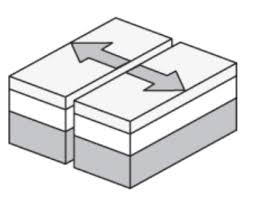
What boundary is this?
convergent
divergent
transform

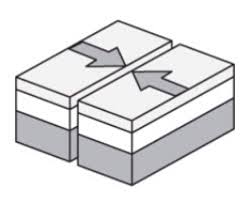
What boundary is this?
convergent
divergent
transform

What boundary is this?
convergent
divergent
transform
At what boundary does a earthquake occur?
convergent
divergent
transform
Why do the plates move?
the earths rotation
the core is hot
the continuous movement of hot magma in the mantle
the ground is moving while the earth is spinning
Continental plates are made of (). Oceanic plates are made of ().
limestone, basalt
granite, limestone
granite, basalt
amber, petrified

What was the name given to all the continents when they were joined as one super continent?
Supreme Continent
Eurasia
Plate tectonics
Pangaea
The hypothesis that the continents slowly move across Earth's surface.
Pangaea
Continental Drift
Supercontinent
Terrestrial separation
a principle that states that geologic processes that occurred in the past can be explained by current geologic processes.
Unconformity
Uniformitarianism
Superposition
Catastrophism

