
 Worksheets
Waves Test Review
Total questions: 40
Worksheet time: 1hrs 17mins
Name
Class
Date
1.
The number of wavelengths that pass a point each per second is:
a)
frequency
b)
period
c)
longitudinal
d)
transverse wave
2.
The type of waves that require medium to pass:
a)
Mechanical Waves
b)
Electromagnetic Waves
3.

Which vocabulary term is used to identify the distance between points C & G?
a)
Amplitude
b)
Crest
c)
Frequency
d)
Wavelength
4.
When the frequency of a wave increases, what happens to the wavelength?
a)
The wavelength is not directly affected by the frequency of a wave.
b)
The wavelength increases.
c)
The wavelength decreases.
d)
More specific information is needed to form a conclusion about the wavelength.
5.
A mechanical wave cannot travel through...
a)
a vacuum(empty space).
b)
water.
c)
air.
d)
glass.
6.
What color has the shortest wavelength and highest frequency?
a)
Violet
b)
Orange
c)
Red
d)
Blue
7.
What color has the longest wavelength?
a)
Black
b)
Green
c)
Purple
d)
Red
8.
Why do we see grass as green?
a)
Green light is absorbed
b)
Green light is reflected
9.
Which of the following can sound travel through?
a)
solid
b)
liquid
c)
gas
d)
all of the above
10.
which material does sound travel the fastest?
a)
solid
b)
liquid
c)
gases
11.
What is a medium?
a)
something between a small and a large?
b)
the substance through which a wave can travel
c)
a pattern of vibration that simulates when a wave is standing still
d)
the distance from any point on a wave to an identical point on the next wave
12.
A mechanical wave cannot travel through...
a)
a vacuum(empty space).
b)
water.
c)
air.
d)
glass.
13.
Sound travels FASTEST through which of these materials?
a)
Air
b)
Empty space
c)
Metal
d)
Water
14.
Sound will travel slowest through which of the following forms of matter?
a)
milk
b)
desk
c)
air
d)
door
15.
When light passes from one transparent medium to another, it changes speed. When light changes speed, it changes direction. This change of direction, or bending, is called refraction.
True or false
True or false
a)
True
b)
False
16.
15. A wave interaction in which a wave bounces off a surface that it does not go through is called
a)
absorption.
b)
reflection.
c)
transmission.
d)
diffraction.
17.

Which explains why the fork looks different under water?
a)
light can't pass through the glass
b)
the wavelength of light lengthens
c)
the amount of light increases when going through water
d)
light is refracted at an angle
18.
What does opaque mean?
a)
You cannot see through it, the light is absorbed.
b)
You can see through it, light is transmitted.
c)
You can see through it a little, the light is transmitted but it is scattered.
19.
T or F
Transparent means that you can only see through it a little because the light is transmitted but scattered.
Transparent means that you can only see through it a little because the light is transmitted but scattered.
a)
True
b)
False
20.
What does translucent mean?
a)
You cannot see thorugh it because the light is absorbed.
b)
You can see through it because light is transmitted.
c)
You can see through it a little because light is transmitted but it is scattered.
21.
A wave with a large wavelength will have a ______ frequency and _____ energy
a)
high, low
b)
high, high
c)
low, high
d)
low, low
22.
Select the correct order of waves on the EMS
a)
Radio, Micro, Infra, Visible, Ultra, X-ray, Gamma
b)
Gamma, X-ray, Ultra, Vis, Infra, Micro, Radio
c)
Vis, Micro, Infra, Ultra, X-ray, Gamma, Radio
d)
Micro, Radio, Vis, Infra, Ultra, X-ray, Gamma
23.
One end of the rope is vibrated to produce a wave with a wavelength of .25 m. The Frequency of the wave is 3.0 Hz. What is the speed of the wave?
a)
3.00 m/s
b)
2.50 m/s
c)
.75 m/s
d)
1.25 m/s
24.
Which has the LONGEST wavelength and, therefore, the lowest frequency/energy
a)
Gamma Rays
b)
Radio Waves
c)
Visible Light
d)
Infrared rays
25.
Which has the SHORTEST wavelength and, therefore, the highest frequency/most energy
a)
Radio waves
b)
Ultraviolet Rays
c)
Gamma Rays
d)
X-rays
26.
Put the visible light colors in order from longest wavelength to shortest wavelength
a)
Violet, Indigo, Blue, Green, Orange, Yellow, Red
b)
Red, Yellow, Green, Orange, Violet, Blue, Indigo
c)
Red, Orange, Yellow, Green, Blue, Indigo, Violet
27.
Which of the following electromagnetic waves is given off as heat?
a)
Radio Waves
b)
Infrared Rays
c)
Visible Light
d)
Gamma Rays
28.
The _______________ determines the color of visible light.
a)
wavelength
b)
speed
c)
amplitude
d)
light
29.
All electromagnetic waves have the same...
a)
frequency
b)
speed
c)
wavelength
d)
energy
30.
The color you see is the color that is ___.
a)
reflected
b)
absorbed
31.

Blurs light as it passes through
a)
Transparent
b)
Translucent
c)
Opaque
d)
Refraction
32.
A wave has wavelength of 10 m and a speed of 340 m/s. What is the frequency of the wave?
a)
34 m/s
b)
3400 Hz
c)
3400 m/s
d)
34 Hz
33.

Allows most light through
a)
eflection
b)
Refraction
c)
Translucent
d)
Transparent
34.

Transfer of energy when a wave disappears into a surface
a)
Transparent
b)
Refraction
c)
Reflection
d)
Absorption
35.

Which color absorbs all light?
a)
White
b)
Black
c)
Orange
d)
Green
36.

Which color reflects all light?
a)
White
b)
Black
c)
Orange
d)
Green
37.
A wave has frequency of 50 Hz and a wavelength of 10 m. What is the speed of the wave?
a)
500 m/s
b)
50 m/s
c)
5 m/s
d)
0.5 m/s
38.
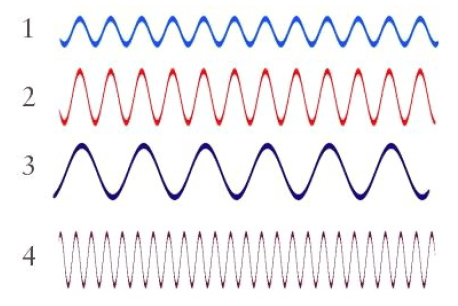
Which wave in the diagram has the greatest frequency?
a)
1
b)
2
c)
3
d)
4
39.

High frequency waves have _________ wavelength.
a)
varying
b)
high
c)
the same
d)
low
40.
What wave has rarefaction and compression?
a)
longitudinal
b)
surface
c)
heat
d)
transversal
100 %

