wayground logo

Free Printable Worksheets

Font size

S
M
L
XL
Worksheets

Air Pollution Quiz_1

Total questions: 50

Worksheet time: 1hrs 2mins

Name
Class
Date
1.

Which product of incomplete combustion gives photochemical smog its reddish browncolor?

a)

PANs

b)

Ozone

c)

VOCs

d)

Nitrous oxide

2.

The two secondary pollutants associated with photochemical smog that cause both eye irritation and potential lung damage are:

a)

Ozone

b)

Nitrous oxide

c)

PANs

d)

Ozone and PANs

e)

All of the above

3.
type of air pollution that is formed when sunlight reacts with waste gases from the burning of fossil fuels
a)
photochemical smog
b)
ozone layer
c)
acid precipitation
d)
global warming
4.
Layer of dense, cool air trapped under a layer of less dense, warm air. It prevents upward-flowing air currents from developing. In a prolonged inversion, air pollution in the trapped layer may build up to harmful levels
a)
Temperature Inversion
b)
Warm Front
c)
Photochemical Smog
d)
Greenhouse Gas
5.
A(n) ____________________ is an area in which the temperature is several degrees higher than that of the surrounding area.
a)
Heat Island
b)
Rural Area
c)
Urban Area
d)
Infrastructure
6.
Ozone in the troposphere is __________.  Ozone in the stratosphere is _________.
a)
bad, good
b)
good, bad
c)
bad, bad
d)
good, good
7.
During what time of day should tropospheric ozone levels peak?
a)
Midnight
b)
Morning
c)
Afternoon
d)
Evening
8.
What two air pollutants that most often produce acid rain?
a)
Nitrogen Oxides and Sulfur Oxides
b)
Carbon Dioxide and Ozone
c)
Particulate Matter
d)
None of the above
9.

Acid rain can damage

a)

Drinking water sources

b)

Aquatic life

c)

Architecture/Buildings

d)

All options

10.
A large percentage of emissions resulting in air pollution today comes from _________________.
a)
motor vehicles
b)
factories
c)
farm animals
d)
ozone depletion
11.
Individuals can reduce air pollution by _______________.
a)
using less electricity
b)
using motor vehicles less often
c)
buying local goods
d)
all of these 
12.
Our atmosphere is ________ % Nitrogen, _________ % Oxygen and  _____% trace gases.
a)
78,21,1
b)
75,24,1
c)
21,78,1
d)
50,25, 25
13.
Coal, oil and gas are examples of
a)
Shell Fuels
b)
Bone fuels
c)
Fossil fuels
d)
Sea fulels
14.
Pollution hanging over urban areas that causes reduced visibility is called
a)
Air pollution
b)
Temperature inversion
c)
Light pollution
d)
Smog
15.
Which of the following are examples of a secondary pollutant?
a)
Carbon Dioxide
b)
Acid rain and Ozone
c)
Nitrogen Oxides
d)
All of the above
16.
Small solid particles or liquids suspended in the air are called________.
a)
Particulate Matter
b)
Photochemical Smog
c)
VOC's 
d)
None of the above
17.
Ozone found in which layer of the atmosphere protects the earth from UV radiation?  (aka Good ozone)
a)
Troposphere
b)
Stratosphere
c)
Mesosphere
d)
Thermosphere
18.
Ozone found in this layer of the atmosphere is considered an air pollutant.
a)
Ionsphere
b)
Mesosphere
c)
Stratosphere
d)
Troposphere
19.

Which is the correct order of the atmosphere layers

a)

Thermosphere, Mesosphere, Stratosphere, Troposphere

b)

Mesosphere, Thermosphere, Troposphere, Stratosphere

c)

Troposphere, Stratosphere, Mesosphere, Thermosphere

d)

Troposphere, Mesosphere, Stratosphere, Thermosphere

20.

Which layer does the ozone belong in?

a)

A

b)

B

c)

C

d)

D

e)

E

21.

Which of the following is not a primary air pollutant

a)

Particulate Matter

b)

Lead

c)

Carbon Monoxide

d)

Sulphuric (sulfuric) Acid

22.

Acid Deposition (Rain) is caused mainly by

a)

Dust

b)

Volcanoes

c)

Burning fossil fuels

d)

ozone

23.

How would acid rain affect the ecosystem

a)

Lakes could turn acidic

b)

Soil could turn acidic

c)

Damaged Foilage

d)

Damaged root systems

24.

What is being represented by this photo?

a)

Photochemical Smog

b)

Industrial Smog

25.

Air pollution causes all of the following, except

a)

holes in the ozone layer

b)

increased particles in the air

c)

acid rain

d)

healthy air to breath

e)

smog

26.

the second-lowest layer of Earth’s atmosphere; the ozone layer is located here.

a)

Troposphere

b)

Stratosphere

c)

Mesosphere

d)

Ionosphere

27.

the lowest layer of Earth’s atmosphere, where weather occurs.

a)

Thermosphere

b)

Mesosphere

c)

Stratosphere

d)

Troposphere

28.

the outer layer of the atmosphere, extending outward into space.

a)

Thermosphere

b)

Exosphere

c)

Ionosphere

d)

Stratosphere

29.

the middle layer of Earth’s atmosphere; that layer in which most meteoroids burn up.

a)

Stratosphere

b)

Mesosphere

c)

Ozone Layer

d)

Barometer

30.

a colorful, glowing display in the sky caused when particles from the sun strike oxygen and nitrogen atoms in the ionosphere; also called the Northern Lights.

a)

Ozone

b)

Temperature Inversion

c)

Aurora Borealis

d)

Ionosphere

31.

the mixture of gases that surrounds Earth. The outermost of the four spheres into which scientists divide Earth.

a)

Atmosphere

b)

Weather

c)

Ionosphere

d)

Temperature Inversion

32.

when a layer of warm air prevents the rising air from escaping.

a)

Aurora Borealis

b)

Air Pollution

c)

Photochemical Smog

d)

Temperature Inversion

33.
An example of a Natural Source of air pollution can be defined as:
a)
Industrial Smokestacks and Volcanoes
b)
Wildfires and Car Emissions
c)
Volcanoes and Wildfires
d)
Coal-Burning Power Plants and Volcanoes
34.

The dissolving of statues and buildings and changing of soil chemistry to prevent plants from uptaking essential minerals is the result of ___.

a)

industrial smog

b)

photochemical smog

c)

acid deposition

d)

ozone depletion

35.

Increasing our use of renewable energy and decreasing our use of coal-powered electricity, increasing alternative transportation such as hybrid/electric vehicles and adding catalytic converters to automobiles has reduced acid deposition in the United States.

a)

True

b)

False

36.
Dust, ash and pollen are examples of this air pollutant
a)
Lead
b)
Ground-level ozone
c)
Particulate matter
d)
Nitrogen oxides
37.
What is a primary pollutant? 
a)
pollutant that is put directly into air by human activities
b)
pollutants that react with other primary pollutants
38.
What is air pollution?
a)
Any harmful substance that builds up in the air 
b)
pollen, dust, gases
c)
industrial pollution
d)
chemicals in the water
39.
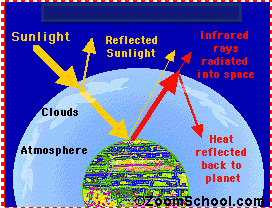
What does this diagram illustrate?
a)
Ozone Layer
b)
The Greenhouse Effect
c)
Ultraviolet Radiation
d)
Layers of the atmosphere
40.
What is the greenhouse effect?
a)
The warming of a planet due to trapped radiation.
b)
The cooling of Earth due to air pollution.
c)
The heating of a solid, such as a rock.
41.

Which ones are consider primary air pollutants?

a)

Nitrogen oxides

b)

Sulfur dioxides

c)

Carbon monoxide

d)

all are correct!!!!

42.
Who am I?
I am colorless and odorless, am formed from the incomplete combustion of fossil fuels, and have the ability to take oxygen's place on a hemoglobin molecule, disrupting its transport.
a)
NOx
b)
SO2
c)
CO
d)
CO2
43.

Activities such as construction and agriculture are primary sources of

a)

a. hydrocarbons.

b)

b. volatile organic compounds.

c)

c. nitrogen oxides.

d)

d. particulate matter.

44.

The automobile’s contribution to air pollution includes

a)

a. water vapor released during combustion.

b)

b. fumes that escape when the gas tank is filled.

c)

c. nitrogen oxides emitted in exhaust.

d)

d. Both (b) and (c)

45.

Choose EACH sentence that is true about the Environmental Protection Agency. MORE THAN ONE ANSWER!!

a)

a. The EPA enforces laws about air pollution.

b)

b. The EPA is part of the U.S. government.

c)

c. The EPA passes laws about air pollution.

46.

Which of the following is not a layer of the atmosphere?

a)

Lithosphere

b)

Biosphere

c)

Mesosphere

d)

Stratosphere

e)

Thermosphere

47.

Gas in the atmosphere that can both a pollutant and protects the earth from UV radiation?

a)

Carbon dioxide

b)

Water vapour

c)

Ozone

d)

Methane

48.
A metallic element that can cause brain damage
a)
Lead
b)
Particulate matter
c)
Ground-level ozone
d)
Nitrogen oxides
49.
Hydrocarbons such as gasoline, solvents, paints, finger nail polish & thinners that vaporize easily.
a)
Sulfur Oxides
b)
Nitrogen Oxides
c)
VOC's
d)
Mercury
50.
Air pollution controlling device found on American cars that removes most (not all) Nitrogen Oxides, VOCs, & Carbon Monoxide from exhaust.
a)
Scrubber
b)
Bag house filter
c)
Electrostatic Precipitator
d)
Catalytic Converter