
 Worksheets
Ionic and covalent bonding
Total questions: 13
Worksheet time: 5mins
Name
Class
Date
1.
When an atom loses an electron, it becomes a:
a)
positive ion
b)
negative ion
c)
neutral ion
d)
neutral atom
2.
Which of the following is NOT a property of ionic compounds?
a)
They have very high melting points
b)
They conduct electricity when in solution
c)
They have high boiling points
d)
They are insoluble in water
3.
How are covalent bonds explained?
a)
When one atom takes the other atom's electron
b)
When the atom shares an electron with an another atom
c)
When the two nucleus merge
d)
When the neutrons leave the nucleus
4.
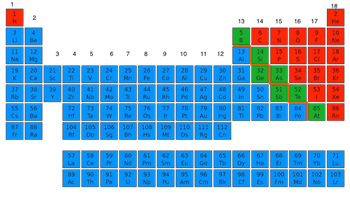
Where are the nonmetals located on the periodic table?
a)
Blue
b)
Red
c)
Green
5.

What is the correct formula for this molecule?
a)
NH
b)
N3H
c)
NH3
d)
NH4
6.
Ionic bonds exist between a metal with a non-metal.
a)
True
b)
False
7.
Magnesium (Mg) and Oxygen (O) form an ________ bond.
a)
Ionic
b)
Covalent
c)
Metallic
d)
Nothing
8.
Calcium (Ca) and 2 chlorine (Cl) atoms make a covalent compound.
a)
True
b)
False
9.
What usually forms the negative ion?
a)
nonmetals
b)
metal
c)
none
10.
Which of the following is NOT formed by a covalent bond?
a)
K2S
b)
H2O
c)
I2
d)
CO2
11.
Simple molecular molecules generally have
a)
low melting and boiling points
b)
high melting and boiling points
c)
ionic bonds
d)
metallic bonds
12.
Which structures conduct electricity as a liquid but not as a solid?
a)
Metallic
b)
Covalent
c)
Ionic
d)
All of the above
13.
Which structure has a sea of free electrons?
a)
Ionic
b)
Covalent
c)
Metallic
d)
All of the above
100 %

