
 Worksheets
APES World Population
Total questions: 30
Worksheet time: 46mins
Name
Class
Date
1.

Which section would see exponential population growth?
a)
1
b)
2
c)
3
d)
4
2.
The intrinsic growth rate of a population:
a)
directly affects environmental resistance.
b)
causes changes in birth rates without affecting death rates
c)
causes changes in death rates without affecting birth rates.
d)
is the maximum rate at which a population may increase.
3.
The human population is currently following roughly a j-shaped curve. This means that the population is growing
a)
arithmetically.
b)
sigmoidally.
c)
at a decreasing rate.
d)
exponentially.
4.
Population size can be estimated using the formula
a)
(CBR + Immigration) + (CDR + Emigration)
b)
(CBR + Immigration) - (CDR + Emigration)
c)
(CBR - Immigration) + (CDR - Emigration)
d)
(CBR - Immigration) - (CDR - Emigration)
5.
The total fertility rate (TFR) is an estimate of:
a)
the number of children that will survive to adulthood
b)
the number of years a typical infant will live
c)
the number of children each woman in a population will have
d)
the number of births per 1000 people per year
6.

Use Figure 7-1. Population A would most likely be in which stage of demographic transition?
a)
Pre-Industrial
b)
Transitional
c)
Industrial
d)
Post-Industrial
7.

A country with an age distribution like that shown in the figure above, is most likely a country that
a)
Is expecting rapid growth
b)
Is experiencing slow or no population growth
c)
Is experiencing a high death rate
d)
Is a less-developed country
8.
The IPAT equation was developed to estimate
a)
the affluence of a country's population
b)
the rate of demographic transition
c)
the impact of human lifestyles on Earth
d)
the gross domestic product o a country
9.
Which is not a density independent factor?
a)
Climate change
b)
Hurricanes
c)
Clear cutting forests
d)
Parasitism
10.
Which is not a density dependent factor?
a)
Competition
b)
Predation
c)
Volcanic Eruption
d)
Disease
11.

The graph on the right best represents which country?
a)
USA
b)
Mexico
c)
Nigeria
d)
India
12.
Organisms that lay eggs, do no nurturing of their young and are adults for only short periods of time:
a)
Type 1
b)
Type 2
c)
Type 3
d)
Zebras
13.
Organisms that have gestation (pregnancy) periods and usually only give birth to one offspring at a time.
a)
Type 1
b)
Type 2
c)
Type 3
d)
Foxes
14.

Use Figure 10-1. Urban populations increased approximately ____% from 1950 to 2000.
a)
3
b)
8
c)
40
d)
68
15.

Identify two main contributors for the dramatic increase in the world population over the last century.
a)
increased access to birth control
b)
development of modern medicine
c)
increased immigration
d)
introduction of the Industrial Revolution
16.

Formula to calculate population change
a)
(b + d) - (i + e)
b)
(b + i) - (d + e)
c)
(d + i) - (b + e)
17.

If a country has a crude birth rate of 22 and a crude death rate of 7, what is the Annual Growth Rate? AGR = (cbr-cdr)/10
a)
0.7%
b)
1.5%
c)
2.2%
d)
7.0%
18.
The intrinsic growth rate of a population:
a)
directly affects environmental resistance.
b)
causes changes in birth rates without affecting death rates
c)
causes changes in death rates without affecting birth rates.
d)
is the maximum rate at which a population may increase.
19.
The most critical factor in controlling human population growth is
a)
controlling reproductive lifespan.
b)
decreasing the age of first birth.
c)
decreasing the average number of births per woman.
d)
decreasing infant death.
20.
A species that plays a major role in determining the structure of its ecological community is
a)
a predator.
b)
a dominator species.
c)
the most abundant species in the community.
d)
a keystone species.
21.
Which of the following characteristics are typical of r-selected species?
I. They produce many offspring in a short period of time.
II. They have very low survivorship early in life.
III. They take a long time to reach reproductive maturity.
I. They produce many offspring in a short period of time.
II. They have very low survivorship early in life.
III. They take a long time to reach reproductive maturity.
a)
I only
b)
II only
c)
III only
d)
I and II
22.

Use Figure 7-1. Population A is most likely:
a)
rapidly growing
b)
rapidly declining
c)
stable or close to stable
d)
going to decline in a few decades
23.
Use Figure 7-1. Population A would most likely be in which stage of demographic transition?
a)
Pre-Industrial
b)
Transitional
c)
Industrial
d)
Post-Industrial
24.
Predation is similar to _______________ in that both types of relationship benefit one of the interacting species while the other is harmed.
a)
commensalism
b)
competition
c)
mutualism
d)
parasitism
25.
Many plants have their roots infected with a specialized fungus. The plant supplies carbon to the fungus, and the fungus supplies nutrients to the plant. This is an example of a _______________ association.
a)
mutualistic
b)
commensalistic
c)
parasitic
d)
predator/prey
26.
According to the theory of demographic transition, countries move through growth phases in which order?
a)
stable growth, rapid growth, slow growth, declining growth
b)
rapid growth, slow growth, stable growth, declining growth
c)
slow growth, declining growth, rapid growth, stable growth
d)
slow growth, rapid growth, stable growth, declining growth
27.

Refer to the diagram of the survivorship curve.
Which curve best describes an organism that invests a lot of energy in parenting?
Which curve best describes an organism that invests a lot of energy in parenting?
a)
A
b)
B
c)
C
d)
this is not a survivorship curve
28.
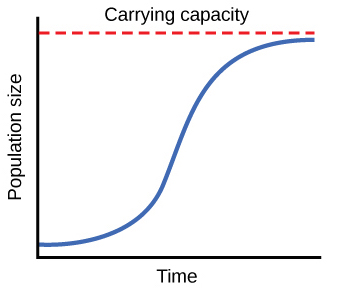
__________ growth shows growth of a population under environmental constraints (carrying capacity-K) that sets a maximum population size
a)
logistic
b)
exponential
c)
niche
d)
uniform
29.
________ grow slowly over time, cares for its young over a long period of time and is usually near the carrying capacity of its ecosystem.
a)
K-strategists
b)
R-strategists
c)
Uniform strategists
d)
environmentalists
30.
A certain plant needs moisture, carbon dioxide, oxygen, light, and minerals to survive. This scenario shows that this particular living organism depends on .
a)
Biotic and Abiotc Factors
b)
Biotic Factors
c)
Abiotic Factors
d)
None of the Above
100 %

