
 Worksheets
Common Assessment 3 HW Review
Total questions: 32
Worksheet time: 1hrs 4mins

The person pushing the ball up the hill is displaying what type of energy?
Potential Energy
Kinetic Energy
Chemical Energy
Loss of Energy
How do you increase an object's potential energy?
Raise the object up higher
Increase the object's speed
Decrease the object's speed
Increase the object's mass

what type of energy would the rock lose if it fell off the cliff?
Kinetic Energy
Chemical Energy
Solar Energy
Potential Energy
Which of the following objects is NOT an example of kinetic energy?
A moving car
A dog chasing a cat
Leaves falling from a tree
A house
What are the two factors that effect kinetic energy?
time and energy
power and mass
mass and speed
time and work

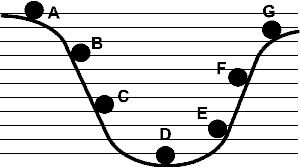
At what position does the rock have the greatest kinetic energy?
A
B
E


While shooting a bow and arrow, which steps will give the most elastic energy?
aiming the arrow and releasing the arrow
Releasing the arrow and loading the bow
pulling back the string and bending the bow
A bowling ball, baseball, golf ball, and ping pong
ball are rolling down a bowling lane at the same
speed. Which one has the most kinetic energy?
Bowling Ball
Baseball Ball
Golf Ball
Ping Pong Ball
If a girl holds a ball at waist level and then lifts the
ball above her head and holds it there, which of
the following is she doing?
Increase Potential Energy
Decrease Potential Energy
Increase Kinetic Energy
Decrease Kinetic Energy
If you take a baked potato out of the oven and
remove the foil you'll notice the foil cools down
quickly. However, it's unwise to bite the potato
right when the foil cools because it will still be
very hot. What is the reason for this?
Radiation from the foil keeps the potato hot.
The foil's high thermal capacity keeps the potato
warm.
The foil's thermal conductivity is low and the
potato's is very high.
The foil has a higher thermal conductivity and
lower heat capacity than the potato.
On a summer morning, John walks barefoot
across his paved driveway with no problem.
However, later that afternoon he steps barefoot
onto the same driveway and must quickly run off
because the bottoms of his feet feel like they are
burning. Which statement best explains why this occurred?
As the temperature increased during the day,
the particles in the pavement moved slower and
the thermal energy increased.
As the temperature increased during the day,
the particles in the pavement moved slower and
the thermal energy decreased.
As the temperature increased during the day,
the particles in the pavement moved faster and
the thermal energy increased.
As the temperature increased during the day,
the particles in the pavement moved faster and
the thermal energy decreased.

Which of these correctly describes the potential
energy and the kinetic energy of the bicycle
rider?
When the rider is at the top of the hill, her
potential energy is the greatest, and her kinetic
energy is the least.
As the rider moves up the hill, her kinetic energy
increases, and her potential energy decreases.
When the rider goes down the hill, her potential
energy increases, and her kinetic energy
decreases.
As the rider reaches the bottom of the hill, her
kinetic energy and her potential energy
decrease.v

Which statement best compares these two
waves?
Wave 1 has a higher frequency because it has a
longer wavelength than wave 2
Wave 1 has a higher frequency because it has a
higher amplitude than wave 2.
Wave 2 has more energy because it has a
higher amplitude than wave 1.
Wave 2 has more energy because it has a
higher frequency than wave1.

Which statement describes the energy changes
that occur when water in a tea kettle is heated on
a stove that uses natural gas?
Some of the light energy in the natural gas
transforms into chemical energy in the water.
Then some of the chemical energy changes into
kinetic energy when the steam leaves the kettle
and sound energy when the water boils.
Some of the thermal energy in the natural gas
transforms into sound energy when the water
becomes hot. Then some of the sound energy
changes into light energy when the kettle
becomes warm.
Some of the electrical energy in the natural gas
transforms into thermal energy, which causes
the water to form steam. Then some of the
thermal energy changes into sound energy and
light energy when the steam leaves the kettle.
Some of the chemical energy in the natural gas
transforms into thermal energy, which heats the
water. Then some of the thermal energy
changes into sound energy when the water
forms steam and the steam leaves the kettle.

Select the statement that is true about
the graph of the two waves shown in the graph
below. The x-component of the graph is time.
The graph is not depicting waves
The red wavelength is 1/2 a second faster than
the blue wavelength
The frequence, amplitude and wavelength are all the same.

Look at the picture of a ball bouncing. Which of
the following best illustrates that energy has been
transferred to the ball?
The ball dropping
the ball bouncing up again
The ball compacting as it hits the ground
The ball being held before being dropped
Looking at the following list of objects which WOULD NOT be using kinetic energy?
A cat chasing a mouse
A falling leaf
A house
A moving car
Select statements is NOT true about waves.
Their wavelength undergoes regular changes.
Their wavelength is constant unless energy is
added or taken away from them.
They have a regular, repeating pattern.

