Wayground logo

Free Printable Worksheets

Font size

S
M
L
XL
Worksheets

Energy and Kinetics

Total questions: 27

Worksheet time: 30mins

Name
Class
Date
1.
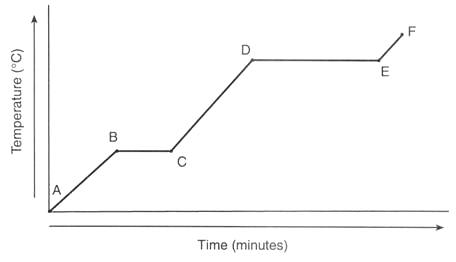
What line segment represents only the solid state?
a)
A-B
b)
B-C
c)
C-D
d)
D-E
2.
What state(s) of matter are present at D-E?
a)
Solid-liquid
b)
Liquid
c)
Liquid-gas
d)
Gas-Solid
3.
Between which points is the temperature of the substance remaining constant?
a)
A-B only. 
b)
A-B, C-D, E-F
c)
B-C only. 
d)
B-C, D-E
4.
A substance's heating curve is shown in the graph.  What is its boiling point?
a)
100 C
b)
60 C
c)
80 C
d)
20 C
5.
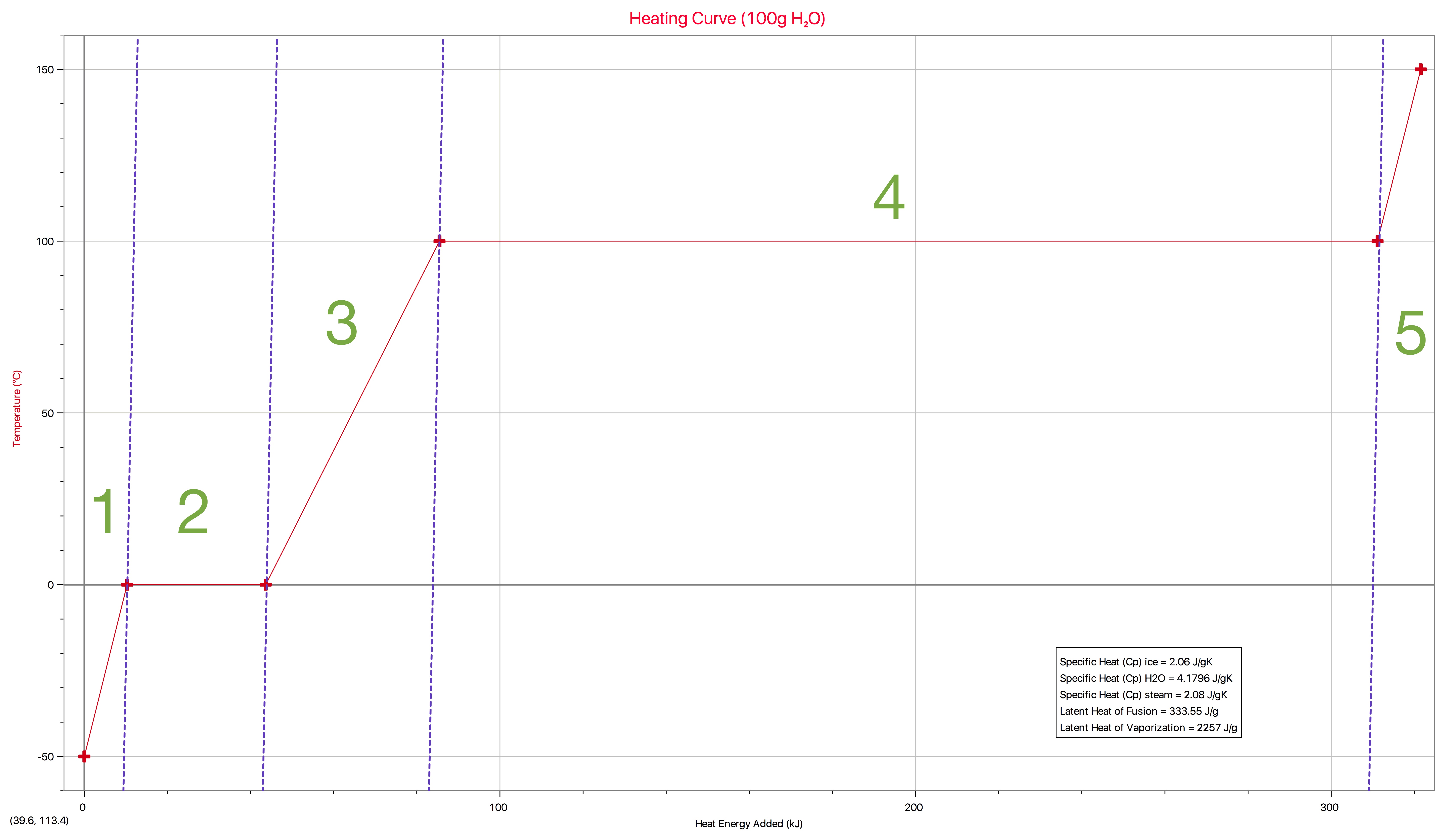
In which region(s) of the graph would the substance be a liquid and a gas?
a)
Region 2
b)
Region 3
c)
Region 4
d)
Region 5
6.
When the temperature of matter increases the particles...
a)
speed up and move closer
b)
speed up and move farther apart
c)
slow down and move closer together
d)
slow down and move farther apart
7.
What phase change(s) may occur at pressures below 4.58 mmHg?
a)
sublimation/deposition
b)
melting/freezing
c)
all phase changes are possible at these pressures
d)
vaporization/condensation
8.
What state of matter is Y?
a)
solid 
b)
liquid
c)
gas
d)
supercritical fluid
9.
What state of matter is Z?
a)
solid 
b)
liquid
c)
gas
d)
supercritical fluid
10.
What change occurs from F to E?
a)
sublimation
b)
deposition
c)
melting
d)
condensation
11.
What is the normal boiling point of this substance?
a)
150 °C
b)
100 °C
c)
-50 °C
d)
0 °C
12.
What is point A?
a)
triple point
b)
critical point
c)
equilibrium point
d)
normal melting point
13.
Which statement is true for carbon dioxide at -60 °C?
a)
All three phases are possible.
b)
It can exist as a solid or a gas, depending on pressure.
c)
It is a solid.
d)
With enough pressure it can be melted.
14.

What quantity of heat is required to raise the temperature of 45 grams of water from 15°C to 85°C? The specific heat capacity of water is 4.184 J/g/°C.

a)

13000 J

b)

16000 J

c)

130 kJ

d)

70 J

15.
A substance with a high specific heat:
a)
Is always extremely hot.
b)
Requires a lot of energy to become hot.
c)
Is not heavy.
d)
Does not requires a lot of energy to become hot.
16.
Stored energy that results from the position or shape of an object is called...
a)
Thermal
b)
Potential
c)
Kinetic
d)
Gravitational
17.
A hot cup of tea absorbs thermal energy from a cold room.
a)
True
b)
False
18.

Diagram A is

a)

Endothermic

b)

Exothermic

19.
1.A sample of iron receives 50.J of heat energy that raises the temperature of the iron 25.0°C. If iron has a specific heat of 0.10 J/g°C, what is the mass of the iron sample?
a)
0.20g
b)
0.30g
c)
20g
d)
30g
20.

The specific heat (c) of platinum is 0.133. How much heat(Q) is released when a 10 g piece of platinum heats up from 50°C to 100°C?


Use the formula: Q=mc∆t

a)

66.5 J

b)

665 J

c)

0.0266 J

d)

0.665 J

21.
If the reactant particles collide with less than the activation energy, the particles will be rebound, and no reaction will occur.
a)
True
b)
False
22.
In a chemical reaction, collisions between the molecules provide the potential energy needed to break the bond.
a)
True
b)
False
23.
More collisions correspond to a: 
a)
Faster reaction rate  
b)
Slower reaction rate
c)
Constant reaction rate 
d)
None of the above
24.
Which of the following is/are the fundamental idea(s) of collision theory?
a)
Molecules react by colliding together
b)
The effective collisions must occur with certain minimum amounts of energy 
c)
In a large sample, the greater the number of effective collisions, and the faster the rate of reaction
d)
All of the above
25.
Under the collision theory, the particles must collide ____ and ____ for a reaction to occur.
a)
sufficient rate and sufficient energy
b)
sufficient surface area and correct orientation
c)
sufficient catalyst and sufficient energy
d)
sufficent energy and correct orientation
26.

How does adding a catalyst increase the rate of reaction?

a)

It increases the kinetic energy of the particles resulting in more successful collisions

b)

It reduces the activation energy by providing an alternative pathway

c)

It increases the number of particles in the reaction and therefore the number of collisions

d)

It provides more surfaces for particles to collide with

27.

How much heat is needed to boil 235 g of liquid water at 100°C ?

(Hf = 80 cal/g . and Hv = 540 cal/g for water)

a)

18,800 cal

b)

127,000 cal

c)

23,500 cal

d)

2.35 cal