wayground logo

Free Printable Worksheets

Font size

S
M
L
XL
Worksheets

Unit 2: Sound Waves

Total questions: 41

Worksheet time: 43mins

Name
Class
Date
1.
Sound is caused by? 
a)
force
b)
vibrations
c)
instruments
2.
Measure of how high or low a sound is
a)
amplitude
b)
compression
c)
speed of sound
d)
pitch
3.
Measure of how high or low a sound is
a)
amplitude
b)
compression
c)
speed of sound
d)
pitch
4.
An object that does not vibrate cannot produce
a)
sound
b)
light
c)
heat
d)
electricity
5.
What is volume?
a)
how high or low a sound is
b)
the loudness or softness of a sound
c)
the number of vibrations per second
d)
vibrations
6.
What medium does sound travel through slowest?
a)
gas
b)
solid
c)
liquid
d)
trees
7.
Sound does not travel in space because
a)
Space is too far away.
b)
There is no matter in space.
c)
Space is the final frontier
d)
Space has planets.
8.
Why is the school library covered with carpet?
a)
So everyone can make a lot of noise
b)
to help absorb sounds to keep it quiet
c)
because it looks good
d)
to help absorb sounds so it can stay noisy
9.
A disturbance that travels through a medium as a longitudinal wave
a)
sound
b)
wavelength
c)
pitch
d)
frequency
10.
The number of wavelengths that pass a point each second
a)
frequency
b)
wavelength
c)
pitch
d)
amplitude
11.
Material (matter) through which a wave travels
a)
medium
b)
Doppler Effect
c)
sound
d)
pitch
12.
When the sound source moves, the frequency changes
ex. police car siren sounding lower pitch after the car passes
a)
pitch
b)
frequency
c)
Doppler Effect
d)
medium
13.
The part of a longitudinal wave where the particles of the medium are close together.
a)
rarefaction
b)
compression
c)
crest
d)
trough
14.
A part in a longitudinal wave where the particles are spread apart
a)
compression
b)
rarefaction
c)
crest
d)
trough
15.
The number of wavelengths that pass a point each second
a)
crest
b)
amplitude
c)
frequency
d)
pitch
16.
A reflected sound wave
a)
frequency
b)
pitch
c)
echo
d)
rarefaction
17.
A wave that requires a medium through which to travel
a)
mechanical wave
b)
chemical wave
c)
electromagnetic wave
d)
pitch
18.
Highest point of a wave
a)
crest
b)
trough
c)
wavelength
d)
frequency
19.

The __________ of a sound wave indicates how much energy the sound has.

a)

speed

b)

pitch

c)

frequency

d)

amplitude

20.

Are frequency and pitch related?

a)

no

b)

yes

c)

possibly

d)

sometimes

21.

Loudness of sound is measured in what?

a)

photons

b)

decimals

c)

decibels

d)

Hertz

22.
A tuning fork starts to vibrate when a certain note is played on the piano, This is an example of _______.
a)
resonance
b)
refraction
c)
diffraction
d)
reflection
23.
What occurs when vibrations traveling through an object match the object's natural frequency?
a)
reflection
b)
diffraction
c)
resonance
d)
refraction
24.

Long waves with low frequency are...

a)

high pitched

b)

low pitched

c)

medium pitched

25.

Short sound waves with high frequency are...

a)

high pitched

b)

low pitched

c)

medium pitched

26.
When the car moves AWAY from you, its horn seems...
a)
Low pitched
b)
High pitched
c)
Normal
27.

When an ambulance moves TOWARD you it sounds ________ pitched.

a)

high

b)

low

c)

medium

28.

Some animals use this to navigate and hunt

a)

frequency

b)

ecolocation

c)

vibration

29.

The electronic use of echolocation to locate objects underwater:

a)

echo

b)

Absorption

c)

Resonance

d)

sonar

30.
A reflected sound wave
a)
frequency
b)
pitch
c)
echo
d)
rarefaction
31.
Which best describes when a sonic boom occurs?
a)
when an object travels above the speed of sound
b)
when an object travels at or above the speed of sound
c)
when an object travels below the speed of sound
d)
when an object travels at the speed of sound
32.

What part is #15?

a)

Outer Ear

b)

Middle Ear

c)

Inner Ear

d)

Sub Ear

33.

What part is #16?

a)

Outer Ear

b)

Middle Ear

c)

Inner Ear

d)

Sub Ear

34.

What part is #17?

a)

Outer Ear

b)

Middle Ear

c)

Inner Ear

d)

Sub Ear

35.

The ear functions for ___________.

a)

balance

b)

hearing

c)

both balance and hearing

36.

Hearing receptors in the inner ear that vibrate are called:

a)

rod cells

b)

cone cells

c)

hair cells

d)

corti cells

37.
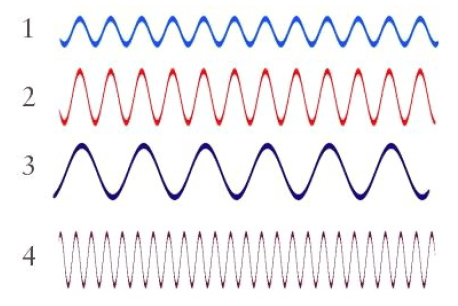
Which wave in the diagram has the greatest frequency?
a)
1
b)
2
c)
3
d)
4
38.

When a wave strikes an object and bounces off. (example echo)

a)

medium

b)

refraction

c)

reflection

d)

interference

39.

Sound Waves that hit a smooth, hard, surface the waves are most likely going to be

a)

absorbed

b)

reflected

40.

Sound waves that hit a rough, bumpy, surface are mostly likely going to be

a)

absorbed

b)

reflected

41.

Sound waves travel faster through

a)

Air that is hot because the particles are moving quickly

b)

Air that is cold because the particles are moving slowly