wayground logo

Free Printable Worksheets

NEW

Font size

S
M
L
XL
Worksheets

Plant Kingdom Pre-Assessment 2nd

Total questions: 28

Worksheet time: 37mins

Name
Class
Date
1.
Plants contain vascular tissue which consists of cells that make up tube structures that...
a)
transport materials along the stem of a plant
b)
transport only water along the stem of a plant
c)
transport only food along the stem of a plant
d)
transport materials along the leaves only of a plant
2.
Two examples of vascular tissue are:
a)
Xylem and Sugars
b)
Stems and Flowering plants
c)
Xylem and Phloem
d)
Xylem and Stems
3.
Xylem transports _____________ from the roots up to the leaves of the plant.
a)
mainly sugars
b)
water and minerals
4.
Phloem carries _____________ throughout the plant.
a)
mainly sugars
b)
water and minerals
5.
Which of the following plant groups produces flowers with seeds?
a)
Angiosperms
b)
Gymnosperms
c)
Pteriophytes
d)
Bryophytes
6.
What is the common name for Angiosperms?
a)
Flowering plants
b)
Conifers
c)
Ferns
d)
Mosses and Liverworts
7.
What is the common name for Gymnosperms?
a)
Flowering plants
b)
Conifers
c)
Ferns
d)
Mosses and Liverworts
8.
A plant group which grows close to the ground would most likely be due to...
a)
Having too much food
b)
Not having vascular tissue
c)
Having vascular tissue
d)
Having too much water
9.

The plant kingdom is considered to be in which domain?

a)
eukaryotic
b)
prokaryotic
10.

Angiosperms make up the largest group in the plant kingdom.

a)

True

b)

False

11.
A plant with roots, stems, leaves, and transporting vessels is a ...
a)
vascular plant
b)
non-vascular plant
12.
What do conifers have to protect their seeds?
a)
cones
b)
flowers
c)
pockets
d)
police
13.
WHich of the following is an example of a nonvascular plant?
a)
daisy
b)
pine tree
c)
mushroom
d)
moss
14.
Part of the plant that attracts insects for pollination
a)
Root
b)
Stem
c)
Leaf
d)
Flower
15.
This is the top part of the pistil of a flower which receives the pollen grains; germination happens here.
a)
petal
b)
sepal
c)
filament
d)
stigma
16.
This is the oval shaped part of a flower that contains pollen and is usually on the filament.
a)
anther
b)
sepal
c)
stamen
d)
stigma
17.

The diffusion of water vapor out of a leaf

a)

transportation

b)

transformation

c)

transpiration

d)

translocation

18.

The main function of stomata is to

a)

capture sunlight

b)

protect leaves from insects

c)

allow gases to move rapidly in/out of leaves

d)

release sugars into the atmosphere

19.

The pistil (or carpel) is the _______ part of the flower

a)

Male

b)

Female

20.

The stamen is the ______ part of the flower

a)

male

b)

female

21.

This is an image of pollen under the microscope. Which male structure produces pollen?

a)

filament

b)

style

c)

stigma

d)

anther

22.

The arrow points to a long stalk that leads to the ovary. This stalk is called ______

a)

ovary

b)

ovule

c)

style

d)

stigma

23.

The arrow points to the green structures that enclose and protect the flower before it opens. These structures are called _____________

a)

stigma

b)

stamen

c)

sepals

d)

pistil

24.

The arrow points to the colorful part of a flower that attracts pollinators. These are called the __________

a)

pollen

b)

sepals

c)

petals

d)

style

25.
Examine this seed. Would you expect it to produce a dicot or monocot plant?
a)
monocot
b)
dicot
c)
Corn
d)
WI Fast Plant
26.
Examine this seed. Would you expect it to produce a dicot or monocot plant?
a)
monocot
b)
dicot
c)
Neither
d)
Cotyledon
27.

Seedless vascular plants reproduce by...

a)

Seeds

b)

Spores

c)

Pollen

d)

Rhyzoid

28.

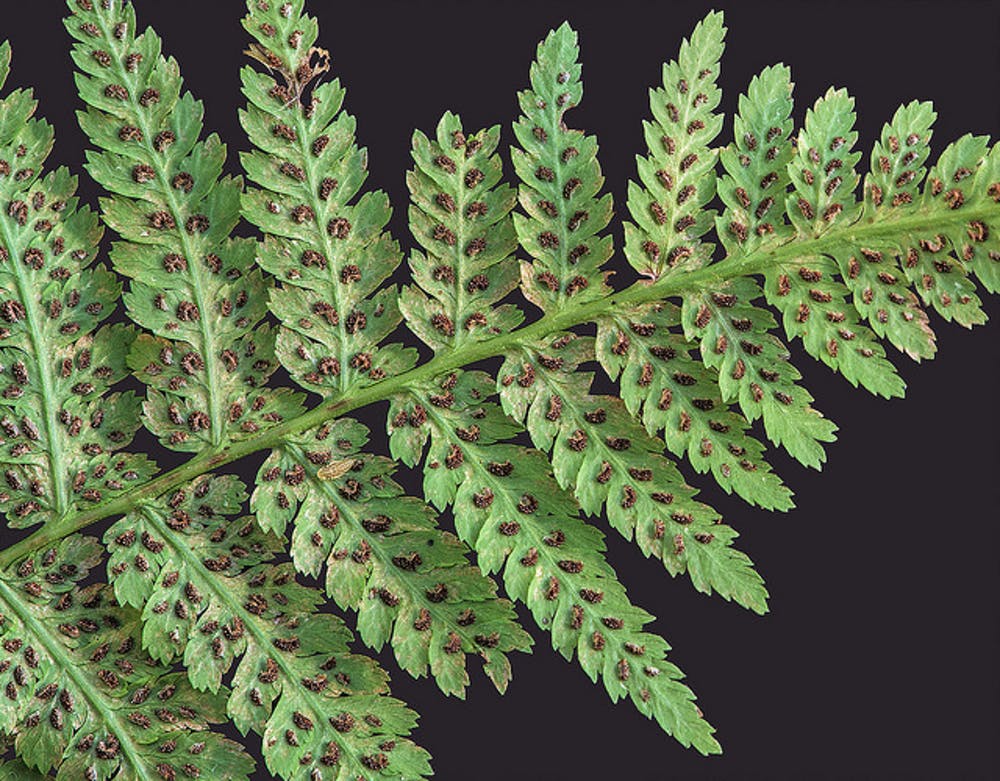
On the bottom of the leaf structure of a Fern plant, we can find these...

a)

Seeds

b)

Spore cases

c)

Pollen cases