wayground logo

Free Printable Worksheets

Font size

S
M
L
XL
Worksheets

March Review

Total questions: 90

Worksheet time: 1hrs 10mins

Name
Class
Date
1.
Adam is conducting a science experiment on the effect of different environments on plant growth.  He put one plant in a closet and the other plant in a window at his house.  He measured the growth of each plant weekly for six weeks.  He then created a graph after he reviewed his data.  What is the dependent variable in Adam's experiment?
a)
Total Growth of Plant.
b)
Plant Environment
c)
The Effect of Different Environments
d)
Measurement Over Six Weeks
2.
What equipment would a scientist most likely use to measure the volume of a liquid?
a)
Graduated cylinder
b)
Triple beam balance
c)
  Ruler
d)
Electron microscope
3.
In an experiment the factor being tested or changed on purpose is called the -
a)
independent variable
b)
dependent variable
c)
constant
d)
experimental error
4.
What can you infer about the temperature for E.coli bacterial growth?
a)
E. coli does not grow well at low and high temperatures.
b)
E coli will continue to grow at very high temperatures.
c)
E.coli grows best at very low temperatures
d)
E.coli grows best at very high temperatures.
5.
The time it takes to run a mile depends on the persons running speed. Name a constant variable. 
a)
The persons running speed 
b)
Same track, same stop watch used, same people performing the experiment.
c)
Same running speed and same track 
d)
The time it takes to run a mile 
6.
Why is it important to perform multiple trials during an experiment? 
a)
It makes sure your results are more accurate 
b)
It fixes errors from the experiment 
c)
It allows you to keep track of your materials 
d)
It is not important to have multiple trials 
7.
Variables that are kept the same throughout an experiment. 
a)
Theory 
b)
Non changing variables 
c)
Dependent variables 
d)
Constants 
8.
What form of energy is produced and transmitted by vibrating matter?
a)
Light
b)
Sound
c)
Heat
d)
Electricity
9.
In a sound wave, the area where molecules have been pressed together is a...
a)
Compression
b)
Rarefaction
c)
Wavelength
10.
Sound travels the ____________ in a solid like wood.
a)
Doesn't travel in a Solid
b)
Slowest
c)
Fastest
11.
Sound travels the _________ through a gas like air.
a)
Does not travel through a Gas
b)
Slowest
c)
Fastest
12.
As frequency increases, _______ increases.
a)
pitch
b)
wavelength
c)
frequency
d)
sound
13.
Why is sound able to travel faster through a solid than a gas?
a)
Gas molecules are packed tightly.
b)
Sound does not travel faster through a solid than a gas.
c)
Solid molecules are packed tightly.
d)
Gas molecules move slowly.
14.
A reflected sound wave
a)
frequency
b)
pitch
c)
echo
d)
rarefaction
15.

How do bats locate their food?

a)

they hunt during the day

b)

they use echolocation

c)

they sniff around the ground

d)

they don't eat

16.
You will see a flash of lightening before you hear the thunder that goes with it because-
a)
the eye is quicker than the ear
b)
thunder occurs much later than lightening
c)
sound travels faster through the  atmosphere than light
d)
light travels faster through the atmosphere than sound
17.
Which images are opaque?
a)
A & C
b)
A,C,E, & F
c)
D, E, & F
d)
A & E
18.
Which explains why the fork looks different under water?
a)
light can't pass through the glass
b)
the wavelength of light lengthens
c)
the amount of light increases when going through water
d)
light is refracted at an angle
19.
Which term means to bounce off the surface of something?
a)
Refract
b)
Absorb
c)
Reflect
d)
prism
20.
The term for any wave that hits a surface and bounces off
a)
Transparent
b)
Translucent
c)
Refraction
d)
Reflection
21.
Blurs light as it passes through
a)
Transparent
b)
Translucent
c)
Opaque
d)
Refraction
22.
Which of the diagrams best shows the arrangement of molecules in a solid? 
a)
A
b)
B
c)
C
d)
D
23.
Gallium is a metal that melts at about 30°C. If a person, whose body temperature is 37°C, held a cube of gallium for five minutes, what will most likely happen to the gallium?
a)
It will change to a gas.
b)
It will change to a liquid.
c)
It will become a solution.
d)
It will become a mixture.
24.
The smallest part of matter that is identifiable as an element is the —
a)
atom 
b)
molecule
c)
cell
d)
compound
25.
Which of these shows how frozen water changes as the temperature of the air increases?
a)
Gas → liquid → solid
b)
Solid → gas → liquid
c)
Liquid → gas → solid
d)
Solid → liquid → gas
26.
The process shown would be classified as —
a)
precipitation
b)
condensation
c)
transpiration
d)
evaporation
27.
What is the steep slope at the edge of the continental shelf?
a)
seamount
b)
mid-ocean ridge
c)
continental slope
d)
rift zone
28.
What is animal-like plankton called?
a)
Phytoplankton 
b)
Animal-likeplankton
c)
Zooplankton
d)
Plankton
29.

What are some of the deepest parts of the ocean called?

a)

abyssal plains

b)

trenches

c)

rift zones

d)

mid-ocean ridge

30.
The Gulf stream carries _____________ water from the east coast of The United States to the West coast of Europe.
a)
Cold
b)
Warm 
c)
Freezing
d)
Fresh
31.
Which factor is MOST responsible for the ocean tides?
a)
the gravitational pull of the moon 
b)
Earthquakes
c)
The wind
d)
Density differences in water
32.
What role do Phytoplankton play in the Ocean food web?
a)
They are predators 
b)
They are carnivores 
c)
They are primary producers 
d)
They are not important in the ocean food web
33.
What percentage of the Earth is made up of ocean?
a)
100%
b)
5%
c)
25%
d)
70%
34.
What increases as you get deeper into the ocean?
a)
Temperature
b)
Pressure
c)
Sunlight
d)
Marine life 
35.
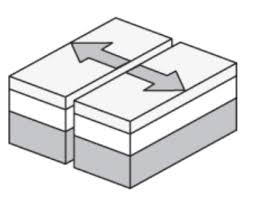
A divergent boundary occurs when plates ....
a)
Pull apart
b)
Come together
c)
Slide past each other
d)
subducting
36.
What type of event will occur at this boundary?
a)
Earthquake
b)
Volcano Eruption
c)
Tornado
d)
Mountain Building
37.
Name the boundary
a)
convergent boundary
b)
divergent boundary
c)
transform boundary
d)
sergent boundary
38.
The _____________ is broken in many large and small tectonic plates.
a)
Crust
b)
Mantle
c)
Outer Core
d)
Inner Core
39.
Sedimentary rocks form by
a)
cementation and compaction of sediment
b)
the melting and cooling of magma and lava
c)
heat and pressure
d)
fossils
40.
Metamorphic rocks are formed by
a)
heat and pressure
b)
melting and cooling
melting and cooling
c)
compaction and cementation
d)
weathering and erosion
41.
Pumice is formed when lava from a volcano cools. Which rock type is pumice?
a)
Gaseous rock
b)
Igneous rock
c)
Sedimentary rock
d)
Metamorphic rock
42.
When something is broken down either chemically and/or physically, _________ is taking place.
a)
Weathering
b)
Erosion
c)
Deposition
d)
Sediment
43.
When something is deposited in a new location, _________ is taking place.
a)
Weathering
b)
Erosion
c)
Deposition
d)
Sediment
44.
When something is moved by water and/or wind, _________ is taking place.
a)
Weathering
b)
Erosion
c)
Deposition
d)
Sediment
45.
Which is not an example of kinetic energy? 
a)
A man standing on the porch about to step off. 
b)
A girl riding a bike
c)
A boy doing a cartwheel
d)
A football player throwing 
46.
Which section of the track is friction most likely to cause the greatest resistance to the motion of the toy sled?
a)
1
b)
2
c)
3
d)
4
47.
A bicyclist rides on a flat road and then stops pedaling but does not apply the brakes. The bicycle stops because of ....
a)
magnetism
b)
balance
c)
attraction
d)
friction 
48.
In which direction will the ball most likely go after it hits the wall? 
a)
A
b)
B
c)
C
d)
D
49.
A person pushes a box as shown. What is the push most likely to change? 
a)
The color
b)
the size
c)
the mass
d)
the position of the box 
50.
Which labeled part in the picture has evidence of kinetic energy? 
a)
1
b)
2
c)
3
d)
4
51.
Which diagram shows an "Open Circuit"?
a)
A
b)
B
52.
Rubber, plastic, and wood are examples of -
a)
Static Electricity
b)
Insulators
c)
Conductors
d)
Electromagnets
53.
Michael Faraday's discovery of the _____?______ was an important contribution to Science.
a)
Parallel Circuit
b)
Open Circuit
c)
Light Bulb
d)
Electromagnet
54.
What famous scientist used electricity to bring light into our homes?
a)
Michael Faraday
b)
Benjamin Franklin
c)
Thomas Edison
55.
Benjamin Franklin discovered that lightning is _____?______.
a)
Sound
b)
Solid
c)
Liquid
d)
Electricity
56.
A fan transforms electrical energy into-
a)
Mechanical Energy (Motion)
b)
Light Energy (Radiant)
c)
Thermal Energy (Heat)
57.
A toaster transforms electrical energy into-
a)
Mechanical Energy (Motion)
b)
Thermal Energy (Heat)
c)
Light Energy (Radiant)
58.

Which of the following creates static electricity?

a)

Taking a bath

b)

Plugging a power cord into the wall outlet

c)

Rubbing your feet on the carpet

59.

This is a _________circuit.

a)

parallel

b)

diamond

c)

circle

d)

series

60.
A fifth-grade class constructed this circuit. Which of these objects most likely made the light glow when connected to points X and Y?
a)
Plastic straw
b)
Cotton string
c)
Aluminum foil
d)
Rubber eraser
61.
During pollination, pollen is transferred from a stamen to a ...
a)
petal
b)
stem
c)
sepal
d)
stigma 
62.
Which plant part develops into a fruit? 
a)
flower
b)
stem
c)
leaf
d)
root
63.
What is the function of a leaf? 
a)
changing energy from the sun into sugar
b)
creating shade
c)
absorbing water from the ground
d)
carrying nutrients
64.
How does the wind help plants reproduce? 
a)
strengthening the plants' root system
b)
giving the plants moisture
c)
cooling the plants
d)
spreading the plants' pollen
65.
What is one thing that plants provide to all animals that they need to survive? 
a)
oxygen
b)
minerals
c)
hydrogen
d)
light 
66.
What are the products of photosynthesis?
a)
Carbon dioxide and water
b)
Carbon dioxide and oxygen
c)
Glucose and oxygen
d)
Glucose and water
67.
Plants need ________ for photosynthesis
a)
oxygen
b)
soil
c)
carbon dioxide
d)
sugar
68.
What are the black dots on the back of the leaves of a fern plant? 
a)
pistils
b)
spores
c)
anthers
d)
chloroplasts 
69.
All the organisms of the same species that live in the same place at the same time are a -
a)
Community
b)
Population
c)
Food Chain
d)
Consumers
70.
Different populations of plants and animals living in the same place at the same time make up a -
a)
Population
b)
Food Web
c)
Producers
d)
Community
71.
The long neck of a giraffe to help reach leaves is an example of a _____________________.
a)
Structural Adaptation
b)
Behavioral Adaptation
72.
A brown bear hibernating in the winter is an example of a _____________________.
a)
Structural Adaptation
b)
Behavioral Adaptation
73.
Which describes energy through this food web?
a)
Salamanders get energy from snakes and mice.
b)
Acorns get energy from insects and pine trees
c)
Mice get energy from salamanders and insects
d)
Snakes get energy from salamanders and mice.
74.
A ____________ breaks down waste or dead organisms and recycles nutrients.
a)
consumer
b)
producer
c)
decomposer
d)
omnivore
75.
Which statement is supported by the data on this map?
a)
Emporia is colder than Bedford at the time of these measurements.
b)
Bedford is the hottest city in the state of Virginia.
c)
LaCrosse will become cooler over the next few days.
d)
Richmond, Farmville, and LaCrosse are all colder than Emporia.
76.
 Which do meteorologists use to measure the amount of precipitation that falls during a storm?
a)
Anemometer
b)
Barometer
c)
Rain gauge
d)
Weather vane
77.
Which type of storm causes the most flooding in areas located near an ocean coastline?
a)
Tornado
b)
Hurricane
c)
Blizzard
d)
Freezing rain
78.
What do the arrows on the map represent?
a)
Size of waves
b)
Water density
c)
Ocean currents
d)
Time between tides
79.
Which early astronomers believed EARTH was the center of the universe?
a)
Aristotle & Ptolemy
b)
Galileo & Copernicus
80.
Which planet is the smallest and closest to the sun?
a)
Mars
b)
Earth
c)
Venus
d)
Mercury
81.
Jupiter, Saturn, Uranus and Neptune are considered...
a)
Inner Terrestrial
b)
Gas Giants
82.
Why does the Earth have seasons?
a)
The temperature of the sun changes.
b)
Earth rotates on its axis.
c)
Earth's axis is tilted as it moves around the sun.
d)
The distance between Earth and the sun changes.
83.
Name this phase of the moon.
a)
waning crescent
b)
waxing crescent
c)
waning gibbous
d)
waxing gibbous
84.
 Which of these is a natural resource of Virginia?
a)
A dam
b)
A glacier
c)
A river
d)
A power plant
85.
Which of these human activities most relies on high-quality soil?
a)
Hiking
b)
Hunting
c)
Coal mining
d)
Growing crops
86.

What is a cultivated forest?

a)

Forest that grows because people planted them

b)

Forest that grows from nature

c)

Forest that grow without the help of people

d)

Forest where all trees are cut down

87.
An area of land over which surface water flows to a single collection place.
a)
resource
b)
lake
c)
river
d)
watershed
88.

Which of the following are natural resources found in Virginia

a)

water, coal, rocks

b)

glass, water, coal

c)

lumber, rocks, cars

d)

farmers, water, soil

89.
 Which of these is the most important product of Virginia forests?
a)
Pecan trees
b)
Pine cones
c)
Hardwood lumber
d)
Maple leaves
90.

Which is the best action to help protect water resources in Virginia?

a)

Rinse spilled gas with a hose.

b)

Put pet waste in a stream.

c)

Put hazardous waste in your house trash.

d)

Organize a river clean up program.