
 Worksheets
EOY Science Review
Total questions: 88
Worksheet time: 2hrs 42mins

You use this instrument to measure temperature.
sieve
hot plate
anemometer
thermometer


What will be the most affected if the decomposers in an ecosystem are removed?
spread of disease
availability of water
quality of the soil
distribution of organisms

A mouse eats seeds and insects. Which best describes the role of the mouse?
consumer
decomposer
herbivore
producer

Which would most likely cause a decrease in a population of herbivores?
an increase in producers
a decrease in decomposers
an increase in plants
an increase in carnivores

Which type of animal usually eats both producers and consumers?
omnivores
carnivores
herbivores
predator

Which classification best describes herbivores?
producers
consumers
predators
decomposers

This is a food chain that includes grass, a grasshopper, and a bird. (grass --> grasshopper --> bird). How is the grass in this food chain best described?
It is producer, because it makes it own food
It is a producer, because it is eaten by consumers.
It is a consumer, because it gets energy from producers
It is a decomposer, because it breaks down sunlight.

What would most likely happen if all the decomposers in an ecosystem were removed?
The animals in the ecosystem would die because of the spread of disease
The plants in the ecosystem would eventually die because of a lack of nutrients in the soil
The plants in the ecosystem would begin to die out because of a decrease in available water
The animals in the ecosystem would eat other types of food because of a decrease in producers

A food chain in an ecosystem includes blackberry bushes, deer, and wolves. (Deer eat blackberries, wolves eat deer). If the population of wolves decreases, how will this affect the population of blackberry bushes?
It will decrease because there will be fewer deer
It will increase because there will be fewer deer
It will decrease because there will be more deer
It will increase because there will be more deer.

Which has the greatest effect on the amount of salt in a salt marsh?
the number of animals living in the marsh
the closeness of the marsh to the ocean
the depth of the water in the marsh
the temperature of the water in the marsh

What would most likely result if all plants in an area were destroyed?
Consumer populations would increase because more sunlight would reach the ground
Decomposer populations would increase because more sunlight would reach the ground
Consumer populations would decrease because plants provide them with water
Consumer populations would decrease because pants provide them with energy

Is the left or right side of the mountain in the rain shadow?
Left
Right

What causes a wagon to speed up when going down a hill?
gravity
friction
air pressure
mass

A bowling ball moves across a flat surface at 7 feet per second. If a student is asked to calculate the total distance traveled by the ball, what other information does the student need to know?
amount of friction between the ball and the surface
amount of force applied to the ball
total time the ball rolled
mass of the ball

How do plants return water back into the environment?
by evaporation
by condensation
by runoff
by transpiration

Water droplets forming on the outside of a cold glass of water on a hot, summer day is an example of which part of the water cycle?
condensation
evaporation
precipitation
transpiration

After lake water flows through a dam, which processes are most responsible for helping replace the water in the lake?
precipitation and runoff
transpiration and condensation
condensation and runoff
transpiration and precipitation

Which is a trait children most likely inherit from their parents?
favorite color
food preference
freckles
weight

On a June day, a warm, moist air mass slowly passes over a colder air mass in North Carolina. What will most likely happen next?
Rain will fall.
Cirrus clouds will form.
Skies will clear.
Atmospheric pressure will rise.

In what way are insects and humans similar?
Both are single-celled organisms.
Both are multicellular organisms.
Both have cells that capture sunlight to make food.
Both have cells that carry out all life functions.

Which human body systems are located throughout most of the body?
digestive and respiratory
skeletal and respiratory
nervous and circulatory
respiratory and circulatory

Some people have a “hitchhiker’s” thumb that allows them to bend their thumbs more than other people. How do these people most likely get this trait?
They learn it from friends.
They inherit it from their parents.
They get it as a result of an illness.
They get it as a result of their jobs.

Which statement best describes the relationship between the nervous system and the muscular system?
The nervous system controls the muscular system.
The muscular system controls the nervous system.
The nervous system provides nutrients and oxygen for the muscular system.
The muscular system provides nutrients and oxygen for the nervous system.

Which characteristic is the best example of an inherited trait?
short hair
eye color
pierced ears
long fingernails

Which is an example of a non-inherited trait?
shape of face
hair color
food preference
tongue rolling


Which is most responsible for the movement of air masses?
ocean currents
Earth's rotation
changes in air temperature
movement of Earth's surface
Which best explains the relationship between precipitation and runoff?
less precipitation increases runoff
more precipitation increases runoff
more precipitation decreases runoff
precipitation and runoff are unrelated
Pete stands in a swimming pool and notices that the water around his feet is a lot cooler than the water near the surface. Which process causes this difference in temperature?
convection
evaporation
radiation
conduction
Jackie places a cup of cold water on a counter in a warm room. After a short time, she notices that the water in the cup is no longer cold. Which best explains why the water in the cup is no longer cold?
The coldness of the water transferred to the air, making the water in the cup warmer.
The coldness of the water was conducted to the cup, making the water in the cup warmer.
The heat from the air transferred to the water in the cup, making the water in the cup warmer.
The heat from the air caused the cold water in the cup to condense, making the water warmer.
Jean has a wooden rod, a steel rod, and a glass rod. How could she compare the materials to find out which transfers thermal energy BEST?
Place the rods in ice water to find out which loses the most heat.
Place the three rods in a freezer to find out which becomes the coldest.
Place the rods in very hot water to see which becomes hot the fastest.
Place the rods on a table in a warm room and find out which feels warmest after a period of time.
Misty was having trouble opening a new glass jar of pickles. Her father told Misty to hold the metal lid of the jar under running hot water for a few seconds, then try again. Then the lid opened easily. What is the MOST likely reason Misty’s father suggested using hot water to loosen the lid?
Glass contracts when it is heated.
Metals expand when they are heated.
Metals are easier to grip when they are warm.
Hot water reduces friction between metal and glass.
Heather fills a bicycle tire with air on a very hot day. The next day, the temperature drops and it is much cooler. Heather notices that the bicycle tire is almost flat. What best explainswhy the tire is flat?
The cooler temperature caused the air in the tire to contract, making the tire appear flat.
The cooler temperature caused the air in the tire to expand, which put a hole in the tire, causing it to go flat.
The cooler temperature caused the air in the tire to freeze, making the tire flat.
The cooler temperature caused the metal part of the bicycle to expand, putting a hole in the tire
and making it go flat.
Campers burned logs in a campfire. How would the campers know that a chemical change has taken place?
The logs changed shape.
The rocks glowed when heated.
The wood became a different substance.
The ground absorbed heat from the coals.
Which of the following changes to matter will result in a new substance with new properties?
Breaking glass
baking a cake
boiling water
chopping wood
A pot is heated on a stove. Which process causes the metal handle of the pot to also become hot?
combustion
convection
radiation
conduction
Lisa bought a box of candles weighing 30 ounces. There were 5 candles in the box. Lisa left the box in her car, and the candles melted together, forming one piece of wax. How much will the box of candles most likely weigh after this change?
20 ounces
150 ounces
35 ounces
30 ounces
Ivy mixed 30 g of hot chocolate mix with 200 g of hot milk. She then added 5 marshmallows with a mass of 8 g each. Which best describes the mass of her hot chocolate?
243 ounces
230 ounces
270 ounces
235 ounces
On a cold winter day with temperatures below 32°F, the local meteorologist records falling air pressure. Which type of weather will most likely occur?
rain
clear skies
a snowstorm
a thunderstorm

The graphic below shows an approaching cold front.
What will most likely happen as a result of the approaching cold front?
It will produce no precipitation.
It will produce some precipitation.
It will produce brief periods of heavy precipitation.
Hannah wanted to take pictures of cirrus clouds at school; however, the morning weather report indicated a low-pressure system over her area. Why will Hannah have to wait to see cirrus clouds?
because low-pressure systems generally bring cool, dry air
because low-pressure systems generally bring fair weather
because low-pressure systems generally do not bring clouds
because low-pressure systems generally bring rainy weather
Which two ecosystems are most likely found close to an ocean?
forest and estuary
grassland and lake
lake and salt marsh
estuary and salt marsh
How are lake ecosystems different from estuary ecosystems?
Estuaries have only freshwater and lakes have only have salt water.
Estuaries have only salt water and lakes have only have freshwater.
Lakes are almost always salt water and estuaries are brackish water.
Lakes are almost always freshwater and estuaries are brackish water.
How are bacteria classified in a forest ecosystem?
as consumers
as decomposers
as herbivores
as producers

The heat from the lamp allows this lizard to remain warm. This is an example of which type of heat transfer?
radiation
convection
conduction
A deer inherits some of its features from its parents. Other features come from its environment. Which feature would a deer MOST likely inherit from its parents?
a long scar
brown eyes
missing teeth
a broken antler
Which statement best explains how a bacterial cell is capable of surviving as a single-celled organism?
It is able to create new cells more slowly than other kinds of cells.
It is large enough to capture the food it needs for growth.
It is so small, it can survive in almost any place.
It has the ability to carry out all of its life functions.
A ball is kicked and rolls along a level field until it comes to a stop. What is most responsible for the ball coming to a stop?
air
gravity
mass
friction
If a car is moving backward along a road, can its speed be measured?
Yes, it can, because the car does not have friction acting on it.
Yes, it can, because the car travels a distance in a certain amount of time.
No, it cannot, because speed can only be measured if the car is moving forward.
No, it cannot, because the distance traveled backward by a car cannot be measured.
Scientists discover an asteroid that is moving through space. What information is needed to determine the average speed of the asteroid?
the mass and size of the asteroid
the distance the asteroid is from Earth
the direction the asteroid is moving and its distance from Earth
how far the asteroid has moved in 24 hours
One morning, a student notices that the grass in the area is wet, although it had not rained during the night. What could have caused the grass to be wet?
During the night, water had evaporated from the trees in the area.
The air above the ground became warmer during the night and caused precipitation.
When the air cooled above ground during the night, water vapor condensed on the grass.
The grass soaked up water from the ground during the night.
Which is the best example of a new substance forming?
lighting a match
cutting a piece of paper
popping a balloon
hitting a nail with a hammer
Which material is best used to keep cold drinks from getting warm too quickly?
glass, because it is a good conductor of heat
foam, because it is a poor conductor of heat
metal, because it radiates heat
paper, because it conducts heat
Which instrument is best used to predict weather changes?
a hygrometer
an anemometer
a thermometer
a barometer
In what way are the circulatory system and the nervous system similar?
They both perform the same function.
They are both structural systems.
They are both transport systems.
They both involve the same organs.
Which system in the human body includes the heart, blood, arteries, and veins?
cardiovascular
digestive
muscular
respiratory
Which of these traits is most influenced by a person’s environment?
ability to roll the tongue
blood type
weight
eye color
What causes a wagon to speed up when going down a hill?
gravity
friction
air pressure
mass
Why are liquids sometimes used in a thermometer?
because most liquids condense when heated and evaporate when cooled
because most liquids melt when heated and freeze when cooled
because most liquids contract when heated and expand when cooled
because most liquids expand when heated and contract when cooled

The chart below shows four identical wagons loaded with different amounts of bricks.
If the same amount of effort is applied to all four identical wagons, why would Wagon W move farthest?
It has the least amount of mass, affecting its motion.
It has the least amount of speed, affecting its motion.
It has the greatest amount of gravity, affecting its motion.
It has the greatest amount of friction, affecting its motion.

The graph below shows the speed of runners during a race.
How can the movement of the runners be accurately compared
(speed = distance ÷ time)?
The red runner had a faster start than the green runner.
The red runner ran at constant speed for a longer duration than the green runner.
The red runner stopped running for a longer duration of time than the green runner.
The red runner had more changes in speed than the green runner in the first 45 seconds.

This graph shows the movement of an earthworm.
Elle and Elin observed an earthworm crawling on the sidewalk for four minutes. When did the earthworm move the greatest distance?
between 0 and 1 minutes
between 1 and 2 minutes
between 2 and 3 minutes
between 3 and 4 minutes
Walker pulled an empty cart to the library. When she leaves the library, the cart is full of books. How does the force of friction on the cart change?
The force of friction increases because there is more mass.
The force of friction decreases because there is more air pressure.
The force of friction increases because the force of gravity decreases.
The force of friction stays the same because Maria is still pulling the cart with the same force.

Water evaporates quickly in the hot part of the day. Water that evaporates goes into the air. It does not stay in the soil.
Penny needs to water her vegetable garden. She wants most of the water to stay in the soil. That way, her plants can use the water. When should she water her garden?
6 a.m.
10 a.m.
2 p.m
10 p.m.

Ms. Morgan’s class took a trip to a lake. The students observed a dark mark on the rocks above the surface of the lake. Ms. Morgan. said the mark showed where the water level in the lake had been in the past.
What MOST likely happened to lower the water level in the lake?
Ice formed over the lake.
Rainfall around the lake increased.
Lightning struck the surface of the lake.
Air temperatures around the lake increased.

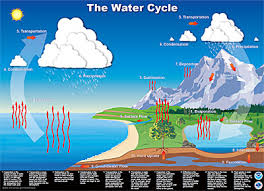
Use the diagram of the water cycle to answer the question that follows.
In the diagram, transpiration is represented by which numbered area?
1
2
3
4

Figure 1 diagram shows an ice cube in a cup. Figure 2 shows the ice cube melted to water in the cup.
Which property of the ice cube remains the same both before and after it melted?
color
shape
weight
temperature
Which is a chemical change?
frying an egg
boiling water
breaking a glass cup
crushing a piece of bread
How is a plant different from bacteria?
A plant is a multi-celled organism in which each cell performs a specific function. Bacteria is a single-celled organism in which one cell performs all functions.
Bacteria is a multi-celled organism in which each cell performs a specific function. A plant is a single-celled organism in which one cell performs all functions.
A plant is a multi-celled organism in which one cell performs all functions. Bacteria is a single-celled organism in which each cell performs a specific function.
Bacteria is a multi-celled organism in which one cell performs all functions. A plant is a single-celled organism in which each cell performs a specific function.
Which characteristic do single-celled organisms and multicellular organisms have in common?
Both have cells with specialized functions for each life process.
Both perform all life processes within one cell.
Both have a way to get rid of waste materials.
Both are able to make food from sunlight.
Which best describes the relationship between the skeletal system and the circulatory system?
The skeletal system transports red blood cells after the circulatory system produces them.
The skeletal system protects red blood cells and the circulatory system pumps those cells through veins and arteries.
The skeletal system produces red blood cells and the circulatory system transports those cells where they need to go.
The skeletal system helps put oxygen in red blood cells and the circulatory system helps those cells rid the body of carbon dioxide.

