
 Worksheets
Waves
Total questions: 31
Worksheet time: 48mins
Name
Class
Date
1.
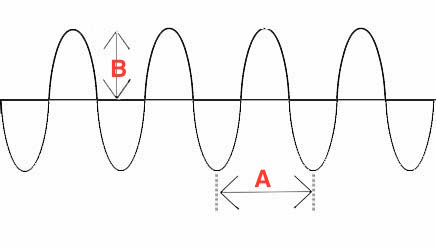
What property of this wave is represented by the letter "A"
a)
amplitude
b)
crest
c)
trough
d)
wavelength
2.
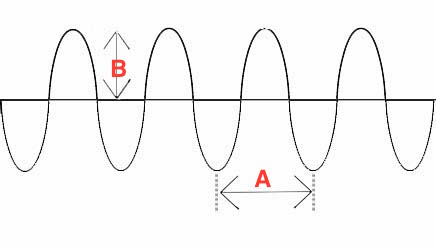
What property of the wave is represented by the letter "B"?
a)
amplitude
b)
crest
c)
trough
d)
wavelength
3.
The number of wavelengths that pass a point each per second is:
a)
frequency
b)
period
c)
longitudinal
d)
transverse wave
4.
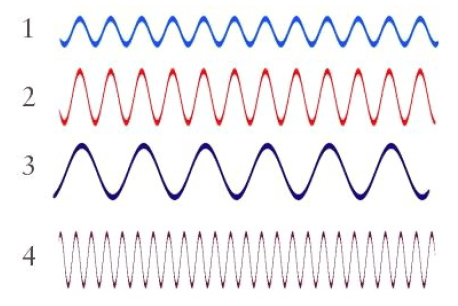
Which wave in the diagram has the greatest frequency?
a)
1
b)
2
c)
3
d)
4
5.
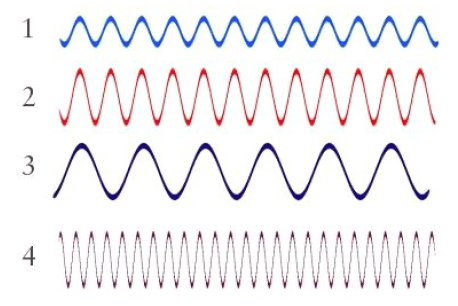
Which wave in the diagram has the greatest wavelength?
a)
1
b)
2
c)
3
d)
4
6.
Which of the following can sound travel through?
a)
solid
b)
liquid
c)
gas
d)
all of the above
7.

What kind of waves can travel through space?
a)
electromagnetic waves
b)
compressional waves
c)
longitudinal waves
d)
sound waves
8.
A wave carries...?
a)
energy only
b)
matter only
c)
energy and matter
d)
neither
9.
A compressional wave is another name for a
a)
longitudinal wave
b)
electromagnetic wave
c)
radio wave
d)
hair wave
10.
In a longitudinal wave, the particles move...?
a)
back and forth
b)
up and down
c)
not at all
d)
at a 90 degree angle
11.
_____________________ is the distance between a point on one wave and the identical point of the next wave.
a)
Amplitude
b)
Wavelength
c)
Frequency
d)
Crest
12.

The units for frequency are measured in _____________.
a)
hertz
b)
seconds
c)
m/s
d)
grams
13.

Which is an example of a longitudinal wave?
a)
light wave
b)
sound wave
c)
visible wave
d)
radio wave
14.
What kind of wave moves at right angles to the direction of the wave?
a)
compressional waves
b)
mechanical waves
c)
transverse waves
d)
ultraviolet rays
15.
What do we call the part of a compressional wave that is spread a part?
a)
compression
b)
rarefaction
c)
crest
d)
trough
16.

This type of Electromagnetic wave shows a break in bones.
a)
gamma ray
b)
x-ray
c)
brokenometer
d)
radio wave
17.

Which letter represents amplitude?
a)
A
b)
B
c)
C
d)
D
18.
When a wave bends as it passes through at an angle from one medium to another.(example: pencil in a glass of water-)
a)
medium
b)
refraction
c)
reflection
d)
interference
19.
When a wave strikes and object and bounces off. (example echo)
a)
medium
b)
refraction
c)
reflection
d)
interference
20.

_______ carry the greatest amount of energy.
a)
x-rays
b)
gamma rays
c)
infrared rays
d)
visible light
21.
How much of the electromagnetic spectrum is visible?
a)
All of it
b)
None of it
c)
Most of it
d)
Only a small part
22.

Cell phones use_____________waves.
a)
Microwaves
b)
Gamma
c)
XRays
d)
Radio
23.
A wave in which the particles of the medium oscillate PERPENDICULAR to the direction of the wave motion
a)
transverse
b)
longitudinal
24.
A wave in which the particles of the medium oscillate PARALLEL to the direction of the wave motion
a)
transverse
b)
longitudinal
25.
What is the equation for wave speed?
a)
Wave speed = frequency x wavelength
b)
Wave speed = amplitude x frequency
c)
Wave speed = frequency / wavelength
d)
Wave speed = wavelength / frequency
26.
What is the speed of a wave with a frequency of 4000Hz and a wavelength of 1x10⁵ m ?
a)
4x10⁸
b)
4x10⁹
c)
4000000
d)
40000000000
27.
The highest point on a wave is:
a)
the crest
b)
the trough
c)
the top
d)
the coast
28.
The lowest point on a wave is the:
a)
Amplitude
b)
Crest
c)
Trough
d)
Wavelength
29.
Why is sound able to travel faster through a solid than a gas?
a)
Gas molecules are packed tightly.
b)
Sound does not travel faster through a solid than a gas.
c)
Solid molecules are packed tightly.
d)
Gas molecules move slowly.
30.
A ray of light is incident on a plane mirror and the angle of incidence is 25 degrees. What is the angle of reflection?
a)
A. 0 degrees
b)
B. 50 degrees
c)
C. 90 degrees
d)
D. 25 degrees
31.
What is the correct order for the electromagnetic spectrum? (select two)
a)
Radio, Micro, UV, Visible, IR, X-ray, Gamma
b)
Gamma, X-ray, UV, Visible, IR, Micro, Radio
c)
Radio, Micro, IR, Visible, UV, X-ray, Gamma
d)
Gamma, X-ray, IR, Visible, UV, Micro, Radio
100 %

