wayground logo

Free Printable Worksheets

NEW

Font size

S
M
L
XL
Worksheets

Revision: Triangle Congruence Criteria

Total questions: 55

Worksheet time: 3hrs 9mins
Name
Class
Date
1.
What does CPCTC stand for?
a)
Corresponding Parts of Corresponding Triangles are Congruent
b)
Congruent Parts of Corresponding Triangles are Congruent
c)
Corresponding Parts of Congruent Triangles are Congruent
2.
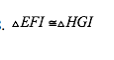
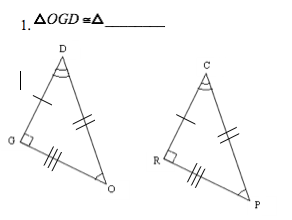
Complete the congruence statement.
a)
CRP
b)
PCR
c)
RPC
d)
PRC
3.
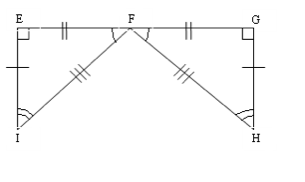
Which segment is congruent to EF? 
a)
HG
b)
HF
c)
GF
d)
IE
4.
Use the congruency statement to answer the following: 
<F = ___
a)
<H
b)
<I
c)
<G
d)
not congruent to another angle
5.
Are these triangles congruent? If so, state the rule which you used to determine congruence.
a)
Yes by ASA
b)
Yes by AAS
c)
Yes by SSA
d)
Not congruent
6.
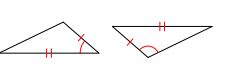
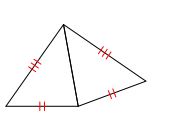
Are these triangles congruent? If so, state the rule which you used to determine congruence.
a)
SAS
b)
SSS
c)
Both SSS and SAS
d)
Not necessarily congruent
7.
Fill in the missing proofs.
a)
Transitive Property, SAS(Side-Angle-Side)
b)
Reflexive Property, SAS(Side-Angle-Side)
c)
Reflexive Property, Vertical Angles Thm.
d)
Transitive Property, SSS(Side-Side-Side)
8.
Congruent by
a)
SSS
b)
SAS
c)
ASA
d)
AAS
9.
Congruent by
a)
SSS
b)
SAS
c)
ASA
d)
AAS
10.
Congruent by
a)
SSS
b)
SAS
c)
ASA
d)
AAS
11.
Congruent by
a)
SSS
b)
SAS
c)
ASA
d)
AAS
12.
Congruent by
a)
SSS
b)
SAS
c)
ASA
d)
AAS
13.
Congruent by
a)
SSS
b)
SAS
c)
ASA
d)
AAS
14.
Congruent by
a)
SSS
b)
SAS
c)
ASA
d)
AAS
15.
Congruent by
a)
SSS
b)
SAS
c)
ASA
d)
AAS
16.
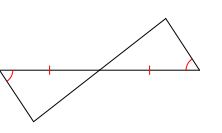
How are these two triangles congruent?
a)
SAS
b)
ASA
c)
AAS
d)
Not enough information
17.
How are these triangles congruent?
a)
SSS
b)
SAS
c)
SSA
d)
Not enough information
18.
How are these triangles congruent?
a)
AAS
b)
ASA
c)
SAS
d)
Not enough information
19.
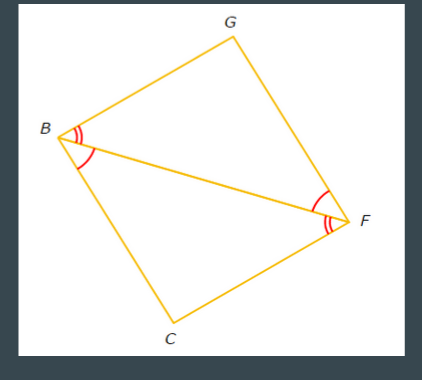
What congruency postulate proves the triangles congruency?
a)
SAS
b)
ASA
c)
SSS
d)
HL
20.
What does SAS stand for?
a)
Side-Angle-Side
b)
Super-Awesome-Side
c)
Side-Angle-Supersized
d)
Sensationally Awesome Superman
21.
What postulate would prove triangle ∆NYQ is congruent to ∆PYQ?
a)
ASA
b)
SAS
c)
SSS
d)
HL
22.
When do you use "CPCTC in a proof?
a)
ALWAYS at the beginning
b)
ALWAYS at the end
c)
It's optional
d)
NEver
23.
What postulate proves these triangles congruent?
a)
HL
b)
SSS
c)
SAS
d)
ASA
24.
What postulate proves these triangles congruent?
a)
SAS
b)
HL
c)
AAS
d)
ASA
25.
Fill in the blank.
a)
Given
b)
Reflexive Property
c)
Transitive Property
d)
They're the same side!!!!!! 
26.
Which side corresponds to CB?
a)
ZY
b)
YX
c)
XZ
d)
AC
27.
a)
Congruent by ASA
b)
Congruent by HL
c)
Congruent by SAS
d)
Not Necessarily Congruent
28.

If the m<EFG = 87°, which other angle has that measurement?

a)

<GEF

b)

<REF

c)

<EFR

d)

<FEG

29.

Given: ΔXYZ ≅ΔMNO. Determine the value of r.

a)

14

b)

28

c)

57°

d)

12

30.
Name the postulate, if possible, that makes the triangles congruent.
a)
SAS
b)
ASA
c)
AAS
d)
Not Possible
31.
What is reason #2?
a)
Vertical angles are congruent.
b)
Consecutive angles are congruent.
c)
Alternate interior angles are congruent.
d)
Definition of Bisect
32.
a)
A
b)
B
c)
C
d)
D
33.
If ∆LMK ≅ ∆LMT, then
∠K ≅ ____
a)
T
b)
∠T
c)
∠M
d)
∠L
34.
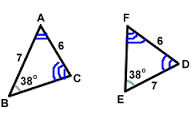
These triangles are congruent. If ∠A is 48o what is the measure of ∠F?
a)
48o
b)
38o
c)
84o
d)
94o
35.
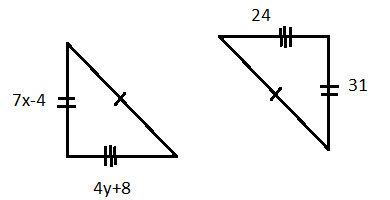
Solve for y
a)
2
b)
3
c)
4
d)
5
36.
Solve for x
a)
5
b)
4
c)
3
d)
2
37.
The sum of all three angles in a triangle is 180 degrees.
a)
True
b)
False
38.
Name the postulate, if possible, that makes the triangles congruent.
a)
SSS
b)
SAS
c)
ASA
d)
Not Possible
39.
What additional information is required for the 2 triangles to be congruent by SAS?
a)
A
b)
B
c)
C
d)
D
40.
If AB = BC and BC = CD, then CD = AB is an example of what?
a)
Reflexive Property
b)
Symmetric Property
c)
Transitive Property
d)
Transformative Property
41.
Which are pairs of vertical angles?
a)
∠COB & ∠COA
b)
∠AOD & ∠AOC
c)
∠COB & ∠AOD
d)
∠BOD & ∠AOD
42.
What is the "reason" for step 5 of the proof?
a)
Angle Bisector Theorem
b)
Reflexive property
c)
CPCTC Theorem
d)
Proof
43.
What is the "reason" for step 4 of the proof?
a)
SAS
≅ theorem
b)
ASA
≅ theorem
c)
SSA
≅ theorem
d)
CPTCT
 theorem
44.
Identify the  missing statement or reason
a)
Definition of Angle Bisector
b)
Alternate Interior Angles Theorem
c)
Reflexive Property
d)
Definition of Midpoint
45.
Identify the  missing statement or reason
a)
Given
b)
Vertical Angles Theorem
c)
Definition of Angle Bisector
d)
Alternate Interior Angles Theorem
46.
Identify the  missing statement or reason
a)
Reflexive Property
b)
Definition of Midpoint
c)
Given
d)
Vertical Angles Theorem
47.
Use the picture to answer the question.
a)
30
b)
60
c)
15
d)
120
48.
∆ABC ≅ ∆LMN. Which statement is NOT true?
a)
LM ≅ AB
b)
∆CAB ≅ ∆NLM
c)
∠C ≅ ∠N
d)
BC ≅ ML
49.
Find the measure of the indicated angle. 
a)
145 degrees
b)
24 degrees
c)
20 degrees 
d)
21 degrees
50.

Triangle QPR is congruent to triangle SPR, as shown in the figure.

What is the value of x?

a)

8

b)

16

c)

17

d)

34

51.

Triangle QPR is congruent to triangle SPR, as shown in the figure.

What is the value of y?

a)

8

b)

16

c)

17

d)

34

52.

Triangle QPR is congruent to triangle SPR, as shown in the figure.

What is the measurement of angle QPR?

a)

35 degrees

b)

60 degrees

c)

70 degrees

d)

85 degrees

53.

Triangle QPR is congruent to triangle SPR, as shown in the figure.

What is the measurement of angle QRP?

a)

35 degrees

b)

60 degrees

c)

70 degrees

d)

85 degrees

54.

Triangle QPR is congruent to triangle SPR, as shown in the figure.

What is the measurement of angle Q?

a)

35 degrees

b)

60 degrees

c)

70 degrees

d)

85 degrees

55.

Triangle QPR is congruent to triangle SPR, as shown in the figure.

What is the measurement of angle S?

a)

35 degrees

b)

60 degrees

c)

70 degrees

d)

85 degrees