

wayground logo

Free Printable Worksheets

NEW

Font size

S
M
L
XL
Worksheets

Oceans

Total questions: 38

Worksheet time: 23mins

Name
Class
Date
1.
A[n] ______________ tide occurs when the sun is at right angles to the line between Earth and the moon. 
a)
high
b)
neap
c)
low
d)
spring
2.
A[n] ___________ tide occurs when the sun, Earth, and the moon are nearly in a line. 
a)
spring
b)
high
c)
low
d)
neap
3.
A neap tide is a tide with the greatest difference between low and high tides
a)
true
b)
false
4.

What is a semi-diurnal tide?

a)

A tide cycle of three high and low tides

b)

A tidal cycle of one high tides and one low tides each lunar day

c)

A tidal cycle of two high tides and two low tides each lunar day, with the high tides of nearly equal height.

d)

A tidal cycle that has no high or low cycles

5.

What is a diurnal tide?

a)

no high and low tides

b)

1 high and low tide

c)

two high and two low tides

d)

3 high and low tides

6.

What is a Mixed Tide?

a)

2 equal low and high tides

b)

a tidal cycle which contains 2 unequal high tides and two unequal low tides

c)

A tidal cycle that contains one equal high tide and one unequal low tide

d)

A tidal cycle that has 3 high tides and 2 low tides
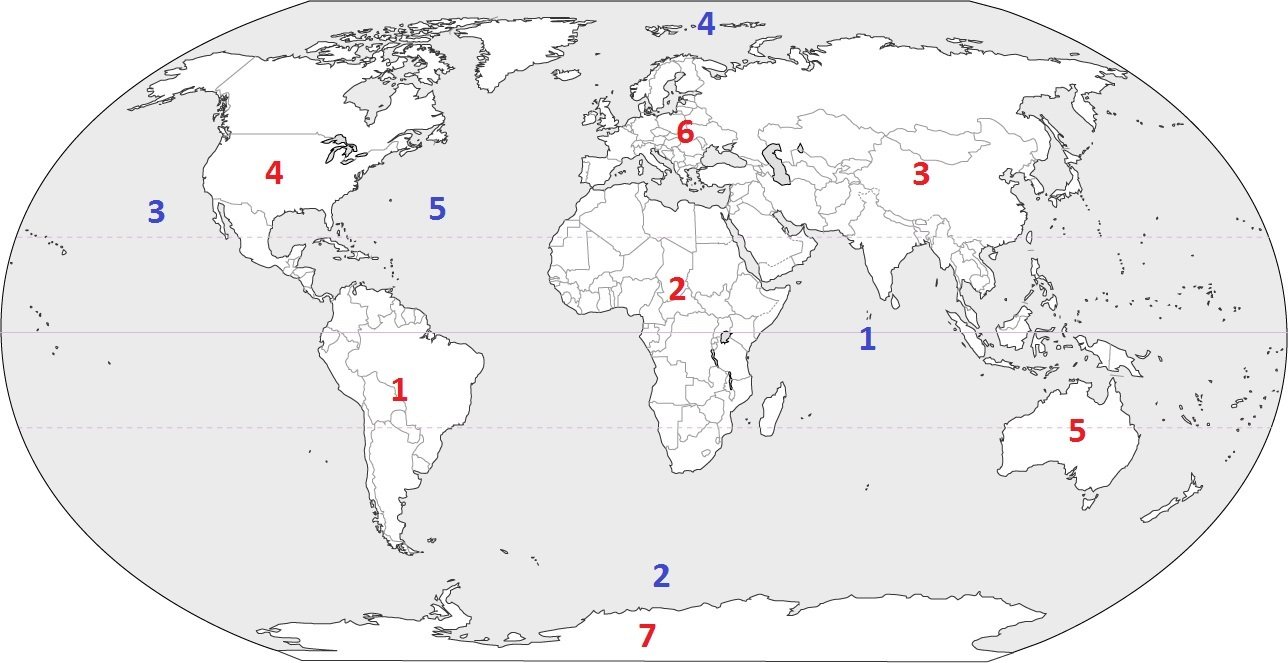
7.
How many oceans are there in the world?
a)
7
b)
6
c)
5
d)
4
8.
Identify the ocean at location #5
a)
Atlantic Ocean
b)
Southern Ocean
c)
Pacific Ocean
d)
Arctic Ocean
9.
Surface currents are a result of
a)
Global Wind Patterns
b)
Earth's Rotation
c)
Density
d)
All of the above
10.
Deep Ocean currents are a result of
a)
Global Wind Patterns
b)
Earth's Rotation
c)
Density
d)
All of the above
11.
The Gulf stream carries _____________ water from the east coast of The United States to the West coast of Europe.
a)
Cold
b)
Warm 
c)
Freezing
d)
Fresh
12.
What happens to a current when it comes in contact with a continent or landmass?
a)
It continues over the continent
b)
It stops
c)
It changes direction
d)
It is absorbed by the land
13.
As you go deeper in the ocean, the water is colder and less salty.
a)
True
b)
False
14.
Due to the Coriolis Effect, water in the northern hemisphere moves
a)
clockwise
b)
counter clockwise
c)
both
d)
neither
15.
Due to the Coriolis Effect, water in the southern hemisphere moves
a)
clockwise
b)
counter-clockwise
c)
both
d)
neither
16.
Warm ocean currents generally come from
a)
The North Pole
b)
The South Pole
c)
The Equator
d)
Both A and B
17.
Cold ocean currents generally come from
a)
The North Pole 
b)
The South Pole
c)
The Equator
d)
Both A and B
18.
Two types of water currents are
a)
local and global
b)
sea and land
c)
surface and deep
d)
warm and cold
19.
Ocean currents have an affect on which two things
a)
climate and weather
b)
temperature and density
c)
land and sea
d)
equator and poles
20.
Constantly moving system of deep-ocean circulation driven by temperature and salinity. It moves water around the globe.
a)
California Current
b)
Global Conveyor Belt
c)
Surface Currents
d)
Gulf Stream
21.
The large, circular surface-current pattern found in each ocean.
a)
California Current
b)
Surface Current
c)
Gyre
d)
Global Conveyor Belt
22.
What is the deepest part of the ocean basin?
a)
abyssal plains
b)
trenches
c)
rift zones
d)
mid-ocean ridge
23.
Which process does NOT lead to a decrease in the salinity of water?
a)
runoff from land
b)
precipitation
c)
sea ice melting
d)
evaporation
24.
In addition to salinity, what factor affects the density of seawater?
a)
depth
b)
latitude
c)
temperature
d)
salt content
25.
What is the most abundant salt in the sea?
a)
calcium chloride
b)
potassium chloride
c)
magnesium chloride
d)
sodium chloride
26.
The highest salinity would be found in which of the following areas?
a)
an area with high rates of precipitation
b)
an area with high rates of evaporation
c)
an area with plenty of runoff
d)
all of the above
27.
Which process increases the salinity of water?
a)
runoff from land
b)
formation of sea ice
c)
precipitation
d)
melting of sea ice
28.
Seawater is typically denser than freshwater due to seawater’s —
a)
Greater depth
b)
Lower freezing point
c)
Smaller mass
d)
Higher salinity
29.
The salt that is in your salt shaker is the same salt that is in our oceans?
a)
true
b)
false
30.
3.5% of the ocean's weight comes from dissolved salt. 
a)
True
b)
False
31.

This layer rapidly decreases in temperature

a)

surface layer

b)

transition layer (thermocline)

c)

deep layer

32.
Upwelling is the process where warm, nutrient rich water from deep in the ocean rises to the surface.
a)
False
b)
True
33.

A current that runs parallel to the shoreline.

a)

longshore current

b)

rip current

c)

density current

d)

storm surge

34.

Narrow coastal land formation that is tied to the coast at one end. Is surrounded by water on three sides.

a)

sandbar

b)

spit

c)

inlet

d)

groin

35.

A long broad sandy island lying parallel to a shore.

a)

lagoon

b)

spit

c)

barrier island

d)

breakwater

36.

A barrier built out into a body of water to protect a coast or harbor from the force of wind, waves, tides and currents

a)

spit

b)

groin

c)

seawall

d)

breakwater

37.

A long, narrow structure built out into the water, perpendicular, from a beach in order to prevent beach erosion or to trap and accumulate sand that would otherwise drift along the beach face.

a)

breakwater

b)

seawall

c)

groin

d)

spit

38.

A form of coastal defense constructed (on the shoreline not offshore) where the sea, and associated coastal processes, impact directly upon the landforms of the coast.

a)

sandbar

b)

groin

c)

breakwater

d)

seawall
