
 Worksheets
Diversity, Bacteria and Viruses
Total questions: 25
Worksheet time: 17mins
Name
Class
Date
1.
This domain is characterized by ancient bacteria that can live in extreme environments, such as volcanoes.
a)
Archaea
b)
Bacteria
c)
Eukarya
d)
Prokarya
2.
This domain contains organisms that have a true nucleus in each of their cells. This domain breaks down into four kingdoms.
a)
Animalia
b)
Archaea
c)
Bacteria
d)
Eukarya
3.
Organisms that are classified as autotrophic are able to-
a)
be seen with the human eye
b)
move
c)
reproduce
d)
make their own food
4.
I am made of many cells. My cells have an organized nucleus. I mostly have two parents, but sometimes one. I make my own food.
a)
Fungi
b)
Bacteria
c)
Plantae
d)
Animalia
5.

What do we call an organism that must eat other organisms in order to obtain energy?
a)
Photosynthesis
b)
Autotroph
c)
Heterotroph
d)
Producer
6.
which of the following is not a domain
a)
PROTISTA
b)
EUKARYA
c)
BACTERIA
d)
ARCHAEA
7.
Animals are more related in?
a)
DOMAIN
b)
KINGDOM
8.
Plants are more related in?
a)
CLASS
b)
ORDER
c)
KINGDOM
d)
PHYLUM
9.
Viruses are...
a)
prokaryotic
b)
eukaryotic
c)
non-living
d)
endospores
10.
Which of the following is not a bacterial shape?
a)
bacilli
b)
spirilla
c)
double helix
d)
cocci
11.
The term "antibiotic resistance" refers to bacteria that
a)
are resistant to a vaccine.
b)
evolve to survive in the presence of an antibiotic.
c)
are weakened and destroyed by antibiotics.
d)
are dead or altered.
12.
Process by which bacteria reproduce asexually
a)
binary fission
b)
transduction
c)
transformation
d)
conjugation
13.
If a bacteriophage attaches itself to a bacterial cell and transfers DNA, what type of reproduction has occurred?
a)
conjugation
b)
transduction
c)
transformation
d)
binary fission
14.
Hydrogenovibrio crunogenus is a chemoautotroph. How does this bacteria obtain nutrition?
a)
from sunlight
b)
from inorganic molecules
c)
from ingesting nutrients
d)
from decomposing matter
15.
The name streptococcus tells you the bacteria are arranged as ___.
a)
pairs of round cells
b)
long chains of round cells
c)
groups of spirals
d)
chains of rods
16.
Which part of a bacteria cell wall "holds" the stain?
a)
plasma membrane
b)
fimbriae
c)
peptidoglycan
d)
pilus
17.
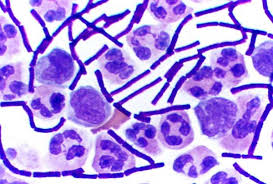
These bacteria are
a)
gram positive
b)
gram negative
c)
nonliving
d)
viral
18.
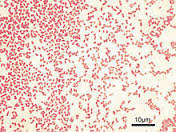
These bacteria are
a)
gram positive and negative
b)
gram positive
c)
gram negative
d)
viral
19.

This is
a)
gram positive
b)
gram negative
c)
confusing (don't choose!)
d)
Who knows? (don't choose)
20.
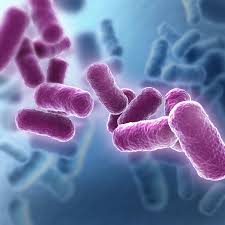
?
a)
coccus
b)
bacillus
c)
spirilla
d)
double helix
21.

?
a)
coccus
b)
bacillus
c)
spirilla
d)
double helix
22.

A(n) _____ is a virus that enters a bacterial cell.
a)
endospore
b)
decomposer
c)
plasmid
d)
bacteriophage
23.
What part of a virus is the protein capsule that houses the genetic material (DNA/RNA)?
a)
tail
b)
nucleus
c)
capsid
d)
glycoprotein
24.
Which viral life cycle kills its host cell by lysing?
a)
lytic
b)
mitosis
c)
lysogenic
d)
S phase
25.
Which viral life cycle allows viral genetic material to lay dormant while the host cell reproduces?
a)
lytic
b)
mitosis
c)
lysogenic
d)
S phase
100 %

