

wayground logo

Free Printable Worksheets

Font size

S
M
L
XL
Worksheets

1920s and Great Depression Review

Total questions: 113

Worksheet time: 1hrs 7mins

Name
Class
Date
1.

Migration, WW1, Flappers, Prohibition

a)

Reasons against suffrage

b)

Examples of social changed in the 1920's

c)

Causes of the great depression

d)

Random things

2.

What was the main results of prohibition?

a)

Jack Daniels went bankrupt

b)

End of domestic violence

c)

Church attendance increased

d)

Bootlegging, organized crime, illegal bars

3.

What 2 things encouraged African Americans to move north?

a)

Jim Crow laws and jobs

b)

Weather

c)

Illegal bars

d)

American Idol

4.

What is fundamentalism?

a)

Conservative Christianity

b)

Strict belief in religious text

c)

Form of Islam

d)

Baseball philosophy- need to work on fundamentals

5.

Who was a target of the KKK

a)

African Americans

b)

AA, Catholics, Jews, any immigrants

c)

City people

d)

Irish and Germans

6.

Government owns all property, single political party, nation 1st

a)

Communism

b)

Monarchy

c)

Democracy

d)

What happens in 3rd hour

7.

The Scopes Monkey Trial was about what?

a)

Domesticating apes

b)

Teaching evolution in school

c)

The 2 Italian guys who were executed for killing someone

d)

Monkey treatment in local circuses

8.

2 Italians who many believed were wrongly convicted of murder were

a)

Tony Soprano and my Uncle Gueto

b)

Socks and vans

c)

Al Capone and Lucky Luciano

d)

Sacco and Vanzetti

9.

What does buying on credit mean

a)

paying cash

b)

it means you are broke

c)

using borrowed money to buy stuff

10.

When people borrowed money to buy stocks this was called

a)

financial suicide

b)

buying on margin

c)

buying on credit

d)

speculation

11.

Stock market crash, bank runs, buying on credit, risky loans

a)

causes of WW2

b)

causes of suicide

c)

all Obama's fault

d)

causes of great depression

12.

When did the stock market crash

a)

1929

b)

1925

c)

yesterday

d)

1934

13.

the area known as the Great Plains became known as

a)

where Michaela is from

b)

middle of nowhere

c)

dust bowl

d)

a diverse urban area

14.

why was the middle of the country knows as the dust bowl

a)

drought and poor farming techniques had ruined the soil

b)

people didn't know how to keep their houses clean

c)

it's shaped like a bowl

d)

dust from California and Mexico had destroyed everything

15.

Hoovervilles, Hoover flags, Hoover blankets, Hoover soup are all examples of

a)

how much people loved the president

b)

products he invented

c)

lack of originality in naming things

d)

how people blamed him for their problems

16.

who won the 1932

a)

FDR

b)

Nixon

c)

JFK

d)

Hoover

17.

How was FDR different from Hoover

a)

he was shorter

b)

felt the government should help people

c)

he wanted to declare war in Europe

d)

Hoover made better soup

18.

What was the main purpose of all of the programs developed by the FDR administration

a)

control climate change

b)

get people back to work

c)

make people hate Hoover even more

d)

make the US a socialist country

19.

Relief for poor/homeless, job creation/infrastructure improvement, stimulate economy

a)

part of the Trump campaign promises

b)

ideas of Social Darwinism

c)

goals of FDR's 100 day plan

20.

The Red Scare following World War I was caused primarily by

a)

the influenza outbreak.

b)

fear of airborne diseases.

c)

the actions of Wisconsin Senator Joseph McCarthy.

d)

fear of communist infiltration of the United States.

21.

In the era after World War I and before the Great Depression, American suburbs began to grow rapidly because of

a)

increased use of airplanes.

b)

invention of electric lights.

c)

mass production of automobiles.

d)

greater availability of information.

22.

It can be argued that radio's MOST important contribution to American life in the 1920s was

a)

broadcast updates about the growing "Dust Bowl."

b)

it helped to create a common culture in the United States.

c)

people could keep posted on all news about the war with Japan.

d)

those in the city could hear Broadway plays instead of attending them.

23.

Why is the Harlem Renaissance of major importance in American History?

a)

The government finally passed a law banning slavery.

b)

The area of New York was rebuilt after a devastating fire.

c)

It finally gave much needed jobs to African-Americans during the Great Migration.

d)

It brought the African-American experience into the cultural conscious of the country.

24.

What group was revived during the 1910s, speaking out against communists, immigrants, Catholics, Jews, and African-Americans?

a)

Nativist

b)

Ku Klux Klan

c)

Know Nothings

d)

Anti-Saloon League

25.

Which 1920 event resulted in the deportation of over 500 suspected anarchists and leftists?

a)

the Red Scare

b)

the Palmer Raids

c)

the Espionage Act

d)

the Communist Purge

26.

The Scopes Trial (1925) involved

a)

conspiracy on the part of labor to restrain trade.

b)

the teaching of Christianity in Tennessee schools.

c)

teaching of the communist doctrine in Tennessee schools.

d)

a conflict in values between traditional fundamentalism and modernism.

27.

What was the primary goal of the Emergency Quota Act of 1921?

a)

to increase the number of women in the workforce

b)

to reduce European immigration to the United States

c)

to increase Japanese immigration to the United States

d)

to limit the number of African Americans in industrial jobs

28.

An obvious defect in the United States' banking system that was exposed during the Great Depression was

a)

excessive government regulation of banks.

b)

the federal government's ownership of banks.

c)

an excessive amount of currency in circulation.

d)

the lack of protection for funds deposited by individuals in banks.

29.

The "Dust Bowl" was an ecological situation associated with

a)

World War I

b)

World War II

c)

The Cold War

d)

The Great Depression

30.

A major cause of the economic depression of 1929 was

a)

a return to the gold standard.

b)

decline in consumer purchasing power.

c)

increased number of public works projects.

d)

government programs designed to reduce agricultural production.

31.

Which event in history is seen by many people as the beginning of the Great Depression in the United States?

a)

the Stock Market Crash of 1929

b)

the beginning of the Dust Bowl

c)

the end of fighting in World War I

d)

the creation of the Federal Reserve

32.

In what is known as The Great Migration, large numbers of African Americans moved from the rural south to northern cities, beginning in the early twentieth century. What motivated this large-scale movement?

a)

the Emancipation Proclamation

b)

the opportunity to serve in the military in World War I

c)

job openings due to industrial growth in northern cities

d)

competition for jobs from immigrants moving into southern states

33.
Which of the following is a characteristic of daily life in the 1920s? 
a)
Many Americans lost all of their money in the Stock Market crash.
b)
Many Americans did not have jobs and there were failed banks and businesses. 
c)
Many Americans experienced an economic boom, furthered by new technologies.
d)
All Americans experienced an economic boom, furthered by new technologies.
34.
What is the significance of the 19th Amendment? 
a)
Women became citizens.
b)
African Americans became citizens.
c)
Women were granted the right to vote.
d)
African Americans were granted the right to vote.
35.
What positive effect did the migration north have on African Americans? 
a)
Segregation
b)
Jim Crow Laws
c)
New job oppurtunities
d)
New sharecropping opportunities
36.
Which of the following best describes a factor that led to the crash of the stock market?
a)
Many Americans began buying more stocks 
b)
Values of stocks increased due to mass production 
c)
Factories were not able to produce goods for consumers 
d)
Factories were overproducing and began to lay off workers 
37.
Which of the following was an effect of unemployment during the Great Depression?
a)
Consumers rushed to put all of their money in the banks.
b)
Consumers made many purchases, so businesses boomed. 
c)
Consumers could not or did not want to buy, so some businesses failed.
d)
Consumers could not buy goods fast enough before businesses sold out.
38.
What is an appropriate title for the chart below? 
·  Assisted with the feeding and housing of the poorest America citizens
·  Put money into the hands of consumers, who spent it, and helped businesses recover
Attempted to reform the system and prevent another economic crisis
a)
Goals of the New Deal
b)
Causes of World War II
c)
Life During the Roaring 20s
d)
Causes of the Great Depression
39.
What was a result of the government’s response to the Great Depression?
a)
The role of the federal government increased.
b)
The role of the federal government decreased.
c)
There was no change in the role of the government. 
d)
The government’s response quickly ended the Great Depression.
40.

What amendment prohibited alcohol

a)

17

b)

18

c)

19

d)

21

41.

What was the main theme of the Harlem Renaissance

a)

pacifism

b)

importance of music

c)

political opportunities

d)

racial pride and resistance to discrimination

42.

Who used the assembly line to make cars more affordable

a)

Don Chevrolet

b)

Sheldon Pontiac

c)

Henry Ford

d)

Harrison Ford

43.

A place where alcohol was illegally sold was called

a)

boar's nest

b)

speakeasy

c)

brothel

d)

casino

44.

Who believed in separatism in his "Back to Africa" movement

a)

Malcolm X

b)

Louis Farrakhan

c)

Marcus Garvey

d)

Booker T. Washington

45.

Which of the following is an example of the fear of communism in America during the 1920s

a)

Scopes Trial

b)

Sacco and Vanzetti Trial

c)

Palmer Raids

d)

Flappers

46.

Which New Deal program put young men to work on conservation projects

a)

CCC

b)

FDIC

c)

SEC

d)

AAA

47.

Which New Deal program helped restore confidence in banks

a)

WPA

b)

Social Security

c)

FDIC

d)

SEC

48.

Which New Deal program was created to regulate the stock market

a)

CCC

b)

NIRA

c)

SEC

d)

PWA

49.

Which New Deal program built dams that provided electricity to parts of southeastern US

a)

TVA

b)

PWA

c)

AAA

d)

CCC

50.

The practice of buying stocks on loan is called

a)

speculation

b)

buying on margin

c)

fluffing

d)

brokering

51.

Which New Deal program tried to help raise farm prices

a)

FDIC

b)

NIRA

c)

AAA

d)

WPA

52.
What type of music was popularized during the Harlem Renaissance?
a)
Jazz
b)
Hip Hop
c)
Country
d)
Rock
53.

A major result of Prohibition during the 1920s was

a)

increased restrictions on immigration

b)

spread of communism

c)

destruction of family values

d)

rise of organized crime

54.
Flappers in the 1920s represented 
a)
the traditional roles of women.
b)
new roles and attitudes for women.
c)
support for Prohibition.
d)
rural fundamentalism.
55.
This was a major innovation found in most homes by the end of the 20s.
a)
Radio
b)
Television
c)
Telephone
d)
Microwave.
56.

What was one of the causes of the stock market crash?

a)

They lost the stocks

b)

Overproduction

c)

WWI

d)

People paid full price for a stock

57.

Why did many banks all over the country fail?

a)

Depositors rushed to withdraw their savings, leaving banks with no money.

b)

Banks did not invest in the stock market.

c)

People were depositing their money into banks at an alarming rate.

58.

What was the New Deal?

a)

Series of programs and agencies to bring economic support to those affected by the Crash.

b)

A war fought between the Axis and Allied powers.

c)

A treaty that forced Germany to accept full responsibility for the war and pay reparations.

d)

A place where soup is served to the needy and homeless.

59.
When the stock market crashed in 1929, Herbert Hoover was president of the United States. The president who followed President Hoover began the New Deal, a program to help people during the Great Depression. This president was
a)
Warren Harding
b)
Calvin Coolidge
c)
Franklin Roosevelt
d)
Herbert Hoover
60.

The economic boom of the 1920s was primarily caused by the

a)

New economic policies of the League of Nations

b)

Development of new consumer goods industries

c)

Advent of advertising on radio

d)

Elimination of barriers to international trade

61.
What is "buying on a margin?"
a)
Buying lots of stocks
b)
Buying stocks then selling them the next day
c)
Buying stocks on borrowed money
d)
Buying stocks for hopes of making a high ROI
62.
Who was president at the time of the Stock Market Crash?
a)
Abraham Lincoln
b)
Franklin D. Roosevelt
c)
Theodore Roosevelt
d)
Herbert Hoover
63.

For the first time in history, people could buy things without paying for them up front. Which term describes this?

a)

bartering

b)

margin

c)

credit

d)

stock

64.
_______________ were young women who rebelled against traditional ways of thinking and acting.
a)
Expatriates
b)
Jazzers
c)
Flappers
d)
Scats
65.

FDR would speak directly to the people of the country using the radio. These talks were called what?

a)

Radio chats

b)

Commercials

c)

Presidential addresses

d)

Fireside chats

66.

What were the goals of FDR's New Deal?

(3 R's)

a)

relief, recovery, reform

b)

relief, reform, reload

c)

recovery, release, re-do

d)

remind, re-use, recylce

67.
When people went to the bank to withdraw their money and the banks had no money was known as the 
a)
Bank Crisis 
b)
Black Tuesday
c)
Stock Market Crash
d)
New Deal 
68.
The collection of markets and exchange where the issuing and trading of equities, bonds and other sorts of securities takes place.
a)
Margin
b)
New Deal
c)
Deficit Spending 
d)
Stock Market 
69.
The name given to the programs enforced by FDR to ensure relief, recovery and reform. 
a)
Stock Market 
b)
Great Depression
c)
Margin 
d)
New Deal 
70.
Why were American's able to afford automobiles in the 1920s?
a)
Government tax incentives
b)
cheaper automobiles
c)
purchasing on credit
d)
subsidies to Automobile companies
71.
By saying "America for Americans" which group did the KKK work with?
a)
Nativists
b)
Isolationists
c)
Suffragists
d)
Prohibitionists
72.
What caused the Economic boom of the 1920s?
a)
installment buying and unregulated stock market
b)
expansion of civil rights 
c)
mobilization for war
d)
increased government restrictions on business
73.
What was not a long term result of the New Deal?
a)
creation of a safety net for families in emergencies
b)
expanded political participation by farmers, workers, and the poor
c)
a shift in voting patterns of the democratic party
d)
state ownership of basic industries such as steelworks and railroads
74.
How did New Deal programs help the economy?
a)
raising the costs of goods and services
b)
creating more competition between workers
c)
offering volunteer work
d)
lowering the jobless rate
75.
What impact did the New Deal have on the economy?
a)
Although it did not end the Great Depression, New Deal programs continue to affect Americans in the 21st century.
b)
It instantly solved the Great Depression.
c)
The New Deal was largely a failure and had little impact on the nation.
d)
The New Deal was successful but was completely dismantled after the Great Depression ended.
76.
What was the purpose of the bonus Army demonstrations?
a)
Protesters demonstrated against the federal government's relative inaction during the early years of the Great Depression.
b)
Protesters demonstrated in support of President Roosevelt's New Deal policies.
c)
Protesters demonstrated against the increase in federal taxes.
d)
Protesters demonstrated in support of the United Automobile Workers strike against General Motors. 
77.
President Franklin Roosevelt won the election of 1932. The country was in the Great Depression, and Roosevelt introduced the New Deal. Which was the MOST important goal of President Franklin Roosevelt's New Deal programs?
a)
to strengthen the economy 
b)
to avoid going to war 
c)
to improve public education 
d)
to end racial discrimination 
78.

What was the "New Deal" of the 1930s?

a)

a government program that gave free land to homesteaders

b)

a government program that helped women get the vote

c)

a government program that spread civil rights throughout the country

d)

a government program designed to help people during the depression
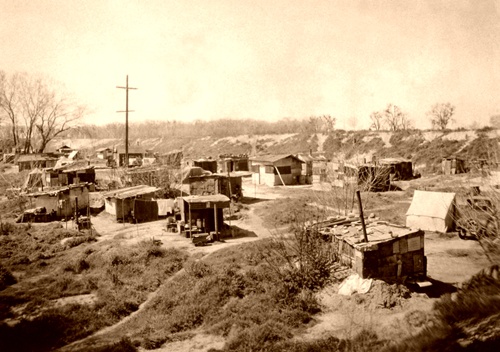
79.
The Great Depression that began in 1929 hit farmers especially hard. Farmers had not been doing well in the 1920s and several years of severe drought turned the land into a "dust bowl." What was an immediate result of this?
a)
Many farmers decided to grow crops that did not use as much water. 
b)
The government built large dams in the West for irrigation. 
c)
Many farmers and their families lost their farms and moved west. 
d)
The government helped farmers by buying their land and equipment. 
80.
Which of the following was a major cause of the Great Depression?
a)
overproduction and underconsumption
b)
a decrease in the supply of consumer goods
c)
an increase in demand for imported products
d)
an increase in the price of wheat on the world market
81.
Who was the President of the United States when the Stock Market crashed?
a)
Franklin D. Roosevelt
b)
Herbert Hoover
c)
Woodrow Wilson
d)
Theodore Roosevelt
82.
How did "bank runs" impact the American people during the Great Depression?
a)
Banks eventually ran out of money to loan, and people's life savings were gone.
b)
Banks made loans throughout the Great Depression, helping people pays bills until they could find work.
c)
Banks were able to people's deposits safe, but they could not loan out any more money.
d)
Banks were not at all involved in the Great Depression because people did not use them.
83.
What was the main reason for the emergence of “Hoovervilles” like the one shown in the photograph?
a)
Many Americans had lost jobs during the Great Depression.
b)
Thousands of homes had been destroyed by the effects of the Dust Bowl.
c)
Housing projects could not keep up with the demand for homes needed by the poor.
d)
Preparations for World War I had created a shortage of building materials.
84.
During the early 1930s, the main goal of the Bonus Army was to pressure the Hoover administration to
a)
strengthen the nation’s defenses
b)
end the military draft
c)
bring American troops home from overseas
d)
support the early payment of money promised to veterans
85.
During the 1930s, poor land management and severe drought conditions across parts of the Midwest resulted in the
a)
formation of the United States Department of Agriculture
b)
creation of wheat surpluses
c)
growth of the Populist movement
d)
development of Dust Bowl conditions on the Great Plains
86.
Which of these statements is true of the 1932 presidential election?
a)
Franklin Roosevelt won in a landslide.
b)
Hoover lost by a narrow margin.
c)
Huey Long ran a strong third-party campaign.
d)
Roosevelt won a third term.
87.
A major difference between the philosophies of President Herbert Hoover and President Franklin D. Roosevelt in responding to the Great Depression is that Roosevelt
a)
wanted to rely on private charities to provide assistance
b)
stressed the need for individual rugged individualism
c)
supported direct relief to people out of work
d)
thought the government should not be involved in economic reform
88.
FDR addressed the American public in weekly broadcasts known as:
a)
FDR Hour
b)
Hangin' With Franklin
c)
Fireside Chats
d)
Around the Fire
89.
As part of the New Deal, the Securities and Exchange Commission (SEC) and the Federal Deposit Insurance Corporation (FDIC) were created to
a)
allow for a quick recovery of stock prices
b)
provide direct loans to businesses
c)
protect individual investors from stock fraud and bank failure
d)
allow banks and companies to invest in the stock market
90.
The Civilian Conservation Corps (CCC) and the Works Progress Administration (WPA) were both New Deal programs developed to address the problem of
a)
excessive stock market speculation
b)
high unemployment
c)
increased use of credit
d)
limited income of senior citizens
91.
The TVA is significant because it hired people to 
a)
deliver food to the poverty-stricken Dust Bowl residents
b)
build dams and generators that provided electricity
c)
work on farms to help stabilize agriculture
d)
publish important facts about businesses
92.
An advocate of President Franklin D. Roosevelt’s farm policy would have likely supported which economic strategy?
a)
Reducing agricultural output to increase product values
b)
Utilizing minimum wage laws to stimulate farm productivity
c)
Allowing market forces to operate freely to achieve stabilization
d)
Increasing agricultural production to ensure an affordable food supply
93.
How would an African American during the Great Depression most likely have felt about the New Deal?
a)
Disappointed, because the TVA failed to bring power to African American farmers in its Rural Electrification Program.
b)
Outraged, because African Americans were ineligible for any benefits under New Deal programs.
c)
Frustrated, because the CCC and other work programs discriminated against African Americans.
d)
Angry, because President Franklin D. Roosevelt did not attempt to restrain his racially insensitive views.
94.
The Fair Labor Standards Act of addressed what labor issue?
a)
Workplace safety
b)
Health insurance
c)
Collective bargaining
d)
Minimum wage
95.
A major reason that President Franklin D. Roosevelt proposed adding Justices to the Supreme Court in 1937 was to
a)
make the Court processes more democratic
b)
end corruption and favoritism in handling cases
c)
influence Court decisions related to New Deal programs
d)
ensure the appointment of members of minority groups
96.
Senator Huey Long, Dr. Francis Townsend, and Father Charles Coughlin are best known as
a)
members of President Franklin D. Roosevelt’s cabinet
b)
outspoken critics of President Franklin D. Roosevelt’s New Deal
c)
supporters of President Franklin D. Roosevelt’s reelection campaign in 1940
d)
members of the Supreme Court nominated by President Franklin D. Roosevelt
97.
Passage of the Social Security Act (1935) helped American workers by 
a)
creating jobs for the unemployed
b)
guaranteeing a minimum wage
c)
legalizing the right to join labor unions
d)
providing financial assistance after retirement
98.
A major result of the New Deal was that it
a)
eliminated poverty in the US
b)
extended the merit system in the civil service
c)
destroyed the private enterprise system
d)
greatly increased the size and power of the Federal Government
99.
How is the Dust Bowl and the Great Depression related?
a)
Both events caused Americans to struggle financially
b)
Both events caused riots throughout the nation
c)
Both events led to World War II beginning 
100.
What was the effect of the Dust Bowl?
a)
New farming techniques were used to prevent erosion
b)
Many Americans moved to east Texas for proper soil
c)
The New Deal restricted farmers from buying future stocks
101.
What happened to the price of crops in 1932?
a)
The price fell very low to  where farmers decided to burn their own crops
b)
They were raised due to the demand of crops
c)
Price would vary depending on the supply given during the season
102.
The Dust Bowl took place in the
a)
Pacific Northwest
b)
Northeast
c)
Southern Great Plains
d)
Mid-Atlantic States
103.
Prohibition was implemented by passage of the
a)
17th Amendment
b)
18th Amendment
c)
19th Amendment
d)
21st Amendment
104.
The group most credited with pushing prohibition was
a)
The KKK
b)
African Americans
c)
Women
d)
Business Owners
105.
When WWI started, what was the wealth gap between the rich and poor like in the United States?
a)
It was very small gap between the rich and the poor.
b)
Wealth in American society was basically equal among all citizens.
c)
There was a large gap between the rich and the poor.
d)
None of the above.
106.
Who were the Palmer Raids meant to find and root out?
a)
Anarchists
b)
Communists
c)
Socialists
d)
All of the above
107.
What did opponents of A. Mitchell Palmer say he was doing?
a)
Weeding out groups who were attempting to take down the United States.
b)
Taking down anybody who was a supporter of Woodrow Wilson.
c)
Protecting people's freedom of speech.
d)
Taking away people's freedom of speech during and directly after WWI.
108.
The Scopes Monkey Trial of 1925 had to do with teaching of Fundamentalism and ______.
a)
school
b)
Evolution
c)
life
d)
religion
109.
After 1921, cheap labor workers decreased in America.  What was the reason for the lack of immigrants? (Red Scare)
a)
Less people wanted to come to the United States
b)
Immigrants were not looking for jobs.
c)
Most of the immigrants were already working.
d)
Adoption of stricter immigration quotas
110.
The Red Scare led to which of the following?
a)
The ratification of the 19th amendment
b)
a demand for limits on immigration
c)
the start of the Great Depression
d)
the repeal of the 18th amendment 
111.
Nativists are against _______?
a)
Corruption
b)
African Americans
c)
Railroads
d)
Immigrants
112.
What was the main reason the KKK revived?
a)
WWI veterans had to compete with immigrants for jobs
b)
Sacco + Vanzetti case outrage
c)
Many "New Immigrants" arrived before immigration laws
d)
Bible Belt humiliated by Monkey Trial 
113.
What was the Harlem Renaissance?
a)
A time when businesses in Harlem were booming.
b)
A neighborhood in New York
c)
A time when African-Americans in New York began to change views by writing books, playing music, and playing sports
d)
Babe Ruth's nickname
