wayground logo

Free Printable Worksheets

Font size

S
M
L
XL
Worksheets

Unit 12 Review

Total questions: 63

Worksheet time: 1hrs 3mins
Name
Class
Date
1.
The kind of heat transfer that travels through space in electromagnetic waves is ______________________.
a)
insulation.
b)
Radiation
c)
Conduction
d)
Convection
2.
In heat transfer, heat always flows from the _______________ substance to the _______________ substance.
a)
Hotter to colder
b)
Colder to hotter
c)
Hotter to hotter
d)
Colder to colder
3.
The type of heat transfer that happens through direct contact of molecules or particles with each other is ___________________.
a)
Convection
b)
Conduction
c)
Radiation
d)
insulation.
4.
___________________ is the type of heat transfer that occurs in fluids, such as warm air rising and cold air sinking; creating wind.
a)
Convection
b)
Conduction
c)
Radiation
d)
insulation.
5.
Which statement is true?
a)
The quicker a molecule moves, the colder it is.
b)
The slower a molecule moves, the warmer it is.
c)
The quicker a molecule moves, the warmer it is
d)
The movement on molecule don�t affect its temperature
6.
Two objects at different temperatures are in contact. Which of the following happens to their thermal energy?
a)
Their thermal energies remain the same.
b)
Thermal energy passes from the cooler object to the warmer object
c)
Thermal energy passes from the warmer object to the cooler object.
d)
Thermal energy passes back and forth equally between the two objects.
7.
Heat from warm sand at the beach moves through the atmosphere by what method of heat transfer?
a)
Convection
b)
Conduction
c)
Radiation
d)
insulation.
8.
Marcie played with her friends out in the cold, cloudy weather, wearing her wool hat. After the group had finished building snowmen and having snowball fights, Marcie went back inside to warm up and drink some hot chocolate. When she took her hat off, she realized that it was very warm. What happened?
a)
The radiant energy from the sun warmed up her hat and the hat kept that heat from the sun.
b)
�� Her hat was warm because wool fabric is warmer than other fabrics.
c)
The humidity outside made her hat warm.
d)
Conduction between Marcie�s warm body and the hat occurred and the hat remained warm because it is an insulator.
9.
Students in a science class performed an experiment with hot and cold water. They dyed the hot water red and the cold water blue. When the students layered the water, they noticed that the hot water rose to the top and the cold water sank. What was this demonstrating?
a)
Radiation
b)
Air Pressure
c)
Evaporation
d)
Density
10.
When you use a microwave, what is the main way that heat is transferred?
a)
Convection
b)
Conduction
c)
Radiation
d)
insulation.
11.
The handle of a metal spoon warms up when it is placed in a hot bowl of soup because of
a)
Convection
b)
Conduction
c)
Radiation
d)
insulation.
12.
Which of the following is NOT a conductor?
a)
oven mitt
b)
curling iron
c)
iron skillet
d)
copper pipe
13.
A large house being heated by heater warms a house when the air is circulating.
a)
Convection
b)
Conduction
c)
Radiation
d)
insulation.
14.
Which of the following is the best example of conduction?
a)
A light bulb warming a lampshade
b)
An egg cooking in a frying pan
c)
Water boiling in a pot
d)
Gases circulating in the atmosphere
15.
Which statement is true about radiation?
a)
Radiation is the transfer of heat through electromagnetic waves
b)
Radiation is the transfer of heat through direct contact.
c)
Radiation is more dangerous than conduction.
d)
Radiation is the transfer of heat through liquids and gases
16.
Which situation best represents convection?
a)
Heat from a campfire
b)
A hot air balloon taking off
c)
Touching a hot piece of metal
d)
Getting sunburned
17.
Which situation best represents conduction?
a)
Heat from a campfire
b)
A hot air balloon taking off
c)
Touching a hot piece of metal
d)
Getting sunburned
18.
How much energy radiated by the sun reaches Earth?
a)
about 80%
b)
about two-billionths
c)
about 50%
d)
about one one-hundredth
19.
The process by which gases in the atmosphere absorb thermal energy and radiate it back to earth is called
a)
the thermal effect.
b)
the greenhouse effect.
c)
global warming.
d)
radiation balance
20.
When the amount of energy received from the sun and the amount of energy returned to space are about equal, it is called
a)
radiation balance
b)
seasonal equality.
c)
solar reradiation.
d)
global warming.
21.
The handle of a frying pan is often coated in rubber because rubber provides...
a)
Heat insulation
b)
Heat conduction
c)
A low melting point
d)
A nonstick surface
22.
Is iron a conductor or insulator?
a)
Conductor
b)
Insulator
23.
Which of the following is NOT an insulator?
a)
Wool
b)
Plastic
c)
Copper
d)
Styrofoam
24.
Is wood a conductor or insulator?
a)
Conductor
b)
Insulator
25.
What is NOT an example of an insulator in the kitchen?
a)
An oven mitt
b)
Pots and pans
c)
A wooden spoon
d)
A plastic measuring cup
26.
A great conductor of energy is:
a)
wood
b)
plastic
c)
metal
d)
cloth
27.
Conductors are materials that...
a)
Allow heat to pass through
b)
Stop heat from passing through
c)
Allow cold to pass through
d)
Stop cold from passing through
28.
All of the following are conductors except _______.
a)
metal spoon
b)
wire
c)
iron nail
d)
plastic spoon
29.
Gloves help keep your hands warm in winter because:
a)
They are conductors of heat.
b)
They are fuzzy.
c)
They are conductors of electrical energy.
d)
They are insulators.
30.
An object that doesn't conduct heat well is known as:
a)
a conductor
b)
an insulator
31.
Thermal energy travels...
a)
Hot to cold
b)
Cold to hot
c)
Inside to outside
d)
Outside to inside
32.

Convection can occur in...

a)

Liquids

b)

Solids

c)

Gases

d)

All of the above

33.

The particles in liquids and gases move .......... when heated.

a)

Faster

b)

Slower

c)

Closer together

d)

Less

34.

When particles of a liquid are heated they become

a)

More Dense

b)

Less Dense

c)

Stay the same Density

d)

I Dont Know

35.

When particles of a liquid cool they become

a)

More dense

b)

Less dense

c)

Density is unchanged

d)

I Don't Know

36.

Convection currents can be seen in lava lamps.

a)

True

b)

False

37.

Convection explains why hot air balloons rise

a)

True

b)

False

c)

I Don't Know

38.

Convection can not take place in...

a)

Liquids

b)

Solids

c)

Gases

d)

Water

39.

In solids the movement of heat energy happens through

a)

Convection

b)

Conduction

c)

Radiation

d)

All of the above

40.

Convection currents are often known as

a)

Conduction loops

b)

Convection loops

c)

Convection circles

d)

Convection spirals

41.

Heat energy is transferred through the air via...

a)

Convection

b)

Conduction

c)

Radiation

d)

All of the above

42.
How many kinds of heat transfer are there?
a)
1
b)
2
c)
3
d)
4 or more
43.
In heat transfer, heat always flows from the _______________ substance to the _______________ substance.
a)
Hotter to colder
b)
Colder to hotter
c)
Hotter to hotter
d)
Colder to colder
44.
The type of heat transfer that happens through direct contact of molecules or particles with each other is ___________________.
a)
Convection
b)
Conduction
c)
Radiation
d)
insulation.
45.
The kind of heat transfer that travels through space in electromagnetic waves is ______________________.
a)
insulation.
b)
Radiation
c)
Conduction
d)
Convection
46.
___________________ is the type of heat transfer that occurs in fluids, such as warm air rising and cold air sinking; creating wind.
a)
Convection
b)
Conduction
c)
Radiation
d)
insulation.
47.
Which statement is true?
a)
The quicker a molecule moves, the colder it is.
b)
The slower a molecule moves, the warmer it is.
c)
The quicker a molecule moves, the warmer it is
d)
The movement on molecule don�t affect its temperature
48.
When you use a microwave, what is the main way that heat is transferred?
a)
Convection
b)
Conduction
c)
Radiation
d)
insulation.
49.
The handle of a metal spoon warms up when it is placed in a hot bowl of soup because of
a)
Convection
b)
Conduction
c)
Radiation
d)
insulation.
50.
Which of the following is the best example of conduction?
a)
A light bulb warming a lampshade
b)
An egg cooking in a frying pan
c)
Water boiling in a pot
d)
Gases circulating in the atmosphere
51.
What kind of heat transfer happens when the sun is heating your body?
a)
Conduction
b)
Radiation
c)
Convection
d)
Density
52.
Which of the following is an example of convection?
a)
A hair dryer is drying up your hair.
b)
When the AC or heater changes the temperature.
c)
When a car engine turns hot after being turned on.
d)
When you are making soup and the water is rising and lowering.
53.
Warm air rises and the cool air sinks demonstrates this type of heat transfer. 
a)
conduction
b)
convection
c)
radiation
d)
Insolation 
54.
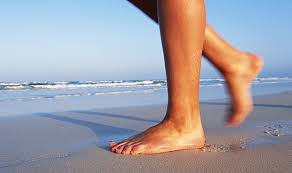
Walking on the warm sand sand with your bare feet demonstrates this type of heat transfer. 
a)
conduction
b)
convection
c)
radiation
55.
Ironing a shirt is an example of...
a)
condensation
b)
conduction
c)
convection
d)
radiation
56.
A group of friends gather around a fire to stay warm.
a)
conduction
b)
convection
c)
radiation
57.
You get sunburned due to __________ from the sun.
a)
conduction
b)
convection
c)
radiation
58.
A toaster toasting bread is an example of 
a)
condensation
b)
conductio
c)
convection
d)
radiation
59.
The candle will slowly heat the metal and transfer the heat directly to the mans hand.
a)
conduction
b)
convection
c)
radiation
60.
A chair is placed several feet from a fireplace.  The fireplace has a glass screen.  The side of the chair facing the fireplace gets warm because of 
a)
conduction
b)
convection
c)
radiation
61.
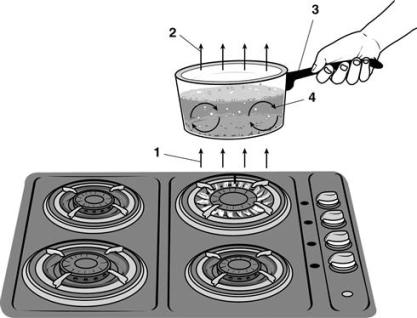
Which numbered part of the picture represents the way that energy from the sun reaches Earth?
a)
1
b)
2
c)
3
d)
4
62.
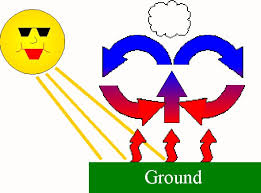
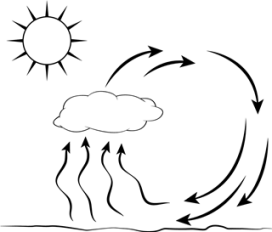
What causes the circulation of air in the atmosphere?
a)
Air in the atmosphere is heated by the sun and sinks to the ground.
b)
The ground is heated by the sun and then heats the air, causing the air to rise.
c)
Air loses heat to the ground and then rises upward to obtain more energy.
d)
The sun heats the clouds which forces the cooler air to move away and sink.
63.
A crayon placed on a dark driveway in bright sunlight melted into a colorful puddle. What caused the crayon to melt?
a)
Solar radiation heated the driveway and then heat transferred to the crayon by conduction.
b)
Solar radiation heated the driveway and then heat transferred to the crayon by radiation.
c)
Solar convection heated the driveway and then heat transferred to the crayon by radiation.
d)
Solar convection heated the driveway and then heat transferred to the crayon by conduction.