
 Worksheets
Bio Revision Sem 2 Set 2
Total questions: 40
Worksheet time: 40mins
What phyla contains animals that have exoskeletons, a brain, jointed appendages and earthworms
Invertebrates
Mollusca
Anthropoda
Annelida

State the class for the organism shown above.
Anthozoa
Hydrozoa
Scyphozoa
Rhizopora
Cell wall of plant cell is composed of cellulose but cell wall of Fungi is composed
cellulose
peptidoglycan
polysaccharides and protein
chitin

Name the phylum of fungi based on the spore bearing structure from these picture.
Ascomycite
Ascomyceta
Ascomycota
Ascomycito

Taenia sp. is example for phylum .....
Nematoda
Annelida
Platyhelminthes
Echinodermata

What type of symmetry is shown in the image?
asymmetry
bilateral
radial
none of these
Which term describes an organism found at the bottom of the food chain?
consumer
predator
decomposer
producer
What are the lake zonation based on light penetration?
Littoral Zone
Photic Zone
Basal Zone
Limnetic Zone

Which type of population growth occurs under ideal conditions with unlimited resources?
Economic Growth
Exponential Growth
Logistic Growth
Linear Growth

Which is the statement below describe the image above?
hybrid breakdown
convergent evolution.
adaptive radiation.
allopatric speciation

How do enzymes speed up chemical reaction?
Increasing activation energy
Decreasing activation energy
Increasing deactivation energy
Decreasing deactivation energy
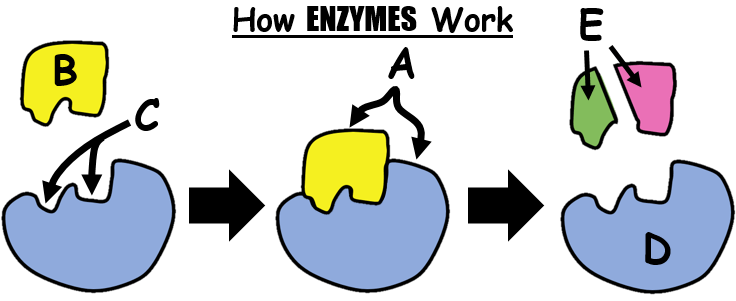
Based on the diagram, name structure B.
active site
enzyme
substrate
products
How many FADH2 molecules are produced by 1 molecule of glucose?
1
2
3
4

The enzyme responsible for carbon fixation in C3 photosynthesis is
RuBisCo
PEP Carboxylase
Hexokinase
Pyruvate Dehydrogenase

The main advantage of C4 carbon fixation is the ability to avoid.....
Transpiration
Photorespiration
Photosynthesis
Signal Transduction
Most of the carbon dioxide produced by the body tissue is transported to the lungs in the form of …
Carbonic acid.
Blood plasma.
Bicarbonate ion.
Carbaminohaemoglobin.
When chemoreceptors detect a slight decrease in pH, this means that _______________ concentrations have increased, and the breathing rate must ________________ .
Carbon dioxide; increase.
Carbon dioxide; decrease.
Oxygen; increase.
Oxygen; decrease.
Which of the following is a result of transpiration?
Bacteria and viruses are destroyed.
Water flows from roots to shoots.
Minerals and nutrients leave plants.
Plants attract pollinators.
During ventricular systole
only the AV valves open
the semi lunar valves open and the AV valves close
only the semi lunar valves close
the semi lunar valves close and the AV valves open
Apoplast pathway is located
Outside the plasma membrane
In the entire cytosol
On both sides of plasma membrane
In the plasticity content
Which of the following concept explained the process of translocation?
Transpirational pull
Pressure flow hypothesis
Root pressure
Cohesion and adhesion
Negative Feedback
a deviation from the norm brings the body back to homeostasis
a regulatory substance transported in the blood to target cells
a deviation from the norm is enhanced until an event occurs
a chemical substance released by nerves

The long dip in the renal tubule, that looks like a hairpin turn, is called the:
loop of Henle
loop of Rachic
loop of Henry
loop of Harry
The blood in the vena cava is...
oxygenated, returning to the heart
deoxygenated, returning to the heart
oxygenated, leaving the heart
deoxygenated, leaving the heart
Special lymphatic vessels that absorb fats and transport them from the digestive tract to the blood are called ____.
peyer"s patch
vili
trabeculae
lacteals
Filtration occurs in which area of the nephron?
Glomerulus/Bowman's capsule
Proximal convulated tubule
Loop of Henle
Collecting duct

What number on the graph represents the depolarization phase?
1
2
3
4
A junction at which a neuron meets another cell
axon
dendrites
myelin sheath
synapse

Part A of the sarcomere refers to...........
Z Line
M Line
H Line
A Line
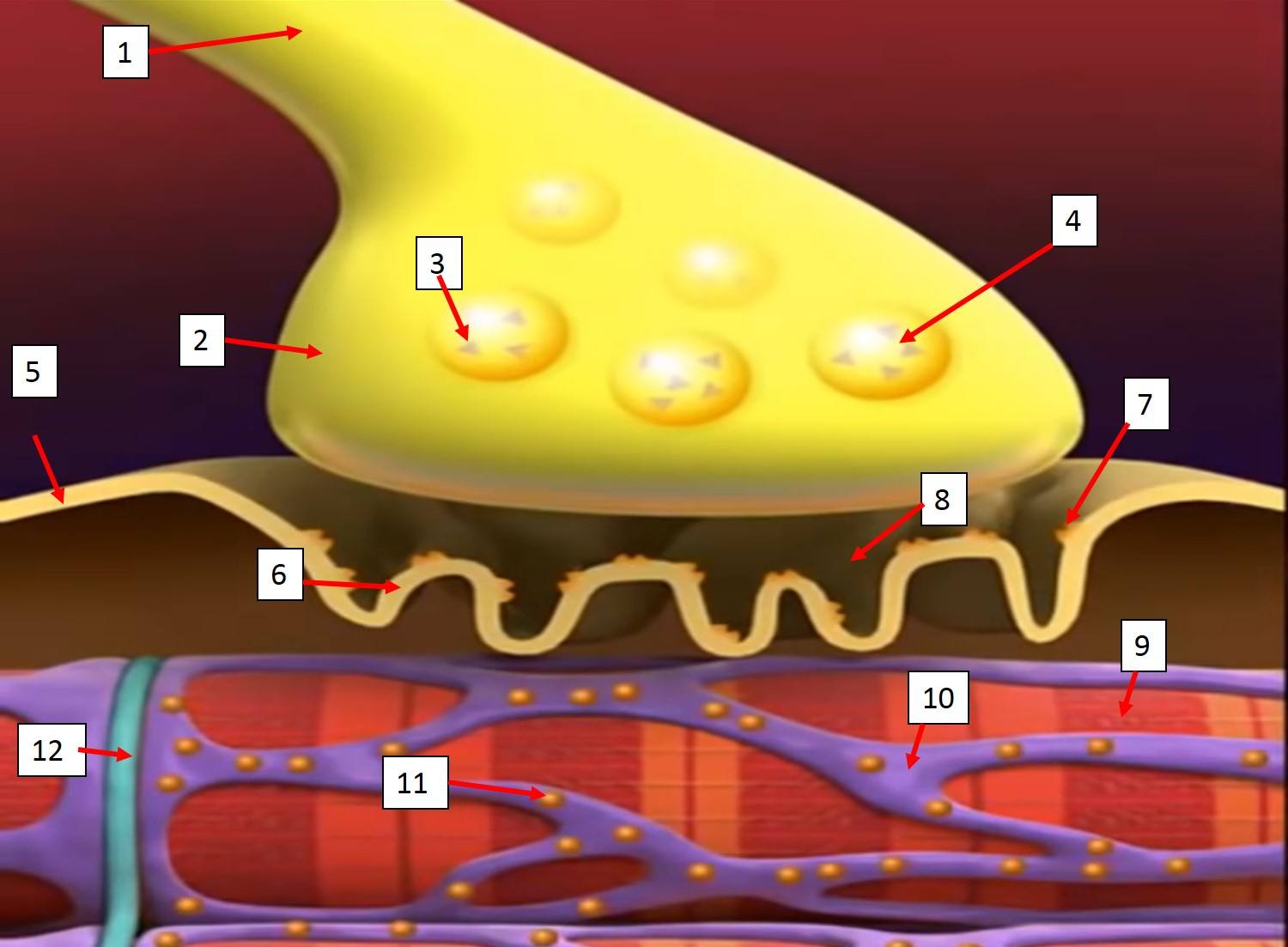
The neurotransmitter stored in the axon terminal identified as shown in the diagram is........
Acetylcholine
Dopamine
Calcium Ion (Ca2+)
Syaptic Cleft
Which cells produce antibodies?
Helper T cells
Cytotoxic T cells
Memory cells
Plasma cells
Which of the following are associated with the cell-mediated response?
B cells
Plasma cells
Antibodies
Cytotoxic T cells

