
 Worksheets
7th grade Science Review
Total questions: 45
Worksheet time: 46mins
Name
Class
Date
1.
The place where an organism lives is its __________.
a)
habitat
b)
ecosystem
c)
organism
d)
population
2.
A group of organisms of the same species living in the same area are called a/an __________.
a)
community
b)
habitat
c)
population
d)
ecosystem
3.
All of the living AND non-living things in an area that interact with each other are called a/an __________.
a)
community
b)
habitat
c)
population
d)
ecosystem
4.
A group of different species that live together and interact in an environment are called a/an __________.
a)
community
b)
habitat
c)
population
d)
ecosystem
5.
ALL energy flow for an ecosystem begins with ...
a)
plants
b)
the moon
c)
the sun
d)
algae
6.
Which is an example of an ABIOTIC factor?
a)
hummingbird
b)
water
c)
dead tree branch
d)
skunk
7.
Which is an example of a BIOTIC factor?
a)
lightning
b)
algae
c)
sand
d)
clouds
8.
A relationship where both organisms benefit is called __________.
a)
mutualism
b)
commensalism
c)
parasitism
9.
A relationship where one organism benefits and one organism is unaffected is called __________.
a)
mutualism
b)
commensalism
c)
parasitism
10.
A bird hitches a free, safe ride on the back of a grey elephant. The elephant doesn't seem to mind and barely notices the bird. Which type of relationship is this?
a)
mutualism
b)
commensalism
c)
parasitism
11.
Carnivores, herbivores, omnivores, and scavengers are all examples of __________.
a)
producers
b)
consumers
c)
decomposers
d)
abiotic factors
12.
Which statement is a part of the cell theory?
a)
all cells come from preexisting cells
b)
bacteria are prokaryotic cells
c)
eukaryotic cells are complex
d)
humans are multicellular
13.
Who looked at cork and named the cell?
a)
Robert Hooke
b)
Van Leeuwenhoek
c)
Robert Brown
d)
Francesco Redi
14.
"All animals are made of cells". This fact was discovered by...
a)
Matthias Schleiden
b)
Theodor Schwann
c)
Robert Hooke
d)
Rudolf Virchow
15.
All plants are made of cells. This was discovered by....
a)
Matthias Schleiden
b)
Rudolf Virchow
c)
Robert Hooke
d)
Aristotle
16.
Rocks are not living because
a)
they never move
b)
they aren't needed for humans
c)
they are not made of cells
d)
they don't break down
17.

Who was the "scientist" who observed pond water and teeth scrapings in his microscope?
a)
Hooke
b)
Leeuwenhoek
c)
Schleidian
d)
Virchow
18.
Which of the following is the smallest unit of life that can carry out all life functions?
a)
the mitochondria
b)
the vacuoles
c)
the nucleus
d)
the cell
19.
Which structures are found in every living cell?
a)
cell membrane and cytoplasm
b)
chloroplasts and mitochondria
c)
a cell wall and nucleus
d)
chloroplasts and cell wall
20.
All cells need energy to function. Which cell organelle is responsible for producing energy in the cell?
a)
chloroplasts
b)
mitochondria
c)
nucleus
d)
vacuoles
21.
The passing of traits from parent to offspring
a)
Heredity
b)
Genetics
c)
Hybrid
d)
Probability
22.
Who was the father of genetics
a)
Sagan
b)
Issac Newton
c)
Gregor Mendel
d)
C.jenkins
23.
The study of heredity and the variation of inherited characteristics
a)
gene
b)
genetics
c)
meiosis
d)
hybrid
24.
Which is homozygous ?
a)
Zz
b)
SS
25.
which is heterozygous ?
a)
Tt
b)
TT
26.
Which is an example of a learned behavior?
a)
blinking
b)
riding a bike
c)
swallowing
d)
crying
27.
What is NOT an example of an inherited TRAIT?
a)
eye color
b)
tongue rolling
c)
height
d)
speaking a language
28.

What are the organisms that break down dead stuff?
a)
Producers
b)
Consumers
c)
Decomposers
d)
Organisms
29.

Which type of consumer is always a first consumer?
a)
Herbivore
b)
Omnivore
c)
Carnivore
d)
Producer
30.

Which type of consumer could be a first or second consumer?
a)
Herbivore
b)
Omnivore
c)
Carnivore
d)
Producer
31.

True/False
Food webs show you everything an animal eats. Food chains show you one thing.
Food webs show you everything an animal eats. Food chains show you one thing.
a)
True
b)
False
32.
Which answer best describes the transfer of energy as it moves up the energy pyramid?
a)
Energy gets larger as you go up the pyramid.
b)
Energy gets smaller as you go up the pyramid.
c)
Energy stays the same as you go up the pyramid.
d)
What is energy?
33.
What is another word for producer?
a)
Heterotroph
b)
Autotroph
34.
What is another word for consumers?
a)
Heterotroph
b)
Autotroph
35.
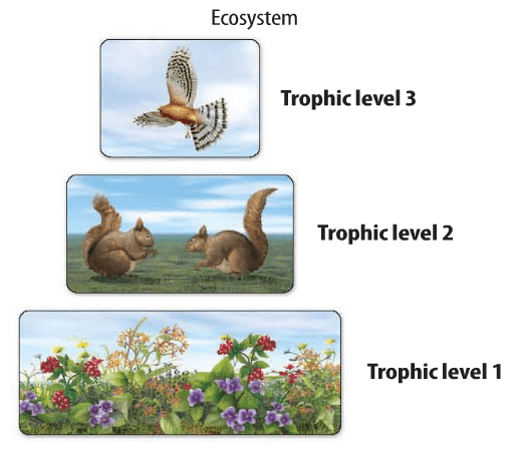
Position that an organism occupies based on what it eats
a)
biomass
b)
autotroph
c)
trophic level
d)
carnivore
36.
Which example is a hypothesis written in the correct format?
a)
How do pulleys make work easier?
b)
I predict that light travels in a straight line.
c)
If a needle floats on water, then it will work like a compass.
d)
The ice will melt the fastest on the cotton ball.
37.
A student's science fair project tested which brand of microwave popcorn had the fewest unpopped kernels. Which is the independent variable?
a)
The cooking time of the popcorn
b)
The microwave that was used
c)
The brand of popcorn
d)
The size of the bag of popcorn
38.
Students want to learn which of two soils holds more water. They put clay in one bottle and sand in the other. Then they put equal amounts of water in the bottles. Some of the water drained into beakers. Which of these is the manipulated, independent variable?
a)
Amount of water
b)
Type of soil
c)
Type of beaker
d)
Number of bottles
39.
A boy did an experiment to see how to get his dog to come to him in the happiest way. He called him, clapped his hands, snapped his fingers, and offered treats. He compared how the dog reacted in each situation. What was the dependent variable?
a)
Dog's reaction
b)
Times the dog was called
c)
Number of treats
d)
Ways to call the dog
40.

A student counted the number of Canada geese that have lived on a pond for the past five years. Based on the graph, how many geese will probably live on the pond in year 6?
a)
75
b)
65
c)
70
d)
60
41.
Which variable do "I" change intentionally?
a)
Independent variable
b)
Dependent variable
c)
Constant
42.
Which variable may change and probably will change in the experiment, but "I" don't change it?
a)
Independent variable
b)
Dependent variable
c)
Constant
43.
A statement that uses "If"....."then" is called a -
a)
observation
b)
conclusion
c)
prediction
d)
hypothesis
44.
When experimenting with the growth of a plant, a scientist uses three (of the same type of) plants, two different fertilizers, equal light, and equal water. The fact that we kept the light, plant, and water the same in each experiment are examples of ____________.
a)
an dependent variable
b)
an independent variable
c)
a control
d)
constants
45.
What axis is the independent variable used on?
a)
Y axis
b)
quadrant 1
c)
quadrant 2
d)
X axis
100 %

