
 Worksheets
AP Micro: Perfect Competition
Total questions: 52
Worksheet time: 30mins


Perfect competition is best described as a market with
few firms producing essentially the same product
many firms producing essentially the same product
many firms producing very different products
few firms producing very different products
Which is not a requirement for a market to have perfect competition?
Diverse buyers and sellers participate in a market
Sellers offer the same products
Sellers can freely enter and exit the market
Consumers and producers are informed about products
A factor that makes it difficult for firms to enter a market is called...
a barrier to entry
an obstacle to entry
a block to entry
an impediment to entry
Perfect competition pushes firms to
maximum sales
take over other firms
maximum possible output
efficiency
Which of the following is NOT a characteristic of a perfectly competitive market?
Free entry and exit
Numerous sellers
Perfect information
No substitutes


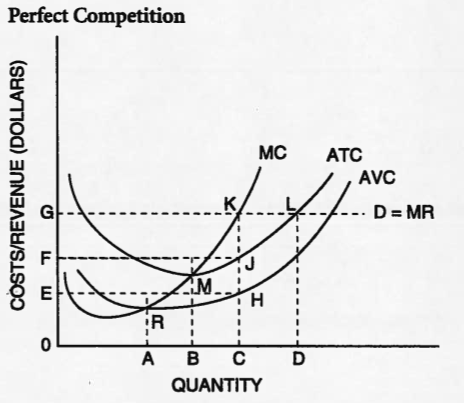
The image above shows a firm making
Economic Profit
Economic loss
Breaking even
Shutting down

Should the following firm shutdown?
Yes
No
Not enough information present


Perfect competition means
every firm will make a loss in the long run
profit are perfectly competitive
abnormal profit will continue until the industry reaches closure
supernormal profit are competed away
Productive efficiency is about
ensuring the cost of production are as low as they can be
using the most up-to-date technological method
making as much profit as possible
All of the above
None of the above
The price charged by a perfectly competitive firm is
higher the more the firm produces.
lower the more the firm produces.
the same as the market price.
indeterminate.
different than the price charged by competing firms.

MR DARP stands for
marginal revenue
demand
average revenue
price
all of the above

If the corn industry is perfectly competitive and the market price for corn is $3 per bushel. How many bushels will Farmer Kardashian sell at $3.50 per bushel?
more than she would at a price of $3 per bushel
some, but fewer than she would at $3 per bushel
just as many as she would at $3 per bushel
none
more info is needed about the prices of other farmers

The Rock is making candles in a perfectly competitive market. When he produces 500 candles, his total cost is $250. If he produces one more candle, his total cost rises to $260. In order to maximize profit, he should produce the additional candle
only if the market price exceeds $250 for a candle.
if the market price for a candle is $12.
only if the market price exceeds $260 for a candle.
if the market price for a candle exceeds $0.50.
if his price exceeds his ATC.
In the long run firms produce at the output level that has the minimum.
average variable cost.
average total cost.
average fixed cost.
marginal cost.
total revenue.

At price $5, the firm is operating in
long run equilibrium at break even.
short run equilibrium with an economic loss.
long run equilibrium with an economic loss.
short run equilibrium with an economic profit.
short run equilibrium at break even.

At a price of $4, this firm will produce _____ items in the ____ run.
8; long
9; short
9; long
11; short
8; short

At a price of $2, below the AVC, this firm will produce ____ items.
8
9
11
0
need more information.

This firm is experiencing
economic loss.
economic profit.
normal profit.
accounting profit.
break-even profit.

This single farmer is experiencing
economic loss.
economic profit.
break-even.
normal profit.
long run equilibrium.

This single farmer is experiencing
economic loss.
economic profit.
break-even.
normal profit.
long run equilibrium.
In the long run we would expect firms to _______ the industry and the market price to _______
leave; rise
leave; fall
enter; rise
enter; fall
enter; remain the same.
In the long run we would expect firms to _____ the market and the market price to ______.
enter; rise
enter; fall
leave; rise
leave; fall
profit from the market; remain the same.

