
 Worksheets
Evolution
Total questions: 20
Worksheet time: 17mins
Name
Class
Date
1.
Which of the following is a fossil?
a)
a plant that has recently died
b)
a group of organisms that can reproduce
c)
a structure or organ that no longer functions
d)
a trace of an organisms that existed in the past
2.
In natural selection, the selective agent is the
a)
humans
b)
mutations
c)
breeders
d)
environment
3.

what did Charles Darwin observe in finch populations of the Galapagos Islands off the coast of South America?
a)
different species on different islands
b)
all species on one of the islands
c)
identical species on all the islands
d)
the same species as North America
4.
Mutations are important because they bring about
a)
death of the organism in which they develop
b)
genetic variation needed for a population to evolve
c)
benefits for the individual, not for the population
d)
Hardey-Weinberg equilibrium within a population
5.
What is the term for a feature that allows an organism to survive better in its environemtn?
a)
variation
b)
adaptation
c)
homologous structure
d)
vestigial structure
6.

The Physical remains of a plant or animal preserved in rock or Earth's crust.
a)
Adapt
b)
Fossil
7.
Who is the father of evolution?
a)
Darwin
b)
Mendel
c)
Newton
d)
Einstein
8.

When an organism is completely wiped out of existence, we call it?
a)
extinction
b)
adaptation
c)
evolution
d)
inbreeding
9.
What are the evidences for Evolution?
a)
Fossil Records
b)
Embryology
c)
Similar body structure
d)
All the above
10.
Evolution is a
a)
law
b)
theory
c)
hypothesis
d)
conclusion
11.

Two organisms that are closely related would have
a)
very similar DNA sequence
b)
exactly the same DNA sequences
c)
no proteins in common
d)
completely different DNA sequence
12.

characteristic or trait that helps an organism survive in its environment
a)
skills
b)
speciation
c)
natural instinct
d)
adaptation
13.
A remnant or trace of an organism from the past is called a _______.
a)
Ancestor
b)
Skeleton
c)
Fossil
d)
Imprints
14.

Change over time...
a)
Evolution
b)
Nucleotide
15.

To adjust to a changing environment
a)
Mutation
b)
Adapt
16.

Who was the naturalist that traveled the world to study plants and animals?
a)
Albert Einstein
b)
Charles Darwin
c)
Charles Barkley
d)
Isaac Newton
17.

When an organism completely dies out, it is called.....
a)
Adaption
b)
Extinction
c)
Fossilization
d)
Mutation
18.
Remains of ancient organisms are called
a)
Extinctions
b)
Fossils
c)
Mutations
d)
Variations
19.
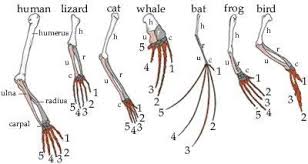
What is this an example of?
a)
vestigial structures
b)
embryology
c)
homologous structures
d)
fossil record
20.
Which term refers to the process by which individuals that are better suited to the environment survive and reproduce therefore passing down their genes to their offspring?
a)
Evolution
b)
Variation
c)
Adaptation
d)
Natural Selection
100 %

