Wayground logo

Free Printable Worksheets

Font size

S
M
L
XL
Worksheets

Phylum Cnidaria

Total questions: 26

Worksheet time: 14mins

Name
Class
Date
1.

Capable of movement

a)

Motile

b)

Medusa

c)

Diffusion

d)

Nerve Net

2.

Symmetry about a central axis

a)

Chemoreceptors

b)

Bilateral symmetry

c)

Asymmetry

d)

Radial symmetry

3.

In cnidarians, a stinging cell that is used to inject a toxin into prey

a)

Nematocyst

b)

Symbiosis

c)

Statocysts

d)

Neurotoxin

4.

A cnidarian body plan characterized by a bowl shape and adapted for a free-swimming life.

a)

Symbiosis

b)

Monoecious

c)

Medusa

d)

Nematocyst

5.

What is the ciliated, free swimming larvae that may metamorph into a polyp?

a)

larva

b)

planula

c)

parenchymula

d)

ephyra

6.
Which of the following is a correct description of the polyp body form?
a)
It is sessile and the tentacles and mouth point downward.
b)
It is sessile and the mouth and tentacles point upward.
c)
It is mobile and the tentacles and mouth point downward.
d)
It is mobile and the tentacles and mouth point upward.
7.
What are the organelles inside the cnidocyte stinging cells that inject paralyzing toxins into their prey?
a)
pinacocytes
b)
lysomatocyts
c)
choanocytes
d)
nematocysts
8.
What surrounds the mouth of Cnidarians?
a)
guard cells
b)
pinococytes
c)
tentacles
d)
spines
9.
A cnidarian gathers it's food by
a)
filtering it through pores
b)
paralyzing it with venom
c)
bringing it into the osculum
d)
killing it with spikes
10.

Cnidocytes

a)

used for digestion

b)

stinging cells of cnidarians

c)

used to propel cnidarians

d)

another word for tentacles

11.

type of reproduction in which cells from two parents unite to form the first cell of a new organism

a)

Zooxanthellae

b)

Chemoreceptors

c)

Asexual Reproduction

d)

Sexual Reproduction

12.
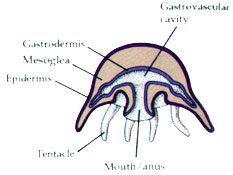
Which body form is represented by this diagram?
a)
Mesoglea
b)
Medusa
c)
Moses
d)
Nematocyst
13.
Polyps are ______, while medusa are ______. 
a)
sessile, motile
b)
motile, sessile
c)
both motile and sessile, just motile
14.
Corals have a mutualistic relationship with a dinoflagellate called:
a)
Ocelli
b)
Zooxanthellae
c)
Sponges
d)
Diatom
15.
All Cnidarians have _____, but no _____.
a)
stinging cells, tissue cells
b)
organs, tissue
c)
tissues, organs
d)
tissue, stinging cells
16.

True or False: Cnidarians do not have a central nervous system.

a)

True

b)

False

17.

How do cnidarians reproduce?

a)

only sexually

b)

only asexually

c)

both sexually and asexually

d)

genetically reproduced in labs

18.

True or False: Cnidarians generally undergo two life stages: a polyp stage and a medusa stage

a)

True

b)

False

19.

What body type does this cnidarian possess?

a)

Polyp

b)

Medusa

20.
When prey touches the “__________” on a cnidarian, the nematocyst ejects the filament with a sharp spine and injects venom.
a)
injector
b)
trigger
c)
spine
d)
prickly
21.
Which Phylum does this animal belong?
a)
Phylum Porifera
b)
Phylum Cnidaria
22.

Which predator of jellies has backwards pointing spines in its throat?

a)

sunfish aka mola-mola

b)

sea turtle

c)

seagull

d)

lobster larvae

23.

An immature, eight-armed, free-swimming medusae formed from a dividing polyp is:

a)

Planula

b)

Ephyrae

c)

Zooid

d)

Schyphae

24.

Which is the largest jellyfish species?

a)

box jelly

b)

sea wasp

c)

lion's mane jelly

d)

Portuguese man'o'war

25.

What species of jellyfish can revert back to its polyp stage, and is considered to be "immortal"?

a)

Tursiops truncatus

b)

Turritopsis dohrnii

c)

Lion's mane jelly

d)

box jelly

26.

If you're stung by a jellyfish, which is NOT a good remedy?

a)

rinse with vinegar

b)

rinse with seawater

c)

urinate on the affected area

d)

seek emergency treatment if difficulty breathing