
 Worksheets
Reaction Rate Review
Total questions: 15
Worksheet time: 27mins
Name
Class
Date
1.
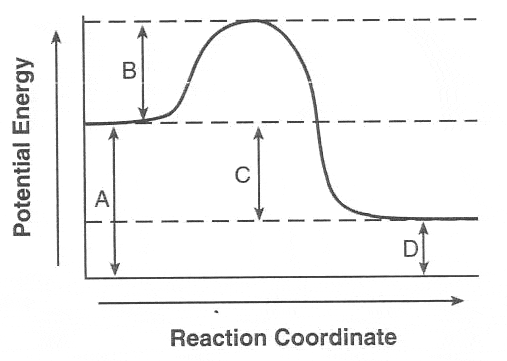
What type of reaction is this?
a)
Endothermic
b)
Exothermic
2.
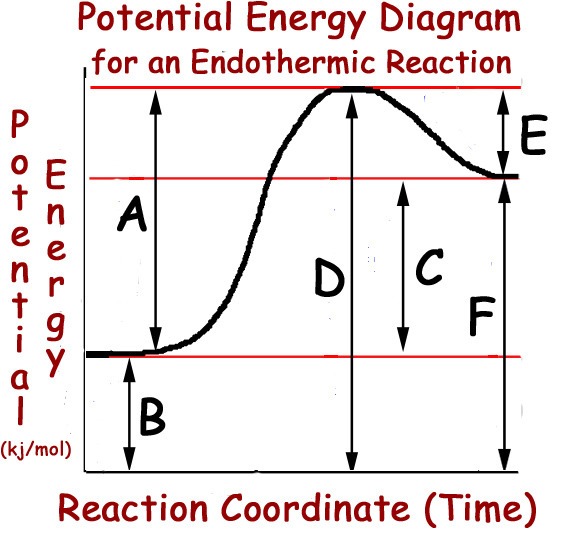
What type of reaction is this?
a)
Endothermic
b)
Exothermic
3.
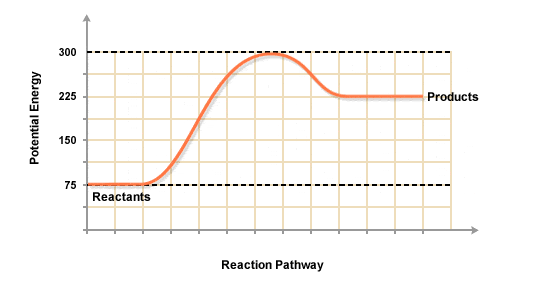
What is the energy of the activated complex?
a)
75 kJ
b)
225 kJ
c)
300 kJ
d)
50 kJ
4.
Grinding a seltzer tablet into powder increases the rate of reaction due to increased
a)
concentration
b)
surface area
c)
temperature
d)
reactants
5.
Which factors increase the rate of a reaction.
a)
increasing temperature
b)
increasing concentration
c)
increasing surface area
d)
all of these
6.
Why does a higher temperature increase the rate of a reaction?
a)
it increases both the frequency and energy of particle collisions
b)
it only increases the frequency of particle collisions
c)
it only increases the energy of particle collisions
d)
it reduces the activation energy of the reaction
7.
Why does a higher concentration increase the rate of reaction?
a)
it increases the amount of reactants
b)
it lowers the activation energy
c)
it increases the energy of particle collisions
d)
it increases the frequency of particle collisions because there are more collision sites
8.
Products will form faster if____________
a)
the particle size of the reactants are larger.
b)
temperature is decreased.
c)
concentration of the reactants are increased.
d)
the reaction is not stirred.
9.
In a chemical reaction, how quickly or slowly reactants turn
into products is called the
a)
Catalyst
b)
Reaction Rate
c)
Concentration
d)
Temperature
10.
What is the name given to a catalyst in the human body?
a)
Biology
b)
Catalyst
c)
Chemical
d)
Enzyme
11.
A ______________ is a substance that increases the rate of a reaction without being used up during the reaction.
a)
catalyst
b)
product
c)
reactant
d)
solute
12.
If the reactant particles collide with less energy than the activation energy, the particles will be rebound, and no reaction will occur.
a)
True
b)
False
13.
The collisions which bring about a chemical reaction are called:
a)
Consistent collisions
b)
Normal collisions
c)
Effective collisions
14.
More collisions correspond to a:
a)
Faster reaction rate
b)
Slower reaction rate
c)
Constant reaction rate
15.
Which of the following is/are the fundamental idea(s) of collision theory?
a)
Molecules react by colliding together
b)
The effective collisions must occur with certain minimum amounts of energy
c)
In a large sample, the greater the number of effective collisions, and the faster the rate of reaction
d)
All of the above
100 %

