Wayground logo

Free Printable Worksheets

Font size

S
M
L
XL
Worksheets

S1.1.1 Separation Techniques Revision

Total questions: 35

Worksheet time: 33mins
Name
Class
Date
1.
To separate a mixture of salt and water what separation method is used?
a)
Filtration
b)
Distillation
c)
Chromatography
d)
Evaporation
2.
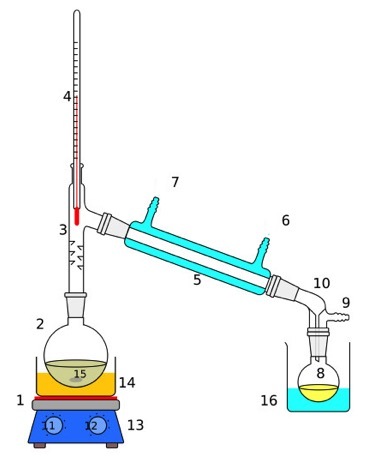
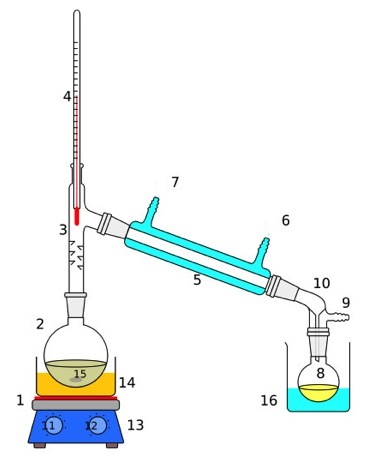
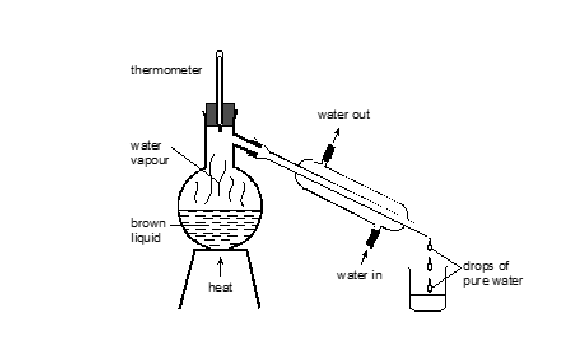
Which separation technique uses the apparatus shown in the diagram?
a)
filtration 
b)
 crystallisation
c)
distillation
d)
chromatography
3.
How can we separate an insoluble solid from a liquid?
a)
chromatography
b)
crystallisation
c)
filtration
d)
condensation
4.
In filtration, the liquid part collected is called the filtrate and the solid bit that remained on the filter paper is called the residue.
In filtration, what is the part that remains called?
a)
Solid
b)
Filtrate
c)
Remainder
d)
Residue
5.
Of these mixtures, which one is a solution?
a)
A
b)
B
c)
C
d)
D
6.
A good time to use filtration to separate a mixture is:
a)
separating iron nails and screws
b)
removing the kool aid out of water
c)
sorting balls of different sizes
d)
taking the sand out of ocean water
7.
The clear liquid which passes through the filter paper is called
a)
filt
b)
filter
c)
filtrate
d)
filtration
8.
Water and alcohol are easily separated by distillation because of their
a)
different densities
b)
different boiling points
c)
different colours
d)
different melting points
9.

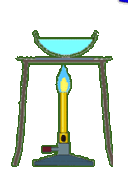
Which one of the following is the name for separation technique in the picture below

a)

distillation

b)

filtration

c)

evaporation

d)

chromatography

10.
In the process of evaporation, which one of the following pieces of laboratory apparatus would NOT be used?
a)
evaporating basin
b)
filter funnel
c)
bunsen burner
d)
Wire gauze
11.
Which one of the following would you use to separate sand from iron filings?
a)
a bar magnet
b)
 filter paper
c)
distillation apparatus
d)
chromatography paper
12.

Dyes in water soluble markers may be separated by means of

a)

Distillation

b)

Filtration

c)

Chromatography

d)

Evaporation

13.
chromatography separates the mixture of dyes on the basis of their ----------------------------
a)
density
b)
solubility
c)
gravity
d)
boiling point
14.
Distillation involves
a)
condensation, then evaporation
b)
evaporation, then condensation
c)
filtration, then evaporation
d)
filtration, then condensation
15.
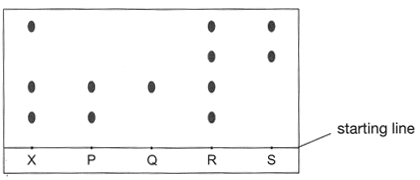
The diagram below shows a chromatogram obtained when a sample X was analysed together with four other known dyes P, Q, R and S. Dye Q was known to cause cancer. Which of the following dye(s) is/are safe for use?
a)
P only
b)
S only
c)
P and S
d)
P and X
16.
Which label identifies where on the diagram the thermometer can be found?
a)
B
b)
D
c)
E
d)
F
17.

Which label identifies where on the diagram the condenser can be found?

a)

A

b)

F

c)

G

d)

H

18.
12. Which label identifies where on the diagram the cold water input can be found?
a)
D
b)
E
c)
G
d)
H
19.

What is 6 and 7?

a)

6: water in / 7: water out

b)

6: water out / 7: water in

20.

What is 8?

a)

distillate

b)

filtrate

c)

residue

d)

solute

21.

Porcelain chips are added to 15. Why?

a)

to raise the water level higher

b)

to increase the boiling point of the mixture

c)

ensure smooth boiling of the mixture

d)

to be dissolved in the mixture

22.

A mixture of water (b.p. 100oC) and alcohol (b.p. 78oC) is separated. Which will be found in 8 first?

a)

water

b)

ethanol

23.

A mixture of water and alcohol is separated. What is the reading on the thermometer at the end of the experiment?

a)

below 78oC

b)

78oC exactly

c)

78oC to 100oC

d)

100oC exactly

24.

What is the function of 3?

a)

prevents air from entering the flask

b)

provides a large surface area for hot vapour to condense

c)

blocks hot vapour from escaping

d)

collects the distillate

25.

A mixture of water and alcohol is separated. What is the reading on the thermometer at the end of the experiment?

a)

below 78oC

b)

78oC exactly

c)

78oC to 100oC

d)

100oC exactly

26.

What is the name of apparatus 2?

a)

conical flask

b)

flat-bottom flask

c)

round-bottom flask

d)

long-neck flask

e)

wide-neck flask

27.

What is the most important feature in fractional distillation?

a)

The two component part must have different boiling point

b)

The two component part must have similar boiling point

c)

The two component part must have same boiling point
28.
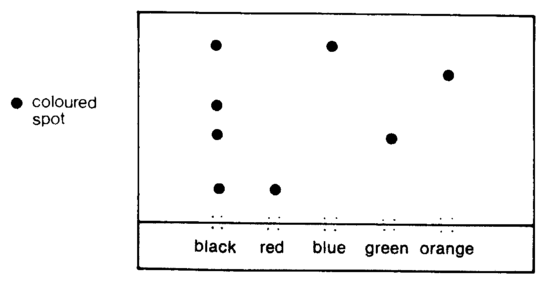
A pure substance shows ------------------ spot on chromat gram
a)
0
b)
1
c)
2
d)
3
29.
Which ink is a mixture of different pigments? 
a)
red
b)
orange
c)
green
d)
black
30.
This chromatogram shows five commercial dyes (X, P, Q, R and S). The pigment in dye Q Is known to cause cancer. Which dye(s) is/are safe for use?
a)
P only
b)
S only
c)
P and S
d)
P and X
31.
Why must the base line be drawn in pencil and not pen?
a)
a) Pencil is good at keeping substances in place.
b)
b) Pencil is soluble in water
c)
c) Pencil is insoluble in water
d)
d) Pencil is not coloured
32.
In paper chromatography, the MOST soluble solute .......
a)
does not move from the start point
b)
stays closest to the start point
c)
travels furthest away from the start point
d)
can be found in the middle of the chromatogram
33.
In paper chromatography, the LEAST soluble solute .......
a)
does not move from the start point
b)
stays closest to the start point
c)
travels furthest away from the start point
d)
can be found in the middle of the chromatogram
34.
In chromatography, if a solute does not separate and remains on the start line ....
a)
the solute is insoluble in the solvent
b)
the solute is soluble in the solvent
c)
the solvent is insoluble in the solute
d)
the solvent is soluble in the solute
35.
If a dye is insoluble in water and cannot be separated using chromatography, how can it be tested to see if it is a mixture?
a)
Use filtration instead
b)
Repeat the chromatography test using a different solvent such as propanone
c)
Use distillation instead
d)
Repeat the chromatography using water as the solvent and see if it separates this time