wayground logo

Free Printable Worksheets

Font size

S
M
L
XL
Worksheets

Light and Sound

Total questions: 41

Worksheet time: 31mins

Name
Class
Date
1.
A section of a longitudinal wave where the particles are crowded together is called a
a)
A. rarefaction.
b)
B. vibration
c)
C.compression
d)
D. surface wave.
2.
What do we call the part of a compressional wave that is spread a part?
a)
compression
b)
rarefaction
c)
crest
d)
trough
3.
Waves that require a medium are called 
a)
mechanical waves
b)
transverse waves
c)
light waves
d)
gamma rays
4.
Sound waves are _______________
a)
Transverse waves
b)
Longitudinal waves
c)
Circular waves
d)
Seismic waves
5.
As the fire truck approached Mary, the pitch of the siren got higher. Once the fire truck passed and moved away, the siren's pitch got lower. This change in pitch is because of a change in the sound wave's
a)
concussion. 
b)
amplitude. 
c)
reflection.
d)
frequency. 
6.
Which of the following would you hear as a low pitched sound? 
a)
sound wave with a frequency of 50 Hz
b)
sound wave with frequency of 10,000 Hz
c)
sound wave with an intensity of 10 dB
d)
sound wave with an intensity of 100 dB
7.
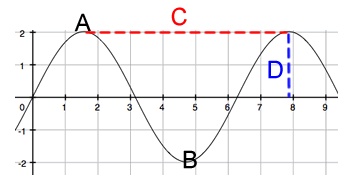
If distance C on the diagram increased, what would happen to the pitch? 
a)
The pitch would be louder. 
b)
The pitch would be softer. 
c)
The pitch would be higher. 
d)
The pitch would be lower. 
8.
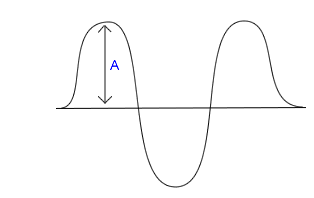
If the distance represented by the letter A were increased, how would it change the way the sound was heard?
a)
The sound would be higher. 
b)
The sound would be lower. 
c)
The sound would be softer. 
d)
The sound would be louder. 
9.
When comparing the two waves that are shown, how would Wave A (green wave) differ than Wave B (black wave)?
a)
Wave A and B have the same amplitude, but wave B (black) has a lower pitch.
b)
Wave A and B have the same amplitude, but Wave A has a lower pitch. 
c)
Wave A and B have the same pitch, but Wave A is a softer sound. 
d)
Wave A and B have the same pitch, but Wave B is a softer sound. 
10.
The number of wavelengths that pass a point each second
a)
crest
b)
amplitude
c)
frequency
d)
pitch
11.

A longitudinal wave can travel through

a)

solids only

b)

liquids only

c)

gas, liquids, and solids

d)

gas and vacuum only

12.

The most common unit to measure loudness is

a)

decibels

b)

pitch

c)

hertz

13.

The height of the wave from the rest position is called

a)

frequency

b)

pitch

c)

amplitude

14.

Sound is able to travel faster in solids than in air because

a)

solid molecules are closer together than air

b)

solid molecules are more easily moved than air

c)

solid molecules are moving faster than air

d)

solid molecules are larger than air molecules

15.

A soft sound has a _________ amplitude and a loud sound has a _____________ amplitude.

a)

large, small

b)

small, large

16.

If the sound is _____, the frequency is low, and if the sound is _______ the frequency is high.

a)

high, low

b)

low , high

17.

High frequency sound will have a ____________ wavelength.

a)

long

b)

short

18.
Sound does not travel in space because
a)
Space is too far away.
b)
There is no matter in space.
c)
Space is the final frontier
d)
Space has planets.
19.
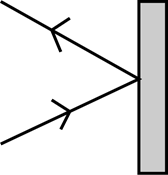
The illustration shows a light ray striking an object.
In the illustration, the light ray striking the object is-
a)
absorbed
b)
stopped
c)
reflected
d)
refracted
20.
A student placed a pencil in a cup of water.  The pencil appears broken because light-
a)
always travels in a straight line
b)
bends when it passes through water
c)
makes the water in the glass evaporate
d)
reflects the pencil on the water's surface
21.
Why do we see objects as white?
a)
They absorb all light
b)
They reflect all light
c)
They absorb some light and reflect some light
22.
Which of these objects is "Opaque"?
a)
A Brick Wall
b)
Eye Glass Lenses
c)
Stained Glass Windows
23.
Which of these objects is "translucent"?
a)
A Brick Wall
b)
Sunglasses
c)
Mirror
24.
Which of these objects is "transparent"?
a)
Stained Glass Window
b)
Wooden Table
c)
Clear Glass Window
25.

The image shows an object that is __________.

a)

transparent

b)

translucent

c)

opaque

26.

The image shows an object that is __________.

a)

transparent

b)

translucent

c)

opaque

27.

The image shows an object that is __________.

a)

transparent

b)

translucent

c)

opaque

28.

Waves that can travel through space where there is no matter are called:

a)

tidal waves

b)

electromagnetic waves

c)

sound waves

d)

none of the above

29.

This is the highest point of a transverse wave:

a)

crest

b)

trough

c)

amplitude

d)

wavelength

30.

This is the lowest point of a transverse wave:

a)

crest

b)

trough

c)

amplitude

d)

equilibrium

31.
which of the following explains why the student sees the color of the green paper? 
a)
Only green light is reflected by the paper
b)
Only green light is absorbed by the paper
c)
only green light is refracted by the paper
d)
only green light is compressed by the paper
32.

Burning Candle

a)

Luminous

b)

Illuminated

33.

Moon

a)

Luminous

b)

Illuminated

34.

Glow worm

a)

Luminous

b)

Illuminated

35.
Luminous means...
a)
Gives out its own light
b)
Reflects light from other things
36.

Materials generally become warmer when light is

a)

absorbed

b)

reflected

c)

transmitted

37.

When light is shining on a plane mirror(completely flat and smooth), the angle of incidence is equal to the

a)

angle of absorption

b)

angle of reflection

c)

angle of transmission

38.

Why do we see objects as black?

a)

They reflect all the light

b)

They absorb all the light

c)

They absorb some light and reflect

39.

A concave lens curves ____ and causes rays of light to _____.

a)

outward; converge

b)

inward; converge

c)

outward; diverge

d)

inward; diverge

40.

A convex mirror curves _____ and causes rays of light to _____.

a)

inward; converge

b)

outward; diverge

c)

inward; diverge

d)

outward; converge

41.

A light wave is a(n) _____ wave, while a sound wave is a(n) _____ wave.

a)

electromagnetic; mechanical

b)

mechanical; electromagnetic

c)

mechanical; mechanical

d)

electromagnetic; electromagnetic