wayground logo

Free Printable Worksheets

NEW

Font size

S
M
L
XL
Worksheets

Pure and Impure Substances

Total questions: 75

Worksheet time: 59mins

Name
Class
Date
1.
Which of the following is a pure substance? 
a)
Water
b)
Salad
c)
Chocolate milk
d)
All of them 
2.
Which of the following is a pure substance? 
a)
Soil 
b)
Salt
c)
Water and sand
d)
Vanilla ice cream with chocolate
3.
A mixture can be separated into its components. 
a)
True
b)
False
4.
A pure substance CAN'T BE separated physically. 
a)
True
b)
False
5.

An _______________ is made up of one or more of the same kind of atom chemically combined.

a)

atom

b)

element

c)

molecule

d)

compound

6.

A ______________ is made up of different kinds of atoms chemically combined.

a)

element

b)

compound

c)

mixture

d)

molecule

7.

___________ are the smallest unit of an element that maintains the properties of that element.

a)

Atoms

b)

Elements

c)

Compounds

d)

Mixtures

8.

A _____________ contains a variety of elements and compounds that are not chemically combined with each other.

a)

compound

b)

element

c)

molecule

d)

mixture

9.

A __________________ is a substance that has definite physical and chemical properties such as appearance, melting point, and reactivity.

a)

mixture

b)

pure substance

c)

compound

d)

element

10.

True or False: elements AND compounds are pure substances.

a)

True

b)

False

11.
A combination of pure substances, not in fixed amounts, that can be easily separated.is a
a)
MIXTURE
b)
COMPOUND
c)
ATOM
d)
PARTICLE
12.
This is a mixture of two or more substances in which one or more of these substances (solutes) is dissolved in another substance.
a)
COMPOUND
b)
MOLECULE
c)
SOLUTION
d)
SOLVENT
13.

Name the separation technique used to recover the salt from seawater.

a)

evaporation

b)

distillation

c)

filtration

d)

decanting

14.

Two or more substances mingled together, but not chemically combined are known as a __________

a)

residue

b)

solution

c)

distillate

d)

mixture

15.

In a coffee machine, the ground coffee is separated from the coffee solution by using..

a)

sand paper

b)

filter paper

c)

toilet paper

d)

tissue paper

16.
Which one of the following would you use to separate sand from iron filings?
a)
a bar magnet
b)
filter paper
c)
chromatography paper
d)
alum
17.

Water and alcohol are easily separated by distillation because of their ______________

a)

different melting points

b)

different colours

c)

different densities

d)

different boiling points

18.
Making a mixture results in ___________________ only.
a)
chemical reactions
b)
separate parts
c)
physical changes
d)
two subtances
19.
To separate iron filings and sulfur what method should you use?
a)
filtration 
b)
sorting
c)
magnet
d)
boiling
20.

To separate the sugar and lemonade, what method should you use?

a)

filtration

b)

hand separation

c)

magnet

d)

evaporation

21.
In an experiment the factors we keep the same are called:  
a)
experimental variables
b)
controlled variables 
c)
independent variables
d)
dependent variables
22.

Dyes in water soluble markers may be separated by means of..

a)

crystallization

b)

sublimation

c)

chromatography

d)

sedimentation

23.
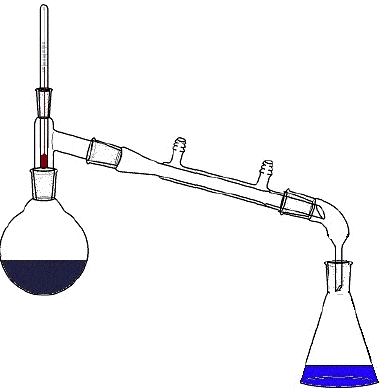
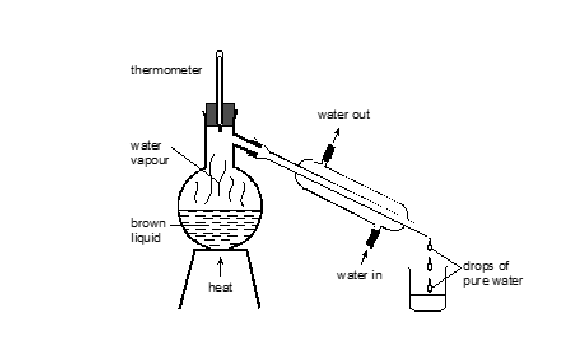
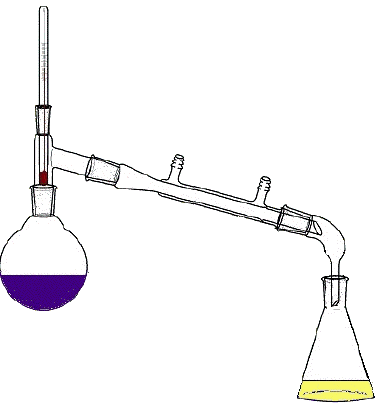
Which separation technique uses the apparatus shown in the diagram?
a)
filtration 
b)
 crystallisation
c)
distillation
d)
chromatography
24.
A saturated solution:
a)
is always cold
b)
as a lot of water in it
c)
will not dissolve any more solvent
d)
will not dissolve anymore solute
25.
What is the process of separating at which the components move at different rates?
a)
centrifugation
b)
chromatography
c)
heating
d)
decantation
26.

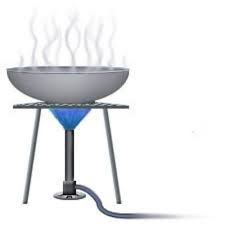
Name the separation technique shown in the diagram.

a)

evaporation

b)

distillation

c)

filtration

27.
Solid particles which are left on filter paper while filtration is called
a)
filtrate
b)
residue
c)
solvent
d)
solute
28.

Pure water can be separated from inky water by simple distillation because:

a)

Water and ink have different boiling points

b)

Water evaporates leaving the ink particles behind

c)

Ink evaporates leaving the water behind

29.

What is the correct order for obtaining salt from a mixture of sand and salt?

a)

Dissolving in water - filtration - evaporation

b)

Evaporation - filtration - dissolving in water

c)

Filtration - dissolving in water - evaporation

30.

Which method is usually used to separate coloured substances from each other?

a)

Simple distillation

b)

Evaporation

c)

Chromatography

31.

If you wanted to make pure drinking water from sea water, what process would you use?

a)

Filtration

b)

Distillation

c)

Evaporation

d)

Chromatography

32.

What is the name of the liquid that ends up in the beaker after the process of filtration?

a)

Residue

b)

Filtrate

c)

Solution

d)

Mixture

33.

Name the piece of apparatus labelled A.

a)

Boiling flask

b)

Biglie Condenser

c)

Liebig Condenser

d)

Beaker

34.

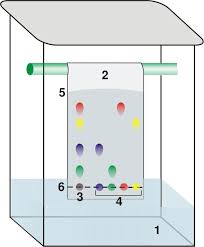
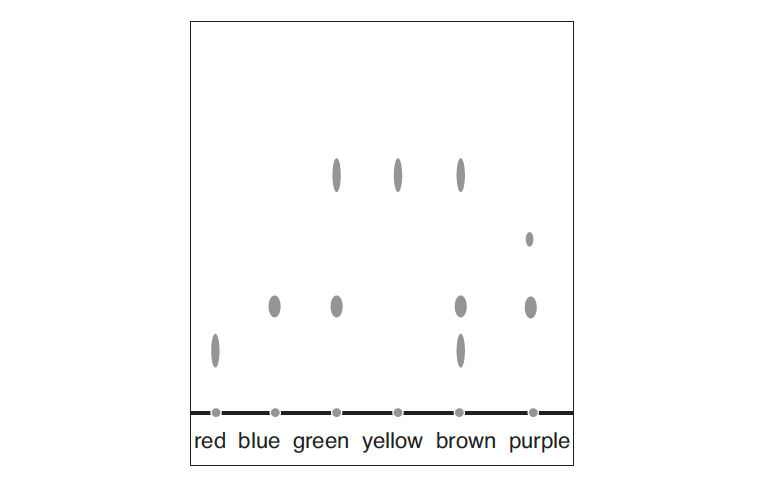
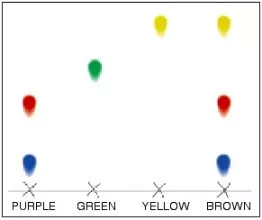
These are the results of a chromatography experiment.


Which colour has the most dyes in it?

a)

blue

b)

green

c)

yellow

d)

brown

e)

purple

35.

These are the results of a chromatography experiment.


Which dye appears in most colours?

a)

blue

b)

green

c)

yellow

d)

brown

e)

purple

36.

This technique is based on the differences of the boiling point of the substance in the mixture.

a)

decantation

b)

distillation

c)

filtration

d)

chromatography

37.

This method is used to separate metals from non metals.

a)

use of magnet

b)

physical manipulation

c)

sieving

d)

chromatography

38.

Look at the diagram. Does it represent an element, compound or mixture?

a)

Element

b)

Compound

c)

Mixture

39.

Look at the diagram. Does it represent an element, compound or mixture?

a)

Element

b)

Compound

c)

Mixture

40.

Look at the diagram. Is it pure or impure?

a)

Pure

b)

Impure

41.

Look at the diagram of gold. What is the percentage purity?

a)

100%

b)

90%

c)

80%

d)

70%

42.

Look at the diagram of gold. What is the percentage purity?

a)

100%

b)

90%

c)

80%

d)

70%

43.

Look at the diagram of gold. What is the percentage purity?

a)

100%

b)

90%

c)

80%

d)

70%

44.
Solubility is defined as
a)
the ability to catch on fire
b)
the ability to be dissolved
c)
the ability to fly.
d)
the ability to get on Mrs. D's nerves.
45.
The substance being dissolved in a solution.
a)
sands
b)
solute
c)
solvent
d)
alloy
46.
The substance in which a solute is dissolved
a)
sands
b)
solvent
c)
alloy
d)
negative particles
47.
Solutions are composed of __________ .
a)
salts and solutes
b)
solvents and salts
c)
solutes and alloys
d)
solutes and solvents
48.
In a sample of salt water, NaCl would be considered the ______.
a)
Solution
b)
Solute
c)
Solvent
d)
Solvation
49.
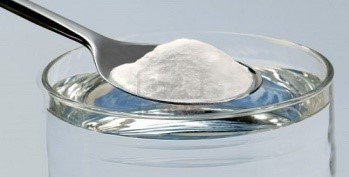
In this mixture, which of the following will be the solute?
a)
The water in the glass
b)
The glass that holds the final mixture
c)
The solution containing both powder and water
d)
The powder on the spoon
50.
Lemonade - Water, lemon juice, and sugar
Identify the solute
a)
water
b)
lemon juice
c)
sugar and lemon juice 
51.
What is a solvent?
a)
The substance that does the dissolving in a solution.
b)
The substance that is being dissolved in a solution.
c)
The mixing of different substances.
d)
The process in which neutral molecules lose or gain electrons
52.
What is a compound? 
a)
 the simplest form of a substance 
b)
a combination only of 3 elements 
c)
a combination of 2 or more elements 
d)
a place where people are held 
53.
Which of the following is not a compound?
a)
HCl
b)
Cl
c)
NaCl
d)
CO2
54.
Sand and gravel may be separated from each other through using..
a)
a filter funnel
b)
a sieve
c)
an evaporating basin
d)
a distillation
55.
Two or more substances mingled together, but not chemically combined are known as a
a)
residue
b)
solution
c)
distillate
d)
mixture
56.
Which of the following pairs of substances may best be separated through distillation
a)
 sand and soil
b)
water and soil
c)
salt and sand
d)
 water and alcohol
57.
Which one of the following techniques would best be used to separate soil and water?
a)
Decanting
b)
distillation
c)
Filtration
d)
Chromatography
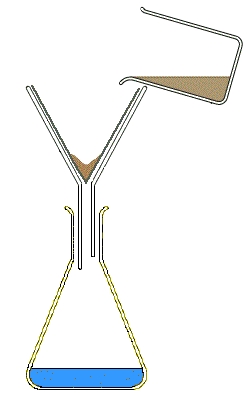
58.
Name the separation technique shown in the diagram.
a)
evaporation
b)
distillation
c)
 filtration
d)
decanting
59.
Sodium chloride can be separated from rock salt by first adding water to the mixture to dissolve the sodium chloride. The separation then takes place in two stages:
a)
evaporation followed by filtration
b)
 distillation followed by decanting
c)
filtration followed by evaporation
d)
filtration followed by decanting
60.
Which one of the following would you use to separate sand from iron filings?
a)
a bar magnet
b)
filter paper
c)
chromatography paper
d)
alum
61.
To separate iron filings and sulfur what method should you use?
a)
filtration 
b)
sorting
c)
magnet
d)
boiling
62.
How would you separate a mixture of sand and salt? 
a)
Mix them with water and let the water evaporate
b)
Mix them with water, pour the mixture through a sieve, then let the water evaporate
c)
Heat the sand and salt mixture for 5 minutes, then let it cool
d)
I would not do any of these because none of these options would work
63.
The diagram shows the chromatogram for three colouring dyes and that for a brown marker. What dye(s) are contained in the marker's ink?
a)
purple and green
b)
purple and yellow
c)
purple only
d)
green and yellow
64.
Which one of the following is NOT a mixture?
a)
Sugar
b)
Paint
c)
Crude oil
d)
Air
65.
Which mixture could you separate by adding water and then pouring through a coffee filter?
a)
sand and salt, because the salt would dissolve and the sand would not
b)
baking soda and salt, because they both dissolve
c)
sugar and salt, because they both dissolve
d)
iron fillings and sand, because neither one dissolves
66.
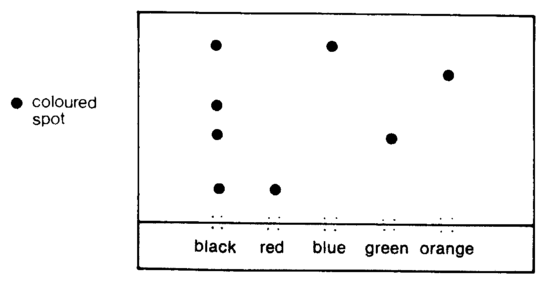
On the chromatogram given -------------- is mixture.
a)
red
b)
orange
c)
green
d)
black
67.
Look at the apparatus setup. It cannot be used to separate which of the following mixtures? 
a)
Marble chips from oil 
b)
Alcohol and water
c)
Chalk from sugar solution
d)
Sand and sea water
68.

Special paper used in filtration

a)

filter paper

b)

filter funnel

c)

litmus paper

69.

Glass object with a bottom used to heat liquids or solids

a)

beaker

b)

test tube

c)

thermometer

70.

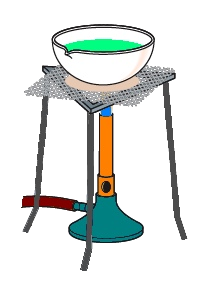
What is this?

a)

tripod

b)

bunsen burner

c)

test tube

71.

What is this?

a)

Beaker

b)

measuring cylinder

c)

petri dish

72.

What is this?

a)

test tube rack

b)

retort stand

c)

filter funnel

73.

What is the boiling point of water

a)

100 degrees Celsius

b)

50 degrees Celsius

c)

0 degrees Celsius

d)

-2 degrees Celsius

74.

What is the freezing point of pure water

a)

100 degrees Celsius

b)

50 degrees Celsius

c)

-2 degrees Celsius

d)

0 degrees Celsius

75.

What is the freezing point of impure water

a)

0 degrees Celsius

b)

-4 degrees Celsius

c)

-2 degrees Celsius

d)

100 degrees Celsius