
NEW
Font size
S
M
L
XL
 Worksheets
Evolution Review
Total questions: 58
Worksheet time: 2hrs 33mins
Name
Class
Date
1.

The gradual change in species over time is...
a)
Evolution
b)
Nucleotide
c)
Adaptation
d)
Natural Selection
2.

To adjust to a changing environment
a)
Mutation
b)
Adapt
3.

Darwin wrote that organisms with traits that are best suited to the environment will ________________
a)
increase in number
b)
become extinct
4.
What characteristic did Darwin observe about the finches on the Galapagos Islands?
a)
Their feathers
b)
Genotypes
c)
Their beaks
d)
Their body sizes
5.

Another word for adapt is ____________.
a)
change
b)
create
6.
Which term refers to the process by which individuals that are better suited to the environment survive and reproduce therefore passing down their genes to their offspring?
a)
Evolution
b)
Variation
c)
Adaptation
d)
Natural Selection
7.
When an organism completely dies out, it is called.....
a)
Adaption
b)
Extinction
c)
Fossilization
d)
Mutation
8.
The white feathers of a snowy owl allow it to blend in with its environment during the winter months (snow). This is an example of ________________
a)
Species
b)
Environmental Change
c)
Adaptation
d)
Variation
9.
Darwin referred to this as survival of the fittest. Over time, it results in changes in the inherited characteristics of a population because organisms with adaptations that make them fit for their environment will survive and reproduce better than those without favorable traits.
a)
Natural Selection
b)
Genetic Variation
c)
Survival of the Fittest
10.
Genetic differences between organisms of the same species
a)
Variation
b)
Adaptation
c)
Behavior
d)
Environment
11.
What is the advantage of having different shaped beaks?
a)
To look different from other species.
b)
To be able to eat the food readily available in the environment.
c)
To protect itself against predators.
d)
To protect itself against prey.
12.
The struggle for existence against other members of an organisms species is
a)
Competition
b)
Natural Selection
c)
gene flow
d)
genetic drift
13.
Remains of ancient organisms are called
a)
Extinctions
b)
Fossils
c)
Mutations
d)
Variations
14.
Which of the following is NOT a factor that affects the process of natural selection?
a)
Overpopulation
b)
Fossils
c)
Competition
d)
Variations
15.
A group of similar organisms that can mate with each other and produce fertile offspring is called a species.
a)
True
b)
False
16.
Dolphins have the same arm structure as wolfs, what type of evidence for evolution does this represent?
a)
DNA
b)
vestigial structures
c)
homologous structures
d)
embryology
17.
Change over time is
a)
evolution
b)
generation
c)
growth
d)
biogenesis
18.
Natural selection is
a)
survival of the fittest
b)
humans change
c)
two species are the same
d)
more animals survive
19.
This makes an organism more suited to its enviornment
a)
species
b)
lifespan
c)
adaptation
d)
mutation
20.
Surviving and reproducing show that an organism
a)
is adapting
b)
is not adapting
c)
is forming fossils
d)
is not reproducing
21.
What is one reason that strawberries are surviving in the winter season?
a)
they have larger leaves
b)
they have genetic variations allowing them to be resistant to cold
c)
they reproduce more
d)
the color is dark
22.
The tree of life is a metaphor for what idea?
a)
we came from a common ancestor
b)
we need water and sunlight to survive
c)
we have multiple species
d)
we are old
23.
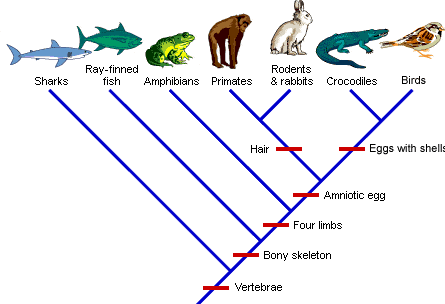
According to this cladogram, sharks are MOST closely related to which organism?
a)
Amphibians
b)
Ray finned fish
c)
Crocodiles
d)
Birds
24.
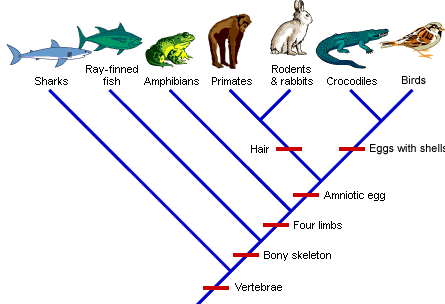
According to this cladogram, birds are LEAST related to:
a)
Amphibians
b)
Sharks
c)
Ray Finned Fish
d)
Crocodiles
25.
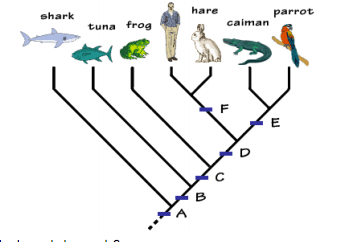
On the cladogram, which organism is the closest relative of the human?
a)
Frog
b)
Hare
c)
Caiman
d)
Parrot
26.
Individuals that are well adapted to their environment will survive and produce:
a)
Fewer mutations
b)
Stronger genes
c)
More offspring
d)
Better traits
27.
You look at two species and see very similar DNA. What does this likely tell you?
a)
These are the same animal.
b)
These animals have a common ancestor.
c)
These animals are not likely related.
d)
These animals are likely becoming one species.
28.
Horse breeding for specific desired traits is an example of which type of evolutionary evidence?
a)
Artificial selection
b)
Embryology
c)
Fossils
d)
Biochemical molecules
29.
speciation
a)
Formation of new species
b)
idk
c)
Formation of old species
d)
none of the above
30.
The finches on the Galapagos island were similar in form except for variations of their beaks. Darwin observed that these variations were useful for:
a)
attracting a mate
b)
defending territory
c)
building nests
d)
gathering food
31.
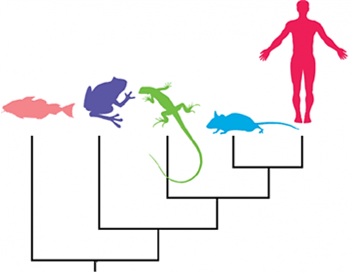
According to this phylogenetic tree, which creature is the least related out of all pictured?
a)
Fish
b)
Frog
c)
Salamander
d)
Human
32.

Where is the alligator and T. rex's common ancestor?
a)
Point A
b)
Point B
c)
Point C
d)
Point D
33.
An inheritable characteristic that gives a survival advantage to the organism
a)
speciation
b)
adaption
c)
rapid speciation
d)
derived character
34.
Which is a source of genetic variation?
a)
mutations
b)
artificial selection
c)
exponential growth
d)
genetic bottlenecking
35.

The diagram below represents possible genetic relationships between groups of organisms.
Which statement is a valid conclusion that can be drawn from the diagram?
a)
Insects are more complex than mammals.
b)
Earthworms and sea stars have a common ancestor.
c)
Snails appeared on Earth before corals.
d)
Sponges were the last new species to appear on Earth.
36.
Which statement is part of Darwin’s theory of evolution by natural selection?
a)
More offspring are produced than can possibly survive.
b)
The organisms that are the fittest are always largest and strongest.
c)
The number of offspring is not related to fitness.
37.

Two organisms that are closely related would have
a)
very similar DNA sequence
b)
exactly the same DNA sequences
c)
no proteins in common
d)
completely different DNA sequence
38.

Individuals that are well adapted to their environment will survive and produce:
a)
Fewer mutations
b)
Stronger genes
c)
More offspring
d)
Better traits
39.
The opossum and kangaroo both incubate their young in a pouch. This provides evidence that they---
a)
are descended from a common ancestor
b)
Have very similar skeletal structures
c)
belong to the same species
d)
must range great distances to eat
40.
Which statement best describes how a new human trait develops and can be passed on to future generations?
a)
A mutation in a stomach cell results in the inability of a woman to produce a certain digestive enzyme.
b)
A mother consumes alcohol during pregnancy, causing the fetus to have a low birth weight.
c)
During meiosis, a new combination of DNA subunits is formed.
d)
During mitosis, DNA does not divide correctly and the cells die
41.
Survival of at least a few members of a population after a major environmental change is most dependent on
a)
the population having an individual that is adapted to the original environment
b)
the population having an individual that is adapted to great changes in the temperature in its environment
c)
variations in many different traits in many individuals in the population
d)
no variations in the color of the fur, skin, or feathers of the individuals in the population
42.
Evolution can occur at different rates; however, for evolution to occur, there must be
a)
variations within a species
b)
extinction of the species
c)
asexual reproduction
d)
no change in the genes of an organism
43.
Natural selection is best described as
a)
a change in an organism in response to a need of that organism
b)
a process of nearly constant improvement that leads to an organism that is nearly perfect
c)
differences in survival rates as a result of different inherited characteristics
d)
) inheritance of characteristics acquired during the life of an organism
44.
Which statement best describes a situation where competition occurs in an ecosystem?
a)
A deer outruns an attacking wolf
b)
A deer, during the winter, consumes tree bark.
c)
A deer and a rabbit consume grass in a field
d)
A deer and a rabbit are both startled by a hawk flying overhead.
45.
Plant species X lives in a hot, dry environment. Slowly, over hundreds of years, the climate becomes wetter. Fungi attack species X and cause the population of species X to decrease. However, plant species X could survive if the plants
a)
try to mutate quickly and synthesize new proteins
b)
are watered often and fertilized with extra nutrients
c)
can adapt to the new conditions by mating with the fungus
d)
have a few members of the population that are fungus-resistant
46.
Many animals have developed courtship behaviors. Males will often dance, swim, or sing in a particular way to attract a female. Males who are more successful at the courtship behavior will have a greater chance of having more offspring. This behavior is a result of
a)
natural selection
b)
genetic engineering
c)
asexual reproduction
d)
gene manipulation
47.
A farmer wanted to rid his apple trees of a particular leaf-eating insect. He sprayed his trees with an insecticide that killed 98% of the insects. The survival of 2% of this population of insects is most likely due to
a)
genes obtained from another species
b)
certain chemicals that stimulated overproduction
c)
variations that resulted from sexual reproduction
d)
their ability to produce food from the pesticide
48.
Which occurrence represents an example of evolution?
a)
Exposure to radiation reduces the rate of mutation in leaf cells.
b)
A mutation in a liver cell causes a person to produce an enzyme that is less efficient.
c)
Cells in a zygote eventually change into bone cells or skin cells.
d)
Some antibiotics are almost useless, because pathogens have developed a resistance to these antibiotics.
49.
Potato farmers in Ireland during the mid 1800s all grew the same type of potato. The potato plants were all produced as clones of one another. When a fungus infected the crop, all of the potatoes were destroyed. This occurred because these potato plants
a)
had little genetic variability
b)
had increased biodiversity
c)
were the product of fertilization
d)
were the result of biotechnology
50.
The corn we eat today is larger and has more kernels than the corn people first grew thousands of years ago. Which process is most likely responsible for the changes that have occurred?
a)
mitosis
b)
succession
c)
direct harvesting
d)
selective breeding
51.
Caffeine is a compound found in the seeds of many different plants, such as coffee beans, cola nuts, and cacao beans (the source of chocolate). The presence of this chemical in all three types of plants suggests that these plants
a)
inherited identical mutations
b)
share a common ancestry
c)
were exposed to the same type of radiation in the past
d)
were cloned from a caffeine plant
52.
Male turkeys are birds that naturally strut and display their large tail feathers, which attracts female turkeys. This display is an example of
a)
a behavioral adaptation
b)
selective breeding
c)
asexual reproduction
d)
a learned behavior
53.
A scientist at a large natural history museum has a collection of fossils that were found throughout the world. Only a few of the fossils represent species that are still alive on Earth today. One reason for this is that
a)
most of the species that have ever lived on Earth are alive today
b)
most of the species that have ever lived on Earth are extinct
c)
fossils of only extinct species have been found
d)
species alive today will not form any fossils for future discovery by scientists
54.
When a paramecium, a single-celled organism, is living under stressful conditions, it sometimes switches from asexual to sexual reproduction. The main advantage when this switch occurs is that the paramecium is most likely to
a)
produce fewer offspring
b)
increase variation among its offspring
c)
avoid having to find a mate
d)
produce clones of itself
55.
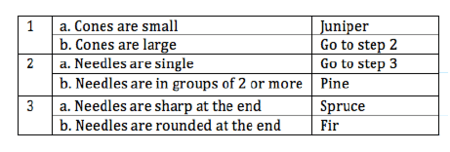
A dichotomous key for trees is provided. Hikers found a tree that has large brown cones and single sharp needles. What species of tree have the hikers found?
a)
Juniper
b)
Pine
c)
Spruce
d)
Fir
56.
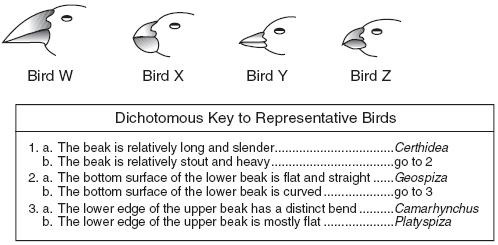
What is the name of bird W?
a)
Certhidea
b)
Geospiza
c)
Camarhynchus
d)
Platyspiza
57.
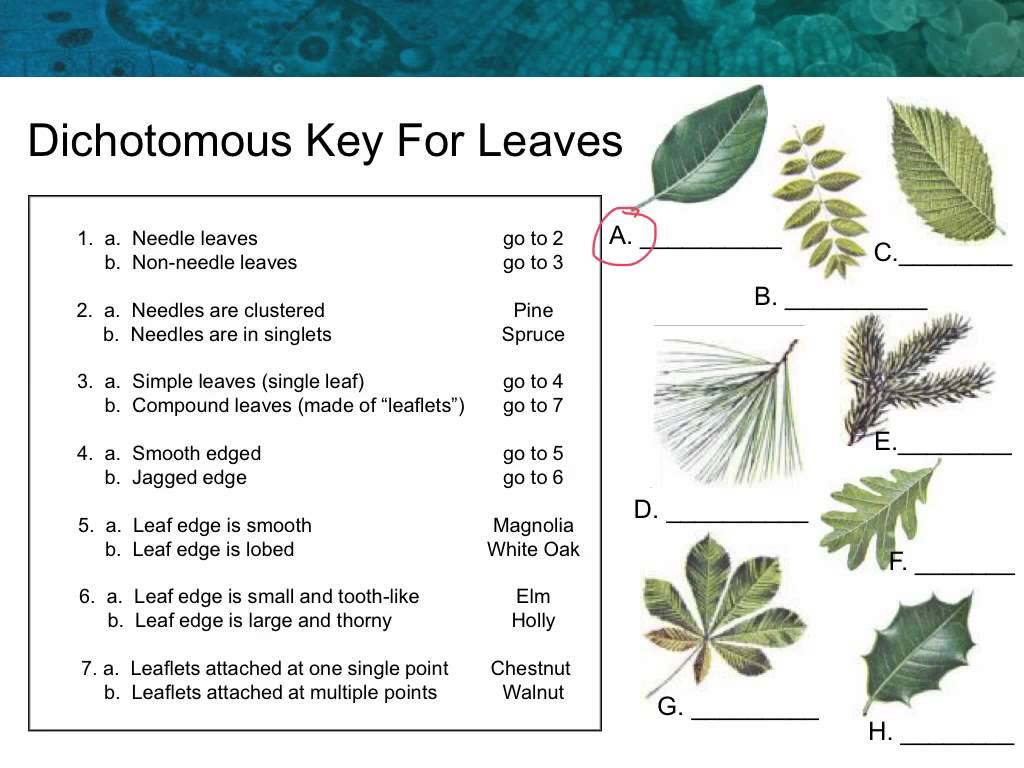
What is a dichotomous key used for in science?
a)
To organize biomes
b)
Classify organisms
c)
Identify bacteria only
d)
None of these
58.
What is adaptive value?
a)
How much an adaptation is worth
b)
How best fit an adaptation is for an environment
c)
How much you can buy an adaptation for at Walmart
d)
An ecological niche
Reset

