
 Worksheets
Aristotle vs Galileo
Total questions: 20
Worksheet time: 41mins

This form of motion can only occur in outer space or in a vacuum. It is solely dependent on the force of gravity.
Free Fall Motion
Centripetal Motion
Projectile Motion
None of the Above

Which form of motion always follows a curved path and requires an initial launch force that is greater than the force of gravity?
Centripetal Motion
Projectile Motion
Free Fall Motion
None of the Above

A leaping frog is an example of which type of motion.
Projectile Motion
Free Fall Motion
Centripetal Motion
None of the Above
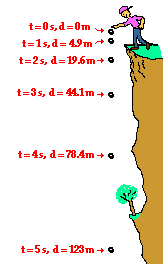
If you are Galileo answer the ff question:
"Why does a bowling ball and feather hit the ground at different times when dropped from the same height?"
They don't; they hit the ground at the same time.
One is more dense than the other.
One is heavier than the other.
Air resistance

The more mass an object has, the faster it will fall.
True
False
Aristotle - TRUE; Galileo - FALSE
Aristotle - FALSE; Galileo - TRUE


Based from Aristotelian Physics, what was natural for planets to do in terms of their type of motion?
They orbit in elliptical motion
They orbit in triangular motion
They orbit in no particular consistent shape
They orbit in circular motion
This is the idea used by Aristotle to explain how objects sustain their horizontal motion.
large amount of force applied
violent motion
antiperistasis
projectile motion
Aristotle explained that the object moves depending on the natural motion of the dominant element of that object. Which among the following element-motion pairs is CORRECTLY matched?
earth - circular
fire - fall
water - fall
celestial - retrograde
Aristotle proposed that all falling objects _______
fall at the same speed
fall at the same acceleration
fall at the same distance
fall at the same time
Based from Galileo, force is needed to ___________
sustain the motion of the object
change the direction of the object
change the speed of the object
oppose the motion of the object
Aristotle stated that:
GREATER FORCE APPLIED = ___________
greater distance covered
greater speed
greater acceleration
greater free falling

