
 Worksheets
Lenses and Refraction
Total questions: 55
Worksheet time: 1hrs 6mins

Name the lens in the diagram.
Thin converging lens
Thin diverging lens
What is the scientific name of length f in the diagram?
Focal length
Lens length
Object distance
Image
An object is placed 5 cm from a converging lens with a focal length of 3 cm. What type of image is produced?
Real, upright and diminished
Real, inverted and magnified
Virtual, upright and magnified
Virtual, inverted and diminished
A student uses a converging lens with a focal length of 20 cm to produce an enlarged virtual image of a scale she wishes to read accurately. What is a suitable distance between the scale and the lens?
16 cm
24 cm
40 cm
48 cm

Where should an object be placed so that a real, inverted & ensmallened image is produced by a lens with the given focal point at F?
A
B
C
D
Where should an object be placed so that a real, inverted and same size image is produced by a lens with the given focal point at F?
A
B
C
D

The above lens is a type of ___.
diverging lens
converging lens
divergent lens
convergent lens
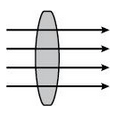
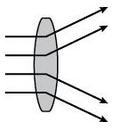
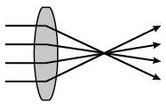
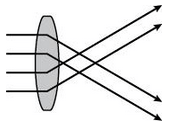
Which lens represents the path light takes through a diverging lens?


Which figure represents the path light takes through a converging lens?
A lens that is thicker in the middle than on the outside is called ___.
diverging
concave
converging
achromatic
A lens that is thinner in the middle than on the outside is called ___.
diverging
converging
convex
achromatic
When an object is placed on the focal point in front of a converging lens, the image produced is ___.
real, reduced, and inverted
real, enlarged, and inverted
real, true, and inverted
There is no image
When an object is placed between the focal point and the converging lens, the image produced is ___.
real, reduced, and inverted
real, enlarged, and inverted
virtual, enlarged, and upright
virtual, reduced, and upright


What type of lens do humans have in their eyes?
Diverging Lens
Converging Lens


Which type of lens brings light rays to single point after exiting the lens?
polarized
diverging
prism
converging
When light travels through a lens and the image produced from the lens cannot be projected onto the screen, which type of image is produced?
real
refracted
virtual
inverted
What is the distance between the the center of the lens and the focal points called?
principal axis
focal length
focal distance
lens radial line
When light from an object exits a lens and the image produced can be seen on a piece of paper, what kind of image is produced?
real
refracted
inverted
virtual
True or False: All real images are are inverted (upside down)?
True
False
Where is the location of the object on a ray diagram if the lens is used as a magnifying glass?
outside of the focal point
on the focal point
between the focal point and the center of the lens
What kind of image does a magnifying glass produce?
real and inverted
real and right-side up
virtual and inverted (upside down)
virtual and right-side up
What do lenses do?
separate white light into a rainbow
bend rays of light to form an image
reflect light similarly to a mirror
absorb all light
In a ray diagram in which the converging lens acts as a magnifying class, where is the image located?
Behind the lens (on the other side of the lens the object is not on)
In front of the lens (same side of the lens as the object) but between the object and the center of the lens
In front of the lens (same side of the lens as the object) but the object is between the image and the center of the lens
no image can be created (image location is infinity)
Why does light refract when it encounters the glass in a lens?
because it speeds up, which causes it to bend
because it slows down, which causes it to bend
because it hits a dense medium, which causes it to bounce off
because it gets absorbed, which causes it to lessen in intensity
How does a diverging lens differ from a converging lens?
A diverging lens is another way to describe a plane mirror; a converging lens is curved
A converging lens is curved inward on both sides; a diverging lens is on only one side
A converging lens has a thick center and thin edges, a diverging lens has a thin center and thicker edges
A converging lens has a thin center and thick edges. a diverging lens has a thick center and thinner edges
What do a prism, a magnifying glass, a microscope, and eyeglasses ALL have in common.
They are opaque
They refract light
They reflect light
That are translucent
Eyeglasses bend light to help the image form properly on the retina. The bending of light as it passes from one medium to another is called
diffraction
interference
reflection
refraction

Which of the following best describes the image for a thin converging lens that forms whenever the object is at a distance less than one focal length from the lens?
inverted, enlarged and real
upright, enlarged and virtual
upright, reduced and virtual
inverted, reduced and real
Which of the following best describes the image for a thin diverging lens that forms whenever the magnitude of the object distance is less than that of the lens' focal length?
inverted, enlarged and real
upright, enlarged and virtual
upright, reduced and virtual
inverted, reduced and real
Which of the following statements are true of converging lenses?
Converging lenses are thicker at the center than they are at the edges
Converging lenses can produce images which are both magnified and reduced in size.
The images formed by a converging lens can be located on either side of the lens relative to the object.
All of these
Which of the following statements are true of diverging lenses?
Diverging lenses only produce virtual images.
Diverging lenses only produce upright images.
Diverging lenses only produce reduced images.
All of these
Which of the following best describes the image formed by a plane mirror?
virtual, inverted and enlarged
real, inverted and reduced
virtual, upright and the same size as object
real, upright and the same size as object
Which of the following statements is/are true of a real image?
Real images can be magnified in size, reduced in size or the same size as the object.
Real images can be projected onto a sheet of paper.
Both of these
Neither of these

