wayground logo

Free Printable Worksheets

Font size

S
M
L
XL
Worksheets

World Geo 2nd Semester

Total questions: 130

Worksheet time: 2hrs 12mins

Name
Class
Date
1.
Like Christians and Jews, the Islamic religion is -
a)
monotheistic
b)
polytheistic
c)
nontheistic 
2.
The two major cities where Islam began are -
a)
Mecca & Medina
b)
Palestine & Jerusalem
c)
Israel & Syria
3.
The man who is considered the prophet who founded Islam is -
a)
Muhammad
b)
Jesus
c)
Allah
d)
Adam
4.

Where did Islam originate?

a)

The Arabian Peninsula

b)

The Balkan Peninsula

c)

The Italian Peninsula

5.

The followers of Islam are divided into two groups, Shia and Sunni. What makes them different?

a)

They are located in different areas of Saudi Arabia

b)

They disagreed on who should lead Islam after Muhammad died

c)

The Shia follow the 5 Pillars of Islam, while the Sunni do not

d)

The Sunni honor the holy month of Ramadan, while the Shia do not

6.

What are the denominations of Islam? Check all that apply.

a)

Sunni

b)

Hindu

c)

Shiite

d)

Orthodox

7.
Most of the people in Afghanistan practice this religion
a)
Christianity
b)
Judaism 
c)
Islam
d)
Hindu
8.
In the 1980's this country invaded Afghanistan
a)
Soviet Union
b)
United States
c)
Great Britain
d)
France
9.

When the Soviet Union invaded Afghanistan the U.S. provided money, weapons, and training to this group to assist their anti-Soviet military efforts?

a)

Mujahedeen

b)

Taliban

c)

Al-Qaeda

d)

ISIS

10.

What religious group took control of Afghanistan's government in 1996 soon after Soviet Russian withdrawal?

a)

Al-Qaeda

b)

ISIS

c)

The Taliban

d)

The Mujahedeen

11.
While the Taliban ruled in Afghanistan they allowed this terrorist group to train in Afghanistan:
a)
Hezbollah
b)
Hamas
c)
ISIS
d)
Al-Qaeda
12.

What is the capital of Afghanistan?

a)

Kabul

b)

Tehran

c)

Kandahar

d)

Islamabad

13.

When the Taliban took power in 1996, what certain things did they prohibit?

a)

flying kites

b)

education for girls and young women after the age of 8

c)

clean-shaven men

d)

all of these were banned

14.

In 1989, the Soviets left Afghanistan and the country was plunged into civil war and chaos. In 1996, which Islamic extremist group took power?

a)

Mujahadeen

b)

al-Qaeda

c)

Taliban

d)

Hezbollah

15.
Who was the former leader of Al-Qaeda?
a)
Mullah Omar
b)
Osama bin Laden
c)
Al-Zawahari
d)
Assah Massoud
16.
What is a Al-Qaeda?
a)
Government of Afghanistan
b)
Religious school
c)
Terrorist Organization
d)
A religious leader 
17.
Who were the Taliban?
a)
Former ruling group that controlled Afghanistan's government
b)
A terrorist group
c)
Group that wanted democracy
d)
Group that wanted communism
18.
What is the main reason the U.S. went to war in Afghanistan?
a)
Free the people from the brutal rule of the Taliban
b)
Attacks of September 11, 2001
c)
To help the Afghans fight the Soviets
d)
The U.S. wanted to fight the Taliban
19.
Who was the fiercest Mongol leader?
a)
Empress Wu
b)
Genghis Khan 
c)
Confucius
d)
Marco Polo
20.
What was one reason why Genghis Khan was so fierce? 
a)
He was really mean
b)
He was well trained in combat
c)
He led the capture of China, Central Asia, & Persia
d)
He killed many of his followers who did not listen
21.
Saudi Arabia is a _____________ that is ruled by the Al Saud royal family.
a)
kingdom
b)
continent 
c)
movie
d)
state
22.
The country's _____ is completely dependent on its oil income.
a)
economy
b)
food
c)
expats
d)
oil
23.
Much of the world's crude ____________ comes from Saudi Arabia.
a)
mud
b)
salt
c)
water
d)
oil
24.

what is the capital city of Saudi Arabia?

a)

Makkah

b)

Madinah

c)

Jeddah

d)

Riyadh

25.

Which branch of Islam do the majority of the world's Muslims belong to?

a)

Sunni

b)

Shia

c)

Walloon

d)

Presbyterians

26.

What is the holiest city in Islam?

a)

Abu Dhabi

b)

Mecca

c)

Las Vegas

d)

Riyadh

27.
The Soviet Union was involved in a long and costly war against the Mujahedeen in which country in the 1980’s?
a)
Syria
b)
Iraq
c)
Afghanistan
d)
Pakistan
28.

Most distinctive land form in S.W. Asia.

a)

Arabian Peninsula

b)

Pontic Mountains

c)

Chinese Peninsula

d)

Zagros Mountains

29.

The Bosporus and Dardanelles Straits link what two Seas?

a)

Mediterranean and Black Sea

b)

Caspian and Red

c)

Arabian and Yellow

d)

China and Yellow

30.

What is Mesopotamia also known as?

a)

The Fertile Crescent

b)

Hajj

c)

Oasis

d)

Shatt al Arab

31.

A trade route connecting China with the Mediterranean Sea

a)

Mediterranean Road

b)

Silk Road

c)

Trade Road

d)

Sunni Road

32.
What country is this?
a)
China
b)
North Korea 
c)
Japan
d)
India
33.
What was the most important thing to the Chinese?
a)
religion
b)
money
c)
family
d)
school
34.
Why was the Silk Road important?
a)
trade
b)
spread of religion
c)
learn about other cultures
d)
all are correct
35.

China has this type of government.

a)

Democratic

b)

Communist

c)

Dictatorship

36.

The capital of China

a)

Ming Dynasty

b)

Confucious

c)

Beijing

37.

The two main rivers in China are

a)

Yangtze and Yellow

b)

Nile and Amazon

c)

Yangtze and Nile

38.

A wise government official that taught people the value of things such as morality, kindness, and education.

a)

Calvin

b)

Confucious

c)

Charles

39.

The Chinese invented paper, the magnetic compass, printing, tea porcelain, silk, and gunpowder, among other things.

a)

true

b)

false

40.

The Chinese emperor ordered his people to build the Great Wall of China for protection from invading enemies.

a)

true

b)

false

41.

Why don't many people live in the western part of China?

a)

Because there is a river in the way

b)

Because the land there doesn't have many resources

c)

Because they don't want to

d)

Because of ongoing religious conflicts

42.

Which Taoist concept states that one must accept both the good and bad in life?

a)

The Way

b)

Yin and Yang

c)

Karma

d)

Nirvana

43.

Which dynasty gave China its name?

a)

Shang

b)

Qin

c)

Hans

d)

Qing

e)

Yuan

44.
What is an important part of ancient Chinese religious beliefs?
a)
reincarnation
b)
respect for parents and ancestors
45.

A ruler could lose the "mandate of heaven" if he or she

a)

became immoral or unjust

b)

did not follow the teachings of the Buddha

c)

would not enforce the ideas of Confucius

d)

did not bring forth heirs

46.

Who had the largest empire in history?

a)

The Mughals

b)

The Ottomans

c)

The Mongols

d)

The Romans

e)

The Byzantines

47.

Chinese history is divided into dynasties. What is a Dynasty?

a)

The Robertson family, Duck Dynasty

b)

When a certain region of a country has control

c)

A dynasty is the longest answer. It is not correct. The longest answer isn't always the correct answer.

d)

When one god is in control of a fate of a country

e)

When one family rules a country

48.

What is contribution from the Ancient Chinese?

a)

wheelbarrow

b)

fireworks

c)

gunpowder

d)

All of them

e)

Paper

49.
What peoples lived in the Gobi desert to the north and raided Ancient China throughout much of its history?
a)
Mongols
b)
Assyrians
c)
Egyptians
d)
Romans
50.

Why was the Great Wall of China built?

a)

To protect the country from Mongolian invasion

b)

To provide a boundary for the Forbidden City

c)

To protect the country from monsoon winds and flooding

d)

To barricade the country against tsunamis

e)

To clearly mark the border of China and Mongolia

51.
meant the gods had blessed that person to rule
a)
mandate of heaven
b)
rules of the law
52.
Chinese philosopher who believed that people should closely follow their roles in society
a)
Loa Tzu
b)
Li Bo
c)
Confucius
d)
Shang Li
53.
Chinese philosophy that says people should be guided by a universal force and live in harmony with nature
a)
Legalism
b)
Buddhism
c)
Daoism
d)
Diaspora
54.
What is the Chinese philosophy that stressed the belief that one should live in harmony with the Dao?
a)
Daoism
b)
Confucianism
c)
Legalism
d)
Buddhism
55.

characters (not letters) that represent ideas or events

a)

ideogram

b)

warlord

c)

pictograph

d)

aristocrat

56.
What were the two major rivers of Ancient China? 
a)
Nile and Amazon
b)
Yangtze and Yellow
c)
Mississippi and Ganges
d)
Tigris and Euphrates
57.
____ is fine, windblown yellow soil
a)
Loess
b)
Clan
c)
Oracle Bone
d)
Yangzi
58.

China today can be best described as (Choose more than one answer)

a)

A Communist nation

b)

Very few rights for its citizens

c)

More democratic and citizens with many rights

59.
Where is the Gobi Desert?
a)
North Korea
b)
Canada
c)
Afghanistan
d)
China and Mongolia
60.
What mountain range is located in southern China?  (hint: it runs along the border between China and India) In the area of the arrow is pointing.
a)
Rockies
b)
Ozark
c)
Himalayan
d)
Alps
61.
What is the name of the river in red?
a)
Yangtze
b)
Huang He
c)
Chang Jiang
d)
Mississippi
62.
A region where the imperial nation only held the power to trade within the country:
a)
Direct Rule
b)
Indirect Rule
c)
Sphere of Influence
d)
Plantation
63.
Why did industrialized countries seek to set up colonies or "spheres of influence" in less developed countries?
a)
for vacation destinations
b)
their countries were overpopulated
c)
3rd world countries were exotic
d)
they wanted raw materials and new markets 
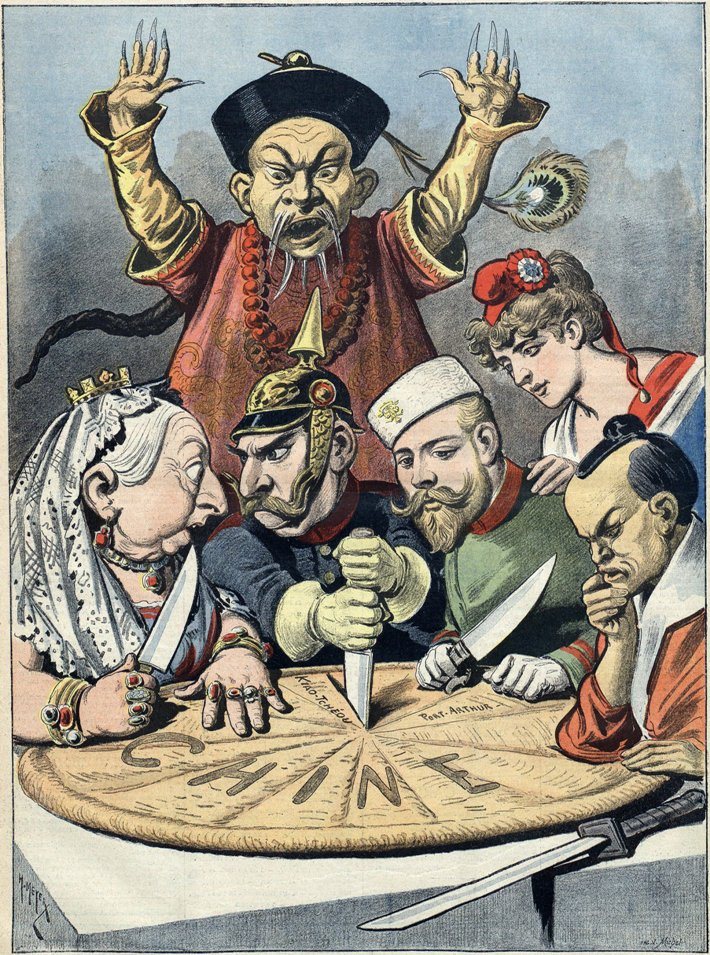
64.
What is the best interpretation of this political cartoon?
a)
China successfully resisted imperialism
b)
Chine modernized and became imperialist
c)
China was divided into spheres of influence by imperialist powers
65.

Northern Europe is a _________________ economy.

a)

Post industrial

b)

Industrial & manufacturing

c)

Socialism

d)

Capitalistic

66.

The landscape of Northern Europe was created by-

a)

Volcanoes

b)

Glaciers melting

c)

Viking invasions

d)

Earthquakes

67.

Great Britain is made up of

a)

England, Scotland and Wales

b)

England, Scotland, Wales and Northern Ireland

c)

England and Scotland

68.

What city is the capital city of the United Kingdom?

a)

Edinburgh

b)

Paris

c)

London

d)

Dublin

69.
Long, steep-sided glacial valley now filled by seawater
a)
hot spring
b)
fjord
c)
entrepot
d)
geothermal energy
70.
_______ is contributing to wetland destruction, with many lakes in Norway and a significant proportion of lakes in Sweden and Finland showing its impact
a)
Deforestation 
b)
Acid Rain
c)
Climate change
d)
Overfishing
71.
Due to dry conditions, poor soil quality, extremely cold temperatures, and frozen ground, vegetation in the _____ climate is limited
a)
humid continental
b)
marine west coast
c)
subartic
d)
arctic tundra
72.

Millions of years ago glaciers created ________ and lakes in Northern Europe .

a)

volcanoes

b)

fjords

c)

islands

d)

icebergs

73.

The Eiffel Tower is located in

a)

Great Britain

b)

France

c)

Germany

d)

Ireland

74.

This makes for a mild climate in NW Europe

a)

Trade Wind

b)

Mistral

c)

Foehns

d)

North Atlantic Current

75.
Which action have cities in Northwestern Europe taken to combat environmental problems caused by acid rain?
a)
prohibited the use of limestone, which is corroded by acid, as a building material
b)
required factories to build tall smokestacks to carry factory emissions away from populated areas
c)
applied acid-resistant coatings to vulnerable buildings and statues
d)
banned the use of fossil fuels in homes and factories
76.
Acid rain is a serious problem in some countries.
a)
True 
b)
False
77.
What is the capital of France?
a)
Bordeaux
b)
Lyon
c)
Paris
d)
Nice
78.
What is a Peninsula?
a)
A piece of land surrounded by water
b)
A piece of land with three sides surrounded by water
c)
A narrow piece of land connecting two larger pieces of land
d)
A narrow stretch of water connecting two larger bodies of water
79.

Who was the leader of the Soviet Union during its collapse?

a)

Vladimir Lenin

b)

Joseph Stalin

c)

Ivan the Terrible

d)

Mikhail Gorbachev

80.

When did the Chernobyl disaster happen?

a)

July 28, 1985

b)

April 26, 1986

c)

June 20, 1987

d)

May 32, 1986

81.

Which Country was the scene of the Chernobyl Accident?

a)

Uganda

b)

Romania

c)

Ukraine

d)

Poland

82.

What is communism?

a)

An economic system where the government owns all property, controls the economy, and tries to achieve equality

b)

An economic system based on private property, competition, profits, and individual freedom.

83.

What is capitalism?

a)

An economic system where the government owns all property, controls the economy, and tries to achieve equality

b)

An economic system based on private property, competition, profits, and individual freedom.

84.

What type of Economy did the U.S.S.R. have?

a)

Communist

b)

Traditional

c)

Capitalist

85.
Which physical feature separates the European and Asia sides of Russia
a)
The Ural Mountains
b)
The Black Sea
c)
The Volga River
d)
Lake Baikal
86.

Russia was also known as the Soviet Union and the U.S.S.R.

a)

True

b)

False

87.

Name the German Philosopher that founded communism

a)

Karl Marx

b)

John Lenin

c)

Adam Smith

d)

Joseph Stalin

88.

An economic system of public ownership of all property, all wealth is shared, and there are no classes of society is known as?

a)

Communism

b)

Capitalism

c)

Neo-Colonialism

d)

Pessimism

89.

Russians faced many hardships during __________ which led to strikes and "bread and freedom " protests (and eventually to the Russian Revolution)

a)

World War I

b)

World War II

c)

The reign of Iva the Terrible

d)

Perestroika

90.

Who was the Soviet Dictator whose 5 year plan to modernize the country led to millions of deaths from famine.

a)

Joseph Stalin

b)

Vladimir Putin

c)

Donald Lenin

d)

Karl Marx

91.
Cuneiform symbols were made with wedge shaped marks on clay tablets
a)
True
b)
False
92.
Who developed the system of writing?
a)
Babylonians
b)
Sumerians
93.
Civilization in Mesopotamia developed between which two rivers?
a)
the Persian Gulf and the Mediterranean
b)
the Tigris and the Persian Gulf
c)
the Persian Gulf and the Euphrates
d)
the Euphrates and the Tigris
94.
Who wrote a legal code that covered most areas of daily life?
a)
Gilgamesh
b)
Hammarabui
c)
Nineveh
d)
Sargon
95.
The Sumerian writing system was called
a)
Cuneiform
b)
Hieroglyphs
c)
English
d)
Sargon
96.

Which of these are Sumerian inventions?

a)

Writting

b)

Wheel

c)

Math

d)

All of them

97.
Babylonian leader who created the first written code of 282 laws that dealt with almost every part of daily life
a)
Gilgamesh
b)
Sargon
c)
Hammurabi 
d)
Sumer
98.

Curved strip of land that runs from the Mediterranean Sea to the Persian Gulf

a)

Mesopotamia

b)

Fertile Crescent/cradle of civilization

c)

silt

d)

Babylon

99.

The word "Mesopotamia" means

a)

middle of the fertile crescent

b)

land in the middle of the desert

c)

land between 2 rivers

d)

land north of the sea

100.
A gradual transition from fertile to less productive land.
a)
desertification
b)
fault
c)
irrigation
d)
nonrenewable
101.

The region that lies between the Tigris and Euphrates rivers )

a)

Mesoamerica

b)

Mesopotamia

c)

Fertile Crescent

d)

Indus

102.

Most of the people of Iran, Iraq, and Turkey are which of the following?

a)

Muslims

b)

Christians

c)

Jews

d)

Pastafarians

103.
The Sumerians developed ____________, the world's first system of writing.
a)
cuneiform
b)
scribe
c)
epics
d)
cylinder seals
104.
Since 1979, Iran is this type of government.
a)
theocracy
b)
democracy
c)
monarchy
d)
communist
105.

An area in which the properties of the land undergo a radical change

a)

Transition Zone

b)

Sahel

c)

Desert

d)

Savannah

106.

Steppe region extending from Senegal to Somalia that receives little rainfall.

a)

Transition Zone

b)

Sahel

c)

Harmattan

d)

Desertification

107.

Agriculture that provides the basic needs of a family with a little surplus.

a)

Subsistence Farming

b)

Nuclear Farming

c)

Commercial Agriculture

d)

Patriarchal Agriculture

108.

A family that is headed by a male family member,

a)

Patriarchal

b)

Maleclanical

c)

Nuclear Family

d)

Animist

109.

Religious beliefs in which nature and objects, such as animals and mountains are thought to have spirits.

a)

Monothiestic

b)

Animist

c)

Christianity

d)

Muslim

110.
Mansa Musa Traveled To The Holy City Of __________
a)
Muslims
b)
Mecca
c)
The Byzantine Empire
d)
None Of The Above
111.
What religion did Mansa Musa practice?
a)
Islam
b)
Christiantity
c)
Animism
112.
Under Mansa Musa the of Empire of Mali _________.
a)
collapsed
b)
doubled in size
c)
was founded
113.

How rich was Mansa Musa?

a)

He was the richest person in human history

b)

He was richer than bill gates

c)

He was the richest person from the past, but modern rich people beat him

d)

He was the richest African

114.
Ghana, Mali, and Songhai all traded which TWO items?
a)
Gold and fish
b)
Gold and salt
c)
Gold and timber
d)
Gold and bronze
115.
What was the main religion of the Empire of Songhai?
a)
Christianity
b)
Buddhism 
c)
Hinduism
d)
Islam
116.

Which city that was once the center of the Mali Empire became the center for the Songhai Empire?

a)

Mecca

b)

Timbuktu

c)

Djenne

d)

Gao

117.

Which of the following best accounts for the European influence on Africa by 1914?

a)

European countries that were the first to explore Africa in the fifteenth and sixteenth centuries became the most dominant in Africa by 1914.

b)

European countries that were the first to industrialize came to dominate Africa by 1914.

c)

European countries that had republican and democratic governments were less likely to dominate Africa than countries with more authoritarian regimes.

d)

European countries that were strongly influenced by national churches were most likely to dominate Africa for missionary purposes.

118.

At the end of the 1800s, colonies were generally seen as a...

a)

place to banish criminals.

b)

sign of a country's relative power.

c)

location to train military forces.

d)

method for suppressing nationalism.

119.

The seizure of a country or territory by a stronger country is called ___________. When this occurred, stronger countries dominated the political, social and economic life of the weaker country or territory.

a)

racism

b)

humanitarianism

c)

marketing

d)

imperialism

120.
Why were European countries interested in colonizing Africa during the Age of Imperialism?
a)
They wanted Africa's natural resources
b)
They wanted land to develop new types of ships
c)
They wanted to create a perfect society
d)
They wanted to learn new languages
121.
What sparked the beginning of the genocide in Rwanda?
a)
President was assassinated
b)
Hutus called Tusis cockroaches
c)
Belgium left Rwanda
d)
Rwanda declared it's independence
122.

The two major ethnic groups in Rwanda are:

a)

Hera and Tari

b)

Hutu and Tari

c)

Hutu and Tulsi

d)

Hutu and Tutsi

123.
What is the definition of a genocide?
a)
A widely held but fixed and oversimplified image or idea of a particular type of person or thing.
b)
The deliberate killing of a large group of people, especially those of a particular ethnic group or nation.
c)
Prejudice, discrimination, or antagonism directed against someone of a different race based on the belief that one's own race is superior.
d)
Preconceived opinion that is not based on reason or actual experience.
124.

Illegal killing or removal of wildlife from their habitats

a)

poaching

b)

extinction

c)

desertification

125.

This is a building where Muslims worship:

a)

church

b)

temple

c)

mosque

d)

bank

126.

What was the purpose of the Berlin Conference?

a)

African leaders met to discuss ways to get Europeans out of Africa.

b)

African and European leaders met to decide how to divide Africa's resources.

c)

European leaders met to decide how Africa should be divided among them.

d)

European leaders met to discuss fair wages for Africans.

127.
Which challenge did many African nations face after gaining independence?
a)
violence from rival groups living together
b)
lack of education / government training to run a country 
c)
their economy was dependent on the European country that colonized them
d)
All of the above 
128.
Which physical feature is located in East Africa? 
a)
Great Rift Valley 
b)
Congo Basin
c)
Cape of Good Hope 
d)
Sahara 
129.
The Great Rift Valley was formed mainly by 
a)
Shifting tectonic plates 
b)
Seawater erosion
c)
Nile River flooding
d)
Large meteor 
130.
What is the highest mountain in Africa?
a)
Mount Everest
b)
Mount Kilimanjaro
c)
Rocky Mountains
d)
Alps