wayground logo

Free Printable Worksheets

Font size

S
M
L
XL
Worksheets

Earth Science Review

Total questions: 65

Worksheet time: 1hrs 4mins
Name
Class
Date
1.
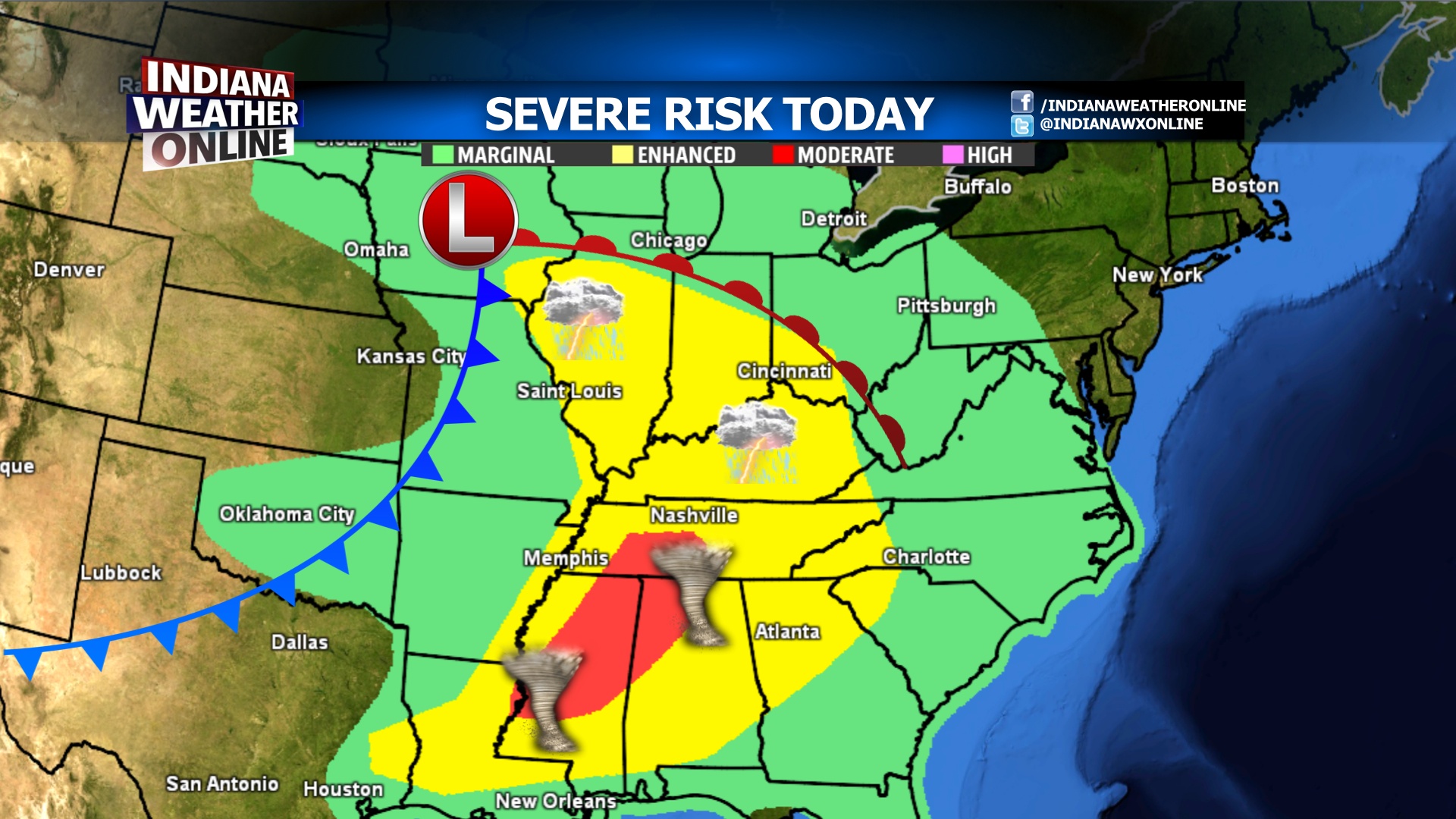
What does this picture show?
a)
weather
b)
climate
2.
In the summer we usually experience high temperatures and very little rain.
a)
weather
b)
climate
3.
We are expecting a cold front to move into the area later today.
a)
weather
b)
climate
4.
The typical weather in the rain forest is warm and rainy.
a)
weather
b)
climate
5.
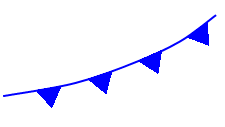
What does this symbol show on a weather map?
a)
cold front
b)
warm front
6.
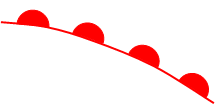
What does this image show on a weather map?
a)
cold front 
b)
warm front
7.
Over the last decade we have had an increase in the amount of rain in our area.
a)
weather
b)
climate
8.
The high temperature today will be near 75 C.
a)
weather
b)
climate
9.
What causes ocean currents in the Northern Hemisphere to curve to the right?
a)
Earth's orbit around the Sun
b)
Earth's spinning on its axis
c)
Earth's magnetic field
d)
Earth's force of gravity
10.
If the Earth did not rotate on its axis, there would be no
a)
Greenhouse effect
b)
Coriolis effect
c)
Global warming
d)
Convection
11.
Earth’s climate system is powered mainly by energy from:
a)
Tilt
b)
The sun
c)
Latitude
d)
The rain shadow
12.
Movements of ocean water in a continuous flow are called?
a)
ocean currents
b)
global winds
c)
air mass
d)
front
13.
What causes wind to blow?
a)
Differences in longitude
b)
Shock waves from clouds
c)
Differences in air temperature and pressure
d)
The rotation of earth
14.
Currents that are far beneath the surface
a)
deep ocean currents
b)
surface currents
c)
current
d)
global winds
15.
Surface currents move because of trade winds and westerlies
a)
false
b)
true
16.
The horizontal movement of air caused by the differences in air pressure
a)
jet stream
b)
monsoon
c)
wind chill factor
d)
wind
17.
These are the winds that blow from the east to the west
a)
westerlies
b)
easterlies
c)
trade winds
d)
jet stream
18.
These are the winds that happen between the equator and the poles
a)
westerlies
b)
easterlies
c)
global winds
19.
Deep Ocean currents are a result of
a)
Global Wind Patterns
b)
Earth's Rotation
c)
Density
d)
All of the above
20.
Surface currents are a result of
a)
Global Wind Patterns
b)
Earth's Rotation
c)
Density
d)
All of the above
21.
The Gulf stream carries _____________ water from the east coast of The United States to the West coast of Europe.
a)
Cold
b)
Warm 
c)
Freezing
d)
Fresh
22.
What happens to a current when it comes in contact with a continent or landmass?
a)
It continues over the continent
b)
It stops
c)
It changes direction
d)
It is absorbed by the land
23.
Due to the Coriolis Effect, water in the northern hemisphere moves
a)
clockwise
b)
counter clockwise
c)
both
d)
neither
24.
Due to the Coriolis Effect, water in the southern hemisphere moves
a)
clockwise
b)
counter-clockwise
c)
both
d)
neither
25.

Warm ocean currents generally come from

a)

The North Pole

b)

The South Pole

c)

The Equator

26.

Cold ocean currents generally come from

a)

The North Pole

b)

The South Pole

c)

The Equator

27.
Two types of water currents are
a)
local and global
b)
sea and land
c)
surface and deep
d)
warm and cold
28.
Ocean currents have an affect on which two things
a)
climate and weather
b)
temperature and density
c)
land and sea
d)
equator and poles
29.
The large, circular surface-current pattern found in each ocean.
a)
California Current
b)
Surface Current
c)
Gyre
d)
Global Conveyor Belt
30.
What process brings the deep cold ocean currents up to the surface?
a)
Conduction
b)
Global Wind Patterns
c)
Convection Currents
d)
Temperature and salinity
31.
Why are surface currents at the surface of the ocean?
a)
colder temperature
b)
colder temperature & more salinty
c)
warmer temperature & less salinty
d)
less salinty
32.
This type of wind comes from the POLES. It blows from east to west and brings freezing weather. 
a)
Prevailing Westerlies
b)
Polar Easterlies
c)
Polar Westerlies
d)
Horse Latitudes
33.

Which wind band is shown in Location B

a)

Polar Easterlies

b)

Westerlies

c)

Trade Winds

d)

Polar Westerlies

34.

Band D is the ____________ and moves from ________________.

a)

Polar Easterlies; east to west

b)

Westerlies; west to east

c)

Trade Winds; east to west

d)

Trade Winds; west to east

35.
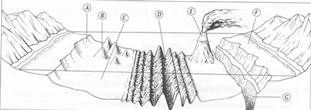
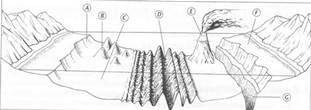
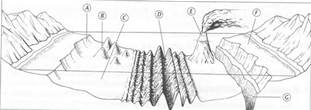
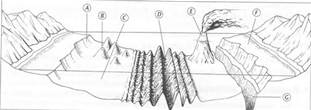
What is letter C?
a)
Mid-Ocean Ridge
b)
Cont. Shelf
c)
Cont. Slope
d)
Abyssal Plain
36.
What is letter E?
a)
Volcanic Island
b)
Seamount
c)
Mid-Ocean Ridge
d)
Abyssal Plain
37.
What is letter A?
a)
Cont. Shelf
b)
Cont. Slope
c)
Seamount
d)
Abyssal Plain
38.
What is letter G?
a)
Mid-Ocean Ridge
b)
Rift
c)
Trench
d)
Cont. Shelf
39.
What letter is B?
a)
Cont. Shelf
b)
Cont. Slope
c)
Mid-Ocean Ridge
d)
Seamount
40.
The gradually sloping part of a continent that extends under the ocean is the...
a)
continental slope
b)
continental shelf
c)
abyssal plain
d)
trench
41.
Seamount is similiar to...
a)
a volcanic island
b)
a small mountain or volcano
c)
The Great Plains
d)
The Grand Canyon
42.
The continental slope is located at the end of the...
a)
shoreline
b)
continental shelf
c)
mid ocean ridge
d)
abyssal plain
43.
The place where new ocean floor forms is called the...
a)
mid ocean ridge
b)
abyssal plain
c)
trench
d)
continental shelf
44.

The amount of dissolved salt present in the water

a)

salinity

b)

chlorine

c)

nitrogen

d)

density

45.

Latitude plays a major role in determining the climate, or long-term weather patterns, of an area. Because of differences in the intensity of solar energy, climates in higher latitudes are generally colder than climates in lower latitudes. What causes some areas of Earth to receive less intense solar energy than others?

a)

the mass of Earth

b)

the curve of Earth

c)

the density of Earth

d)

the elevation of Earth

46.

Which of the following explains why there are fewer air molecules at the top of a mountain when compared to that at sea level?

a)

Air pressure stays the same as altitude increases

b)

The air is too heavy

c)

Air pressure decreases as altitude increases

d)

Air pressure increases as altitude increases

47.

Which of the following human activities releases the greatest amount of greenhouse gases into the atmosphere?

a)

Using solar energy

b)

Building cement buildings

c)

Burn fossil fuels (like gas and coal)

d)

Polluting our rivers and streams

48.
Our _________ is the layer of gases that surrounds our planet.
a)
ocean
b)
weather
c)
atmosphere
d)
ozone
49.
In which layer of the atmosphere do we live and weather occurs?
a)
stratosphere
b)
thermosphere
c)
mesosphere
d)
troposphere
50.
Where is the ozone layer, which absorbs UV radiation, located in our atmosphere?
a)
stratosphere
b)
thermosphere
c)
mesosphere
d)
troposphere
51.
Which layer of our atmosphere has no outer limits? (Hint: where satellites are located)
a)
ionosphere
b)
stratosphere
c)
thermosphere
d)
exosphere
52.

In which layer of the atmosphere is the most water vapor found?

a)

thermosphere

b)

mesosphere

c)

troposphere

d)

stratosphere

53.

Which layer of the atmosphere would jets fly in to avoid a thunderstorm?

a)

troposphere

b)

thermosphere

c)

mesosphere

d)

stratosphere

54.

On a mountain in the spring, snow melts and trickles into a creek. In turn, the creek flows into a river, which eventually reaches the ocean. Of which part of the water cycle is this an example?

a)

Runoff

b)

Condensation

c)

Evaporation

d)

Transpiration

55.

Water moves under Earth’s surface to fill in open spaces in rocks or soil. What is this type of water called?

a)

watershed

b)

water table

c)

groundwater

d)

surface water

56.

Deep ocean currents are mostly caused by

a)

temperature

b)

salinity

c)

altitude

d)

coriolis effect

57.

Which is the main factor used to divide the atmosphere into layers?

a)

Altitude

b)

Elevation

c)

Ozone

d)

Air temperature

58.

Bryan is doing a science experiment on the stomata of plants. He wants to study how tomato plants are involved in the water cycle. What is the main role of plants in the water cycle?

a)

They take in water from the air.

b)

They release water vapor into the air.

c)

They provide a surface for condensation.

d)

They store water in their stems and leaves.

59.

Many factors are used to determine the climate of an area. Which of the following is one of the main factors that determine climate?

a)

humidity

b)

air pressure

c)

elevation

d)

wind conditions

60.

Which of the following is the best example of how energy can transfer in the water cycle?

a)

a flooding river depositing silt on a floodplain

b)

a warm ocean current warming the air above it

c)

ocean water depositing sand particles on a shore

d)

water seeping through the soil and dissolving salts

61.

Humans can cause different types of environmental pollution. When household cleaners are dumped down the drain and make their way into the water supply, which type of pollution has taken place?

a)

air pollution

b)

biological pollution

c)

chemical pollution

d)

thermal pollution

62.

During El Niño years, warm water in the Pacific Ocean flows eastward, toward North America. How might this affect the climate of western coast of North America?

a)

It will be cooler and drier than usual.

b)

It will be warmer and drier than usual.

c)

It will be cooler and wetter than usual.

d)

It will be warmer and wetter than usual.

63.

Which two are important greenhouse gases?

a)

carbon dioxide

b)

oxygen

c)

methane

d)

nitrogen

64.

What type of soil can retain the greatest amount of water?

a)

one that has low porosity

b)

one that has high porosity

c)

one that has low permeability

d)

one that has high permeability

65.

The most abundant gas in the atmosphere.

a)

Oxygen

b)

Ozone

c)

Nitrogen

d)

Carbon Dioxide