Wayground logo

Free Printable Worksheets

Font size

S
M
L
XL
Worksheets

Q3 Exam Review

Total questions: 91

Worksheet time: 58mins

Name
Class
Date
1.

Hellenistic culture is a perfect example of

a)

isolation

b)

monarchy

c)

equal rights

d)

cultural diffusion

2.

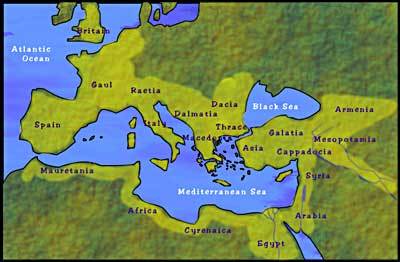
Who united most of the ancient world into one empire (see the picture above)?

a)

Archimedes

b)

Philip II

c)

Alexander the Great

d)

Plato

3.

A wealthy, upperclass person in the Ancient Roman Republic

a)

patrician

b)

plebian

c)

counsul

d)

dictator

4.
An ordinary citizen in the ancient Roman Republic
a)
patrician
b)
plebian
c)
counsul
d)
mercenary
5.

Which group most heavily influenced Roman art and architecture?

a)

Babylonians

b)

Greeks

c)

Egyptians

d)

Persians

6.
In what sea was Rome a peninsula, which allowed it to prosper in trade and interact with and conquer other lands? 
a)
Red
b)
Black
c)
Mediterranean
d)
Arabian
7.
What is a form of government called in which the leader is put into office by citizens with the right to vote?
a)
Republic
b)
Monarchy
c)
Empire
d)
Theocracy
8.
Who made himself dictator for life and was seen as a hero to the plebeians because he gave them land & food, but was power-hungry to the patricians?
a)
Julius Caesar
b)
Mark Antony
c)
Scipio
d)
Caesar Augustus
9.
By expanding the empire and reorganizing the military and government to make it safe and strong, Caesar Augustus created a new era of prosperity that lasted 200 years called 
a)
Pax Romana
b)
Golden Years
c)
Pax Augustus
d)
Age of Prosperity
10.

Which emperor made Christianity the official religion of Rome?

a)

Caesar

b)

Augustus

c)

Diocletian

d)

Constantine

11.

Which is NOT a reason for the Fall of Rome?

a)

Barbarian Invasion

b)

Weak Emperors

c)

Corrupt government

d)

Disease

12.

Which generalization about the Roman Empire can be made based on the information shown in this chart?

a)

Rome traded only within the empire.

b)

Expansion of the empire provided access to varied trade goods.

c)

Olive oil was the most important of the Roman trade goods.

d)

Conquered areas were required to build structures with marble from Greece.

13.

Both the Han and the Roman empires declined as a result of

a)

undisciplined armies and limited access to trade

b)

overexpansion and foreign invasions by nomadic peoples

c)

inefficient theocratic rulers and few government regulations

d)

harsh climates and high taxes

14.

The cultures in North Africa are more closely associated with Middle Eastern cultures than with the cultures of the rest of Africa mainly because

a)

the geography of Africa has limited contact between North Africa and the rest of Africa

b)

only North Africa was part of the Roman Empire

c)

most of the people of North Africa have emigrated from Asia

d)

sub-Saharan Africa has been subject to European imperialism

15.

The Twelve Tables were the written laws of

a)

ancient Babylonia

b)

the Mauryan Empire

c)

the British Empire

d)

ancient Rome

16.

The political system of the ancient Roman Empire was characterized by

a)

a strong central government

b)

rule by a coalition of emperors and religious

leaders

c)

universal suffrage in national elections

d)

strict adherence to constitutional principles

17.

The ancient Romans' most significant contribution to Europe has been in the area of

a)

economics

b)

poetry

c)

drama

d)

law

18.

A major contribution of the Roman Empire to Western society was the development of

a)

gunpowder

b)

the principles of revolutionary socialism

c)

monotheism

d)

an effective legal system

19.

An immediate result of the fall of the Roman Empire was

a)

a renewed interest in education and the arts

b)

a period of disorder and weak central government

c)

an increase in trade and manufacturing

d)

the growth of cities and dominance by the middle class

20.

Rome had two _________ to keep balance, so they could veto the other's plans.

a)

consuls

b)

plebeians

c)

senators

d)

kings

21.

Rome created a ________, which allowed voters to elect leaders into office to make laws.

a)

republic

b)

democracy

c)

monarchy

d)

oligarchy

22.

This brings water into a city. Some still work in Rome today!

a)

copper pipes

b)

aqueducts

c)

an irrigation system

d)

wells

23.
The period of time of peace and success at the beginning the Roman Empire 
a)
Pax Romana 
b)
 Era Of Good Feelings 
c)
Roaring 200's 
d)
Ear of Corn 
24.

Who is credited with the split of the Roman Empire for easier management?

a)

Diocletian

b)

Justinian

c)

Constantine

d)

Theodora

25.

Why is the location of Constantinople ideal?

a)

Provided protection of the eastern frontier

b)

far from Germanic invasions in western empire

c)

had crossroads of trade

d)

all of the above

26.

How did adopting Christianity help Constantine?

a)

By making it legal, it stopped persecutions

b)

By making Christianity legal, it unified the people

c)

By making Christianity legal, it spread throughout the empire.

d)

All of the above

27.

The Byzantine Empire is the name we call

a)

The Eastern Roman Empire after the West fell

b)

The Western Roman Empire after the East fell

c)

Constantinople

d)

The Hagia Sophia

28.
What was the primary language of the Byzantine Empire?
a)
Greek 
b)
Roman
c)
Latin
d)
Turkish
29.

Justinian's most famous achievement is the

a)

Wall of Constantine

b)

Holy Crusade

c)

Crowning of Charlemagne

d)

Justinian Code

30.
Justinian's Code was an important contribution in the area of...
a)
The military
b)
Architecture
c)
Religion
d)
The law
31.
What was the Hagia Sophia?
a)
Church in Byzantine Empire
b)
Capital city of Byzantine Empire
32.

Constantine issued the Edict of _________ allowing Christians to practice their faith.

a)

Rome

b)

Milan

c)

Constantinople

d)

Hagia Sophia

33.

What are the similarities between the Roman Catholic and the Eastern Orthodox Church?

a)

Both united the people

b)

Both are monotheistic and worship the same god

c)

Both are forms of Christianity

d)

All of the above

34.
Which of the following choices was NOT a  reason for why Constantine chose to move the capital east to Byzantium
a)
 it was in a great location for trade
b)
it was far away from barbarians in the west
c)
it was on an easy to defend peninsula
d)
it was in a place that was holy to many Christians 
35.
Who moved the Roman empire's capital east from Rome to Byzantium?
a)
 Justinian
b)
Augustus Caesar
c)
Julius Caesar
d)
Constantine
36.

A group of territories or nations under a single ruler or government is known as a/an

a)

empire

b)

mosaic

c)

proverb

d)

philosophy

37.
Constantinople served as a center for what two cultures?
a)
Greece and Rome
b)
Persia and Rome
c)
Phoenicia and Rome
d)
Greece and Hebrew
38.
Why was Constantinople such a prosperous city?
a)
Trade hub for Europe, Asia, and Africa
b)
Great architecture 
c)
Autocratic rulers 
d)
The pope lives there
39.

One economic advantage of naming Constantinople as the capital of the Eastern Roman Empire was that it __________

a)

was surrounded by protective walls.

b)

was a center of religious power.

c)

had shrunk in size.

d)

was located near trade routes between Europe and Asia.

40.

What does secular mean?

a)

optional

b)

centered on religion

c)

non religious

41.

What is a fief?

a)

large piece of land

b)

manor

c)

payment

42.

Agreements between those who owned the land and those who worked on the land were called?

a)

manor obligations

b)

feudal obligations

c)

vassals

d)

fiefs

43.

Large farming communities that included manor houses, cultivated lands, woodlands, pastures, fields, and pastures were called?

a)

Manors

b)

feudalism

c)

vassals

d)

fiefs

44.

Choose all correct answers. Manors were ___________.

a)

made their own food

b)

self sufficient

c)

made their own clothing

d)

made their own housing

45.

Was there social mobility (could you move up) in the Manorial system?

a)

No

b)

Yes

46.

Why did peasants enter into feudal agreements with Vassals?

a)

to make money

b)

for protection

c)

for better trade

47.
What is the name for the system of promises between lords and vassals that governed Europe in the Middle Ages?
a)
Christianity
b)
Feudalism
c)
Shinto
d)
Chivalry
48.
Which answer choice shows the order of Feudal Society from highest to lowest?
a)
peasants, knights, nobles, king
b)
king, nobles, knights, peasants
c)
knights, king, peasants, serfs
d)
merchants, knights, commoners, serfs
49.
Who was responsible for farming the fields on a manor?
a)
knights
b)
peasants
c)
merchants
d)
nobles
50.
What is the name for the system of promises between lords and vassals that governed Europe in the Middle Ages?
a)
Christianity
b)
Feudalism
c)
Shinto
d)
Chivalry
51.

How did the plague impact Europe? (Choose all that apply)

a)

Trade declined due to bankrupt businesses

b)

30 - 60% of Europe's population died (1/3 to 2/3 of the population)

c)

It contributed to the decline of feudalism

d)

More cathedrals were built

52.
Where did the plague start?
a)
Asia
b)
Africa
c)
Europe
d)
Australia 
53.
How did the Bubonic Plague spread?
a)
Bad water
b)
Fleas on rats
c)
Looking at people
d)
Alignment of the stars
54.
Which religious group fought against the Christians in the Crusades?
a)
Hindus
b)
Buddhists
c)
Muslims
d)
Catholics
55.
What was special about the Holy Land?
a)
it was where Jesus had lived
b)
it was where the pope's castle was
c)
it was the location of gold mines
d)
it was the birthplace of the Prophet Muhammad
56.
This city was on a crossroads between Europe and the Middle East.
a)
Cairo
b)
Constantinople
c)
Paris
d)
Moscow
57.

Which map represents the Silk Road?

a)
b)
c)
58.

Which map represents the Trans-Saharan Trade Route?

a)
b)
c)
59.

Which map represents the spread of the Bubonic Plague?

a)
b)
c)
60.
The Crusades were inspired mainly by 
a)
money
b)
religion
c)
politics
d)
trade
61.
What of the following is not true of the Crusades?
a)
Knights wore or carried red crosses
b)
Christians wanted to help the Jews take over Jerusalem
c)
Christians wanted to reclaim the Holy Land from Muslims
d)
Trade increased
62.
Feudalism developed mainly because 
a)
the monarchy was too powerful
b)
the Catholic Church was failing
c)
people needed protection
d)
King John created it
63.
What was a major effect of the Black Death?
a)
trade decreased
b)
it strengthened feudalism 
c)
food prices inflated
d)
manors became overcrowded
64.
* helped to end feudalism
* trade increased
* Christianity spread
* towns flourished again
These are all effects of which event 
a)
signing of the Magna Carta
b)
The Crusades
c)
The Black Death
d)
The Roman Catholic Church
65.
The picture best illustrates
a)
a fief
b)
a farm
c)
a guild
d)
a manor
66.
Religious officials who lead a church service are called
a)
mass
b)
clergy
c)
noble
d)
vassal
67.
In 632, Abu Bakr became the first _____________, a title that means “successor”. He promised Muslims that he would closely follow Muhammad’s example.
a)
Bureaucrat
b)
Sunnis
c)
Caliph
d)
Stronghold     
68.
All the regions had fallen under Muslim control by 1400 except for the region in this color
a)
Orange
b)
Red
c)
Purple
d)
Green
69.
Where did Islam originate?
a)
Abrabian peninsula
b)
China
c)
North Africa
d)
India
70.
1.  After the death of Muhammad, what led to the split between the Sunni and Shia? 
a)
They could not agree on who should become leader.
b)
They could not agree if they were allowed to eat pork.
c)
They could not agree on how many times they should pray each day.
d)
They could not agree on how to make Greek fire.
71.
Where did the Islamic Empire expand?
a)
all around the world
b)
the entire continent of Africa
c)
across Asia and Africa and into Spain
d)
into Australia
72.
How did Muslims treat the people they conquered?
a)
They forced them to serve as soldiers.
b)
They enslaved them for building projects.
c)
They allowed them religious freedom.
d)
They forced them to convert to Islam.
73.
What did non-Arab converts have to do in the Umayyad dynasty?
a)
fight in the military
b)
become teachers in Islam
c)
pay a poll tax
d)
leave the cities
74.
What is the best definition of a golden age?
a)
a period of great prosperity
b)
a time when gold was used to make weapons and tools
c)
a peaceful, happy time in history
d)
a time during which a society or culture is at its peak
75.
How did trade impact the spread of Islam? 
a)
Traders spread Muslim ideas as they traveled. 
b)
Trade had no impact. 
c)
Trade slowed the spread of Islam because Muslim traders were also warriors. 
d)
Merchants developed a new denomination of Islam. 
76.
Why did the Muslim way of praying lead to advances in astronomy? 
a)
Muslims prayed facing the stars. 
b)
Muslims wanted to know the precise direction of Mecca. 
c)
After the feast of Ramadan ended, Muslims prayed outdoors. 
d)
The illumination of the stars symbolized the illumination of the divine. 
77.
What was the primary cultural contribution of the Muslims during their Golden Age?
a)
The Muslims preserved the works of the ancient philosophers and added work in mathematics, astronomy, medicine, and chemistry.
b)
The Islamic restriction on depicting living things meant that Muslims did not develop artistically.
c)
Although the material culture of the Abbasid period remained poor, Muslims were able to make some advances in music.
d)
Islamic learning was necessarily unique, as they had no access to the ancient traditions of philosophy and science.
78.
In West African Kingdoms, the dominant trade exchange was: 
a)
Gold for Salt
b)
Water for Grain
c)
Spices for Silver
d)
Cattle for Corn
79.
Mansa Musa, the ruler of Mali, was well known for:
a)
giving away enormous amounts of gold to citizens
b)
creating a taxation system to gain wealth from the gold-salt trade
c)
leading the resistance of Africans against Europeans
d)
unifying all of Africa into one tribe
80.
In steppe areas, clearing trees or herding large amounts of livestock can cause 
a)
Farmers to become angry
b)
Desertification
c)
Irrigation problems 
d)
Soil to become compacted 
81.
Process that turns fertile land into land that is too dry to support life is called 
a)
Deforestation
b)
Desertification
c)
Drought 
d)
Canopy
82.

What major landform did many of the trade routes between Western Africa and the Mediterranean Sea have to cross?

a)

Sahara Desert

b)

Mount Kilimanjaro

c)

Great Rift Valley

83.

Which line of latitude runs through the middle of Africa?

a)

Tropic of Capricorn

b)

Tropic of Cancer

c)

Equator

84.

Which of the Sahara Desert landforms consist of a flat area covered with sand, gravel, and salt?

a)

Salt Falts

b)

Regs

c)

Dunes

85.

What are long trains of camels used to transport goods called?

a)

Savannas

b)

Caravans

c)

Nomads

86.

What religion spread throughout the region through Arab traders?

a)

Islam

b)

Christianity

c)

Buddhism

87.

What was a feature that helps camels in crossing the desert?

a)

They can eat sand for food.

b)

They get their energy from the sun.

c)

They can go long periods without water.

88.

Distance from the Equator, elevation, and distance to the coast all impact Africa's...

a)

religious groups

b)

ethnic groups

c)

climate

d)

history

89.
What major river helped to shape the history, culture, and trade in West Africa?
a)
Nile River
b)
Niger River
c)
 Congo River
d)
Tigris River
90.
What geographic feature covers 25% of all of the land in Africa?
a)
Alps Mountains
b)
Himalayan Mountains
c)
Gobi Desert
d)
Sahara Desert
91.
What valuable resource from West Africa was used as the foundation for currency in theMediterranean and Arab worlds?A. goldB. silverC. riceD. rock salt
a)
Gold
b)
Silver
c)
Rice
d)
Rock Salt