
 Worksheets
Motion and Speed 2020
Total questions: 35
Worksheet time: 21mins

Sophia was trying to explaining to Tyler how to find the speed. What equation should she use to calculate speed?
speed = time/distance
speed = distance X time
speed = voleicty X time
speed = distance/time

What is the speed of the marble at 2 s?
5 m/s
5 s/m
20 m/s
20 s/m

What is the average speed of the marble's entire trip? ?
5 m/s
45 m/s
20 m/s
24 m/s


What is happening at D?
Not moving
Speeding up
Fast steady speed; moving away from the starting position
Slower steady speed; moving away from the starting position

What is happening at C?
Not moving
Speeding up
Fast steady speed; moving away from the starting position
Slower steady speed; moving away from the starting position
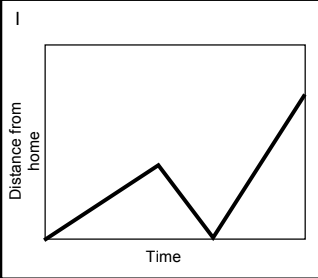
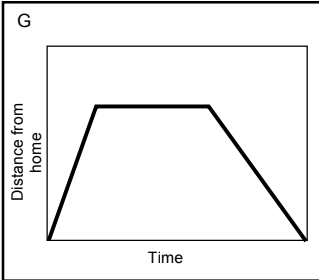
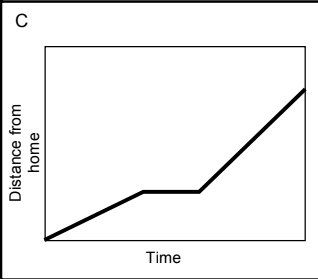
Match the description to the graph:
"The car is stopped."


Match the description to the graph:
"The car is traveling at a constant speed."
Match the description to the graph:
"The speed of the car is decreasing."
Match the description to the graph:
"The car is coming back."

How long did Charlie stop for a rest?
2.5 seconds
2 seconds
3 seconds
5 seconds

In a duck race, a rubber duck travelled 400 meters in 10 minutes. What was the rubber duck´s speed?
40
40 minutes
40mm/s
40m/m

Joe rode his bike around town. The graph below shows his position over time. Which best describes Joe’s motion between hours 1 and 2?
He traveled 0 mph.
He traveled 0.5 mph.
He traveled 2 mph.
He traveled 4 mph.
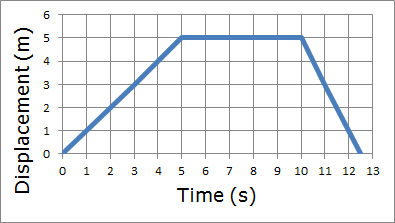
According to the graph how far does the person travel in the first 5 seconds?
2 m
10 m
0 m
5 m

What is the average speed of the object shown in the graph?
2 m/s
4 m/s
1 m/s
10 m

An eagle can fly 10 miles in 30 minutes. What is his average speed in miles per hour?
10 mph
15 mph
50 mph
20 mph

During what time interval did the boy stop riding the bike ?
0 - 5 minutes
5 - 10 minutes
10-15 minutes
15-20 minutes

Which position shows the vehicle moving the fastest?
Position L
Position M
Position N
Position O

What is the speed of the object between 4 and 6 seconds?
5 m/min
10 m/min
15 m/min
20 m/min
A sail fish can travel 34 km in 30 minutes. What is the average speed of a sail fish in km per hour?
17 km/h
34 km/h
68 km/h
1,020 km/h


Which of these is NOT an unbalanced force ?
A big ball rolling down hill
A car gaining speed to pass another car
A truck stopped at a red light
Turn to enter the cafeteria from the hallway
What is happening at A?
Not moving
Speeding up
Fast steady speed; moving away from the starting position
Slower steady speed; moving away from the starting position

How does distance change the effort when using an inclined plane?
as distance increases, effort decreases
as distance decreases, effort decreases
as distance increases, effort increases
nothing, they both stay the same

The diagram shows a wooden block being pulled up an inclined plane that is 30 cm in height. Using the inclined plane reduces the amount of force needed to life the block while increasing the-
mass of the wooden block.
surface area of the block.
pull of gravity on the block.
distance the block must move.
Which of these is true about unbalanced forces ?
Can cause a change in direction
Can cause a change in position
Can cause a change in speed
All are true.

