
 Worksheets
Human Body EOC review
Total questions: 18
Worksheet time: 36mins

The illustration below shows four lobes of the human brain.
What lobe is designated by label 2?
A. temporal
B. parietal
C. occipital
D. frontal

Which lobe of the brain is designated by number 4?
A. occipital lobe
B. parietal lobe
C. frontal lobe
D. temporal lobe
The rate at which blood flows through the human body changes in response to many factors. Which statement describes one of these factors and its effect on blood flow?
A. A high viscosity of blood causes an increased resistance in the blood vessels and leads to slow blood flow.
B. A low blood pH decreases the rate of diffusion through the blood vessels and leads to slow blood flow.
C. The changing of the shape of red blood cells to a crescent shape decreases resistance and lead to a faster blood flow.
D. The narrowing of blood vessels increases pressure and leads to a faster blood flow.
Which of the following factors would most directly affect blood flow through the circulatory system?
A. blood pressure
B. blood sugar
C. respiratory rate
D. outside temperature

Which line in the graph above best illustrates an effect of the carbon dioxide level in the blood on breathing rate before, during and after a period of exercise?
A
B
C
D
What is the body's first line of defense against infection by foreign organisms?
A. antibodies
B. lymph nodes
C. white blood cells
D. the skin
What is immunity?
A. The body's ability to produce cells that inactivate foreign cells or substances.
B. The body's ability to regulate homeostasis through feedback loops.
C. The body's ability to produce the "fight or flight" response.
D. The body's ability to use the endocrine system to fight disease.
What is the term for a strong response to a harmless antigen in the environment?
A. cell-mediated immunity
B. an allergy
C. inflammatory response
D. an autoimmune disease

A fertilized egg undergoes several stages before it is successfully implanted. The diagram below shows these stages as the fertilized egg travels through the female reproductive system.
In which of the following structures of the female human reproductive system is the blastocyst implanted during normal human development?
A. ovary
B. uterus
C. vagina
D. amniotic sac

Which structure is represented by the letter D?
A. scrotum
B. testes
C. prostate gland
D. epididymus
What is the human embryo called after the eighth week of development?
A. a zygote
B. an infant
C. a fetus
D. a morula
What is a baby called during the second trimester?
blastocyst
fetus
zygote
embryo
Although vaccines cannot be used to treat a person who is sick, they can help to prevent infections. Vaccinations tell the body to create "memory cells", which will function later to create antibodies against certain pathogens. When a person is vaccinated, what are they injected with?
live pathogens
antibodies to a disease bacterium
weakened viruses or antigens from the virus
blood from a person who has had the disease
Which of the following is the function of the cardiovascular system?
transporting oxygen and nutrients to cells and taking away wastes
mounting a response to invading pathogens
sending messages around the body
making enough blood for your body
What causes blood pressure?
removal of oxygen from the blood
cholesterol in the blood
stress that exercise puts on heart muscle
contraction of the ventricles in the heart
Many pathogens have become resistant to antibiotics because antibiotics have been so widely used. Now, pathogens that used to be killed by antibiotics are more difficult to treat. What is the best way to proceed in dealing with this public health problem?
Antibiotics should no longer be used.
Antibiotics should only be prescribed to people with bacterial infections.
Anti-viral medications should now be used instead of antibiotics.
Antibiotics should only be prescribed to people with viral infections.
The point at which the umbilical cord attaches to the fetus becomes the belly button after birth. What is the function of the umbilical cord for mother and fetus during fetal development?
Nutrients from foods digested by the mother and oxygen pass from her blood to the fetus through blood vessels in the umbilical cord.
Part of any food consumed by the mother passes from the mother’s stomach, through the umbilical cord, and into the stomach of the fetus.
Waste products produced by the fetus travel through the umbilical cord and out through the mother’s kidneys.
Liquids consumed by the mother flow through the umbilical cord and into the stomach of the fetus.
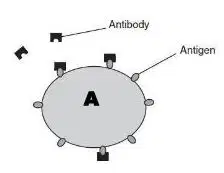
An activity that occurs in the human body is shown below.
What is being represented by figure A?
a pathogen
a lymphocyte
a white blood cell
a B-cell

