wayground logo

Free Printable Worksheets

NEW

Font size

S
M
L
XL
Worksheets

Ecology Unit Review PAP - 2022

Total questions: 61

Worksheet time: 56mins

Name
Class
Date
1.
Which organism do the owl and the weasel compete for in the food web?
a)
Hawk
b)
Spider
c)
Grasshopper
d)
Shrew
2.
Which of the following is a herbivore?
a)
cricket
b)
frog
c)
hawk
d)
shrew
3.
Which of the following would be the most likely effect, if there were a sudden increase in the cricket population?
a)
There would be a decrease in the small bird population.
b)
There would be a decrease in the grass/flowers population.
c)
There would be a decrease in the mice population.
d)
There would be an increase in the grass/flowers population.
4.
How many herbivores are in this web?
a)
1
b)
2
c)
3
d)
4
5.
How many primary consumers are there in this food web?
a)
1
b)
2
c)
3
d)
4
6.
In the energy pyramid here, which organisms have the most energy available?
a)
Producers
b)
Carnivores
c)
Herbivores
d)
Top Predator
7.

In the energy pyramid below, which organism has the least amount of energy available?

a)

Producer

b)

Primary consumer

c)

secondary consumer

d)

tertiary consumer

8.
In the energy pyramid here, how much of the energy in each level gets lost as heat or used by the organism for survival?
a)
80%
b)
90%
c)
10%
d)
20%
9.

These organisms exist within every trophic level giving nutrients back to the soil.

a)

herbivore

b)

omnivore

c)

carnivore

d)

detritivore

10.

Which level on the energy pyramid has the greatest biomass?

a)

tertiary consumer

b)

secondary consumer

c)

primary consumer

d)

Producer

11.
The Cattle Egret is often seen in the company of grazing animals.  The grazers stir up insects, which the egret then eats.
a)
Mutualism
b)
Commensalism
c)
Predation
d)
Parasitism
12.
The oxpecker is a bird that rides around on the backs of cattle and other large animals such as rhinos.  The oxpecker feeds on ectoparasites of the cattle, such as ticks, and warns the animals of approaching predators.
a)
Mutualism
b)
Commensalism
c)
Predation
d)
Parasitism
13.
The horsehair worm starts life as an egg laid in a puddle.  The puddle dries out and a grasshopper comes along and eats the egg, which promptly hatches and burrows through the gut of the insect into its body cavity.  Here, the insect grows until it reaches adulthood. At that point it starts producing chemicals which take over the brain of the insect and cause the insect to seek out water, which it jumps into.  The worm then exits the hopper and lives in the puddle, mating and laying more eggs.  The grasshopper, if it doesn't drown, may survive the ordeal. 
a)
Mutualism
b)
Commensalism
c)
Predation
d)
Parasitism
14.
relationship in which two species live closely together
a)
resource
b)
mutualism
c)
succession
d)
symbiosis
15.
A feeding relationship where one organism hunts and one is hunted.
a)
Commensalism
b)
Decomposistion
c)
Mutualism
d)
Predator-Prey
17.
In an ecosystem, which is NOT a density-
dependent limiting factor?
a)
competition
b)
parasitism
c)
predation
d)
natural disaster
17.
In an ecosystem, which is NOT a density-
dependent limiting factor?
a)
competition
b)
parasitism
c)
predation
d)
natural disaster
18.
 What does the term carrying capacity describe?
a)
The maximum number of birth rates for a population.
b)
The ability of a population to accept new immigrants.
c)
The ratio of birth rates to death rates in a population.
d)
The population size that the environment can sustain.
19.
An environmental factor such as predation, disease, and competition that depends on the number of members in a population per unit
a)
dispersion
b)
density- independent factor
c)
density- dependent factor
d)
population growth rate
20.
largest number of individuals of a population that the environment can support  
a)
carrying capacity
b)
primary succession 
c)
denitrification
d)
mutualism
21.
When a population grows past the ecosystem's carrying capacity, what happens to the population?
a)
Continues to grow
b)
The population starts to die off to return to carrying capcity
c)
The population will go extinct due to lack of resources
d)
The population grows then finds a new carrying capacity
22.

What point on the graph represents the carrying capacity or food source sustainability of the ecosystem?

a)

A

b)

B

c)

C

d)

D

23.
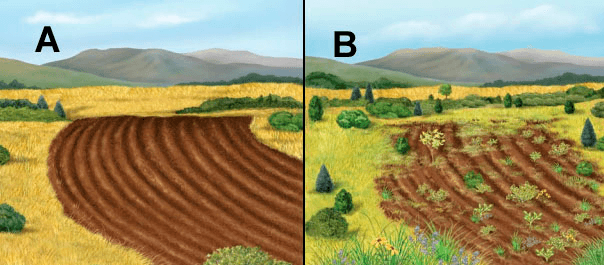
What type of succession is shown going from figure A to figure B?
a)
primary succession
b)
ecological succession
c)
secondary succession
d)
intermediate
24.
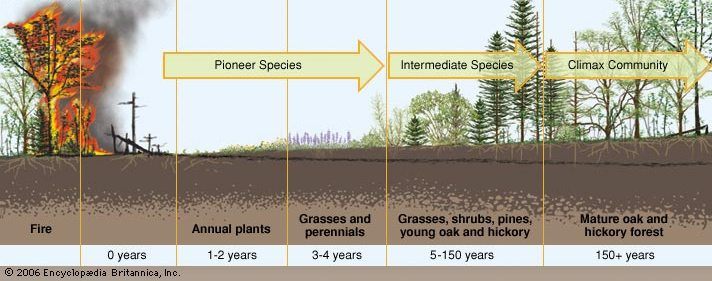
The picture shows what type of succession?
a)
primary
b)
secondary
c)
tertiary
d)
quadanary
25.
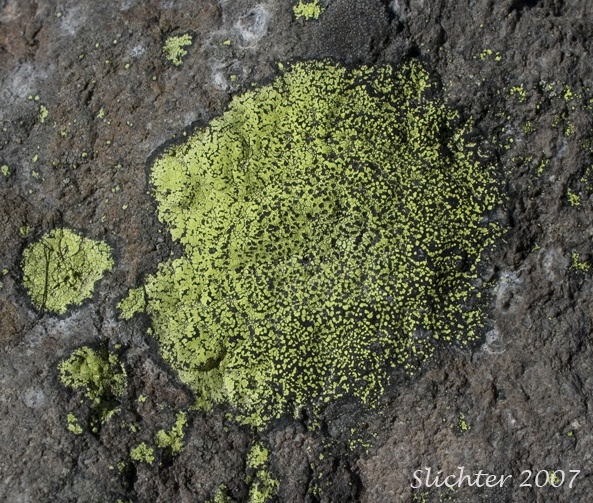
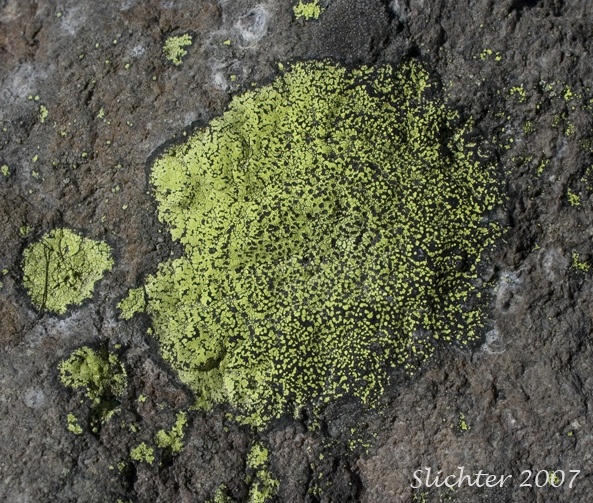
What is the name given to lichen or algae after a primary succession?
a)
pioneer species
b)
volunteer species
c)
founder species
d)
conqueror species
26.
What are examples of pioneer species in a primary succession?
a)
Bushes and Shrubs
b)
Oak trees
c)
Mossess and Lichens 
d)
A rose Bush
27.
After a volcanic eruption, lava covers the land. What is the order that plants grow to repopulate the area?
a)
Lichens → Shrubs → Grasses → Trees
b)
Lichens → tree → shrubs→Grasses
c)
Grasses → Lichens → Shrubs → Trees
d)
Lichens → Grasses → Shrubs → Trees
28.
the process by which a new community forms where no community lived before 
a)
resource
b)
invasive (non- native) species
c)
primary succession
d)
competition
29.
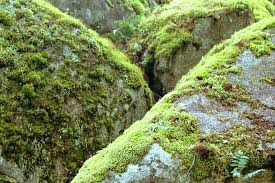
What is the first species you will see after a primary succession? (in picture)
a)
lichens
b)
grasses
c)
small plants
30.

Which of the following is the correct sequence for organizing life from least complex to most complex?

a)

Heart - Cardiac Muscle - Muscle Tissue - Muscle Cell

b)

Lung Tissue - Trachea - Nostrils - Circulatory Systtem

c)

Muscle Cell - Muscle Tissue - Bicep Muscle - Muscular System

d)

Nervous System - Nerve Cell - Brain - Brain Tissue

31.

A student is researching a microorganism that aids in a process called Nitrogen Fixation in soil and on plant roots, which of the organisms below is responsible for this process?

a)

Nitrifying Bacteria

b)

Perimicium

c)

Euglena

d)

Denitrifying Bacteria

32.

A species that is introduced to an ecosystem that has no natural predator, is a consumer and can rapidly reproduce is called

a)

Native Species

b)

Non-Native Species

c)

Predator

d)

Prey

33.

Consumers produce ________________ during cellular respiration that producers are dependent upon for survival.

a)

Glucose

b)

ATP

c)

Oxygen

d)

Carbon Dioxide

34.

Which Trophic Level would contain the greatest concentration of toxins on a food pyramid?

a)

Producer

b)

Primary Consumer

c)

Secondary Consumer

d)

Tertiary Consumer

35.

As part of the Nitrogen Cycle, animals aquire amino acids by doing which of the following?

a)

Breathing air

b)

Eating plants

c)

Drinking water

d)

produce waste

36.

If a non-native species were to be introduced into an environment, how would it affect the biodiversity of an ecosystem?

a)

Biodiversity Increases

b)

Biodiversity decreases

c)

No change to Biodiversity

d)

If

37.

What is the purpose of a decomposer (Fungi) in a biogeochemical cycle (Nitrogen or Carbon Cycle)?

a)

perform gas exchange for autotrophs

b)

extract materials from soil to recycle

c)

transport nutrients through plants

d)

return organic materials to the soil for plants to absorb

38.

Based on the food web, which organism will have the least amount of energy available?

a)

Fox

b)

Grasshopper

c)

Rabbit

d)

Grass

39.

Based on the food web, which organism is a direct source of energy for the Owl, which is a secondary consumers?

a)

Carrot

b)

Grasshopper

c)

Bird

d)

Rabbit

40.

The diagram illustrates levels of biological organization, In what order are the levels in the diagrams?

a)

Population - Community - Ecosystem

b)

Organism - Community - Population

c)

Organism - Population - Community

d)

Ecosystem - Population - Community

41.
In the energy pyramid here, how much of the energy in each level gets lost as heat or used by the organism for survival?
a)
80%
b)
90%
c)
10%
d)
20%
42.

The collective mass of all living things in a particular area or at a specific trophic level of an ecosystem is known as...

a)

Population Size

b)

Biomagnification

c)

Biomass

d)

Apex Trophism

43.

The phenomenon by which toxins concentrate in the organisms at higher trophic levels within an ecosystem is known as...

a)

Biotoxicity

b)

Biomagnification

c)

Eutrophication

d)

Predation

44.
What does a food web represent?
a)
All connections of energy flow throughout all organisms in a habitat.
b)
The specific ways that mutualism is carried out.
c)
A single pathway or energy flow between organisms. 
d)
How carnivores get their food. 
45.
A wolf eats a rabbit, that just ate some berries.  What would you call the rabbit?
a)
Producer
b)
Omnivore
c)
Primary Consumer
d)
2nd order Heterotrph
46.

What is the ultimate source of energy for most organisms?

a)

The Sun

b)

The Earth

c)

Plants

d)

Producers

47.

Which of the following correctly shows an energy pyramid?

a)

A

b)

B

c)

C

d)

D

48.
Ostriches and gazelles eat together.  They both watch for predators and danger.  Since they see things differently, they each can identify threats the other animal may not see.  Both species are benefited.  
a)
mutualism
b)
commensalism
c)
predation
d)
parasitism
49.
Mistletoe takes water and nutrients from the oak tree. This is good for the mistletoe but bad for the tree.
a)
mutualism
b)
commensalism
c)
parasitism
d)
competition
50.
A bison walks through the grass, insects fly up and are seen and eaten by egretsThis neither harms nor helps the bison, but it is easier for the egrets to get food.
a)
mutualism
b)
parasitsm
c)
commensalism
d)
competition
51.
Hermit crabs live in shells that snails don't use anymore. The hermit crab gets a nice free home.  This neither harms nor helps the snails.
a)
mutualism
b)
commensalism
c)
parasitsm
d)
predation
52.
Which of the following best describes a population?
a)
members of the same species living in the same place at the same time
b)
all the red birds in an area
c)
all types of organisms living in the same place
d)
all members of the same species
53.
The average number of people per square mile
a)
population distribution
b)
population density
c)
urbanization
d)
population rate
54.
Largest number of individuals of a population that the environment can support...  
a)
carrying capacity
b)
population crash
c)
lag phase
d)
mutualism
55.
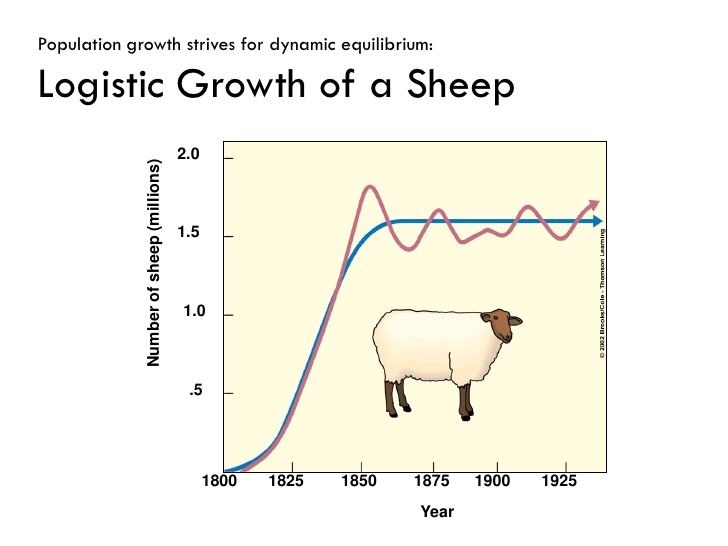
What is the carrying capacity for this sheep population?
a)
1.8 million
b)
1.25 million
c)
1.6 million
d)
1.o million
56.
Any thing or organism that regulates the size of a population of another organism is known as __________.
a)
a limiting measure
b)
a limiting factor
c)
factorization
d)
materialization of precipitation
57.
Which is NOT a process of the water cycle?
a)
precipitation
b)
freezing
c)
transpiration
d)
evaporation
58.
The process of plants losing water through their leaves is called ____.
a)
condensation
b)
evaporation
c)
transpiration
d)
exhaling
59.
Where is carbon stored in the environment?
a)
Fossil fuels
b)
Wood of trees
c)
Calcium carbonate (shells and bones)
d)
All of the above
60.
What converts nitrogen into a useable form for plants and animals?
a)
bacteria
b)
fungi
c)
rain
61.
Carbon dioxide is added to the atmosphere by
a)
Burning fossil fuels 
b)
Cellular respiration
c)
Decomposing organic matter
d)
All answers are correct