wayground logo

Free Printable Worksheets

NEW

Font size

S
M
L
XL
Worksheets

Unit 3 - Weather and Climate Review Quiz

Total questions: 48

Worksheet time: 34mins

Name
Class
Date
1.
What is the temperature according to the thermometer?
a)
70 degrees F
b)
60 degrees F
c)
70 degrees F
d)
65 degrees F
2.
What weather instrument is this and what does it measure?
a)
thermometer-temperature
b)
rain gauge-rain fall
c)
barometer-air pressure
d)
hygrometer-humidity
3.
This weather instrument is a...
a)
thermometer
b)
anemometer
c)
rain gauge
d)
barometer
4.

As you move towards the poles, what happens to temperature?

a)

temperature becomes hotter

b)

temperature becomes colder

5.
What imaginary line divides our world into the northern and southern hemispheres?
a)
equator
b)
international date line
6.
Which climate zone gets the least amount of direct sunlight and is the coldest?
a)
tropical
b)
temperate
c)
polar
7.
Which climate zone gets the most amount of direct sunlight and rainfall and is the warmest?
a)
tropical
b)
temperate
c)
polar
8.
What part of the water cycle includes rain, sleet and snow?
a)
condensation
b)
precipitation
9.
When air pressure is high, what type of weather do we experience?
a)
sunny and clear
b)
rainy and cloudy
10.
When air pressure is low, what type of weather do we experience?
a)
sunny and clear
b)
rainy and cloudy
11.
What are the daily conditions of temperature, humidity and precipitation?
a)
weather
b)
climate
12.
Clouds are made up of tiny drops of ______ or ice. The moisture in the cloud affects the weather.
a)
dust
b)
water
c)
cloud particles
d)
precipitation
13.

What city will experience decreasing temperatures in the next day?

a)

Denver

b)

El Paso

c)

Memphis

d)

Los Angeles

14.

What city is most likely going to see temperatures rise?

a)

San Jose

b)

El Paso

c)

Jacksonville

d)

Chicago

15.

name this front

a)

warm front

b)

cold front

c)

stationary front

d)

occluded front

16.

name this front

a)

warm front

b)

cold front

c)

stationary front

d)

occluded front

17.
What direction is the warm front moving?
a)
Northeast
b)
Northwest
c)
Southeast
d)
Southwest
18.
What direction is the cold front moving?
a)
Northwest
b)
Southeast
c)
Northeast
d)
Southwest
19.
Meeting of two different types of air masses
a)
warm and cold
b)
hurricane
c)
precipitation
d)
weather front
20.

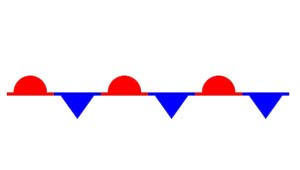
LABEL THE FOLLOWING FRONTS AND/OR WEATHER MAP SYMBOLS.

a)

warm front

b)

cold front

c)

stationary front

d)

occluded front

21.

Based on the weather map, which city will most likely experience increasing temperatures during the next 24 hours?

a)

Denver, because it is raining there

b)

Minneapolis, because a cold front is approaching

c)

Atlanta, because a warm front is approaching

d)

Houston, because it is in a high pressure area
22.
What are the two main factors that determine the climate of an area?
a)
precipitation and humidity
b)
temperature and air pressure
c)
wind conditions and humidity
d)
temperature and precipitation
23.
What is the condition of the Earth's atmosphere at a certain time and place?
a)
climate
b)
temperature
c)
weather
d)
air pressure
24.
What is the weather conditions in an area over a long period of time?
a)
climate
b)
temperature
c)
elevation
d)
precipitation
25.
What causes some areas of Earth to receive less intense solar energy than others?
a)
the mass of earth
b)
the curve of earth
c)
the density of earth
d)
the elevation of earth
26.
The temperature of a tropical climate is?
a)
consistently warm
b)
consistently cool
c)
consistently moderate
d)
warm and cool
27.
A polar climate is?
a)
warm and cool
b)
consistently moderate
c)
consistently cool
d)
consistently warm
28.
The gradual increase in the temperature of the atmosphere is known as ___________________.
a)
greenhouse effect
b)
global warming
c)
fossil fuels
d)
ice ages
29.
What is the difference between climate and weather?
a)
 Climate averages the weather conditions in a specific place over a long period of time, while weather describes the state of the atmosphere at a specific moment in time.
b)
 Weather averages the weather conditions in a specific place over a long period of time, while Climate describes the state of the atmosphere at a specific moment in time.
c)
Climate describes the weather conditions at night, while weather describes the conditions during the daytime.
d)
 There is not a difference between climate and weather.
30.
The main human activity that releases greenhouse gases is
a)
using bottled water
b)
burning fossil fuels
c)
texting on cellphones
d)
eating meat
31.
It was hot all week last week.  Is this a sign of climate change?
a)
Yes
b)
No
32.
Worldwide, temperatures have been increasing for more than 100 years.  Is this evidence of global warming?
a)
yes
b)
no
33.
The greenhouse gas having the greatest role in human-caused global warming is
a)
methane
b)
carbon dioxide
c)
CFCs (chlorofluorocarbons)
d)
ozone
34.
Carbon is used by plants during which process?
a)
Respiration
b)
Transpiration
c)
Photosynthesis
d)
Transportation
35.
What is the greenhouse effect?
a)
warming of the earth due to gases in our atmosphere.
b)
cooling of the earth due to gases in our atmosphere
36.
We need the natural greenhouse effect for Earth to be habitable.
a)
True
b)
False
37.
The enhanced greenhouse effect leads to global warming.
a)
True
b)
False
38.
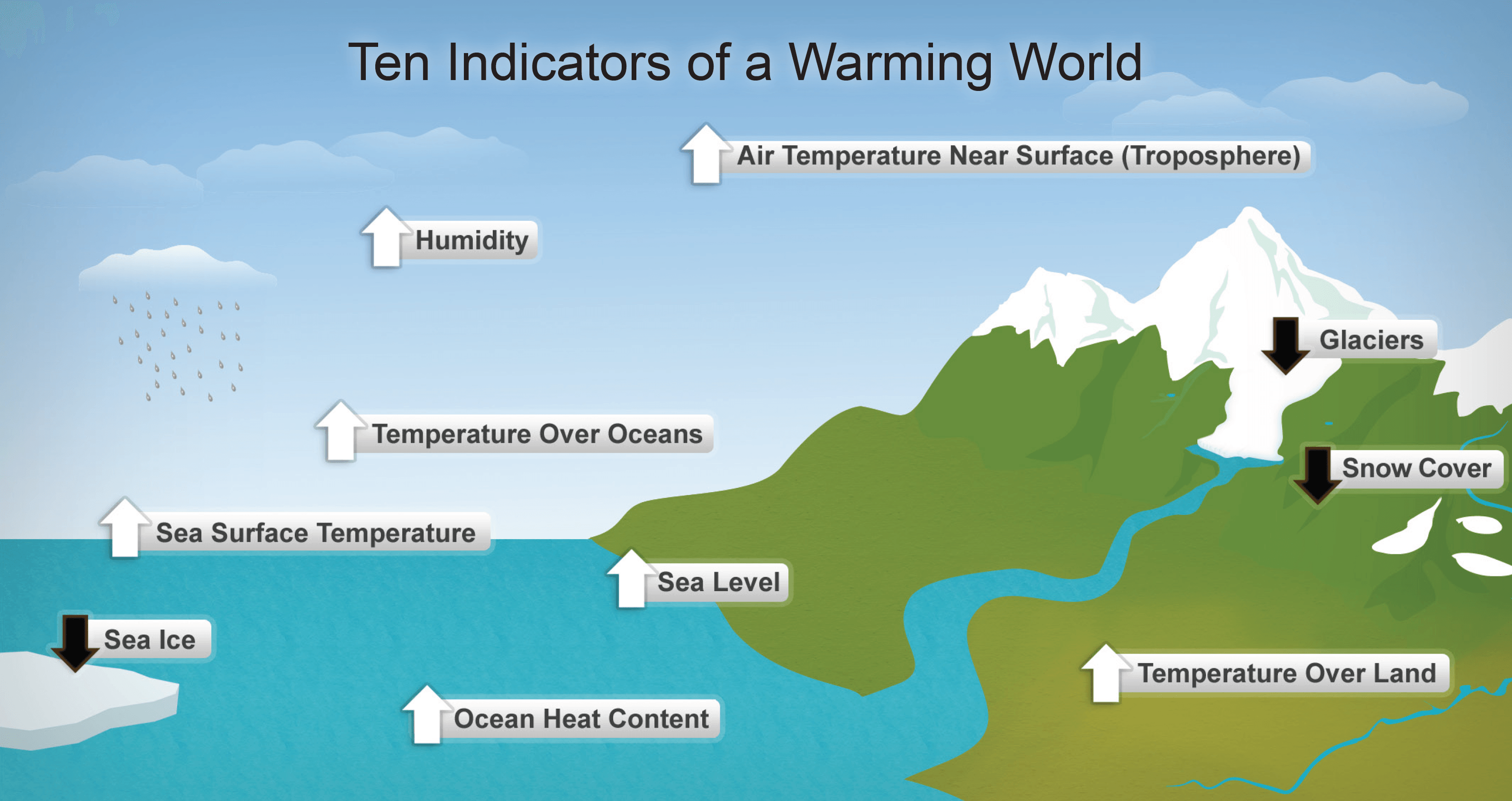
Which of the following sets of evidence supports global warming?
a)
CO2 levels rising
b)
Sea Levels rising
c)
Glacier mass decreasing
d)
All of the Above
39.
The following graph tells us what?
a)
Sea Levels are decreasing.
b)
Sea Levels are rising.
40.
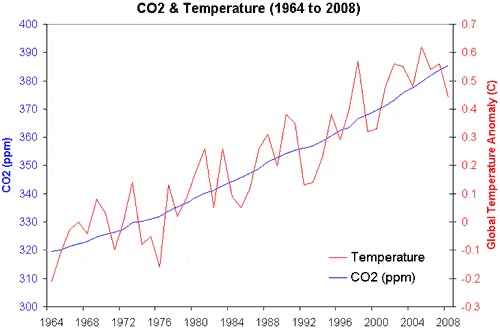
The graph below shows CO2 emissions and temperatures from 1909 to 1949.  What conclusion is best supported by the graph?
a)
There is no relationship between carbon dioxide concentrations and temperatures
b)
As carbon dioxide concentrations increase, temperatures increase
c)
As carbon dioxide concentrations increase, temperatures decrease
d)
As carbon dioxide concentrations decrease, temperatures increase
41.
What is the mixture of gases surrounding the Earth called?
a)
carbon
b)
concentration
c)
atmosphere
d)
emissions
42.
Things you can do to help decrease global warming include:
a)
Eat more ice cream.
b)
Keep your freezer door open.
c)
Keep your air conditioner on high.
d)
Turn off your lights when you’re not using them.
43.
Burning fossil fuels is one of the main causes for global warming.
a)
True
b)
False
44.
Without the Greenhouse Effect the Earth would be too
a)
warm 
b)
cold
c)
dead
d)
funny
45.
Water in the form of gas is called
a)
ice
b)
graupel
c)
sleet
d)
water vapor
46.
Percentage of Earth's atmosphere that carbon dioxide makes up
a)
less than 1%
b)
5%
c)
20%
d)
80%
47.
Warm air rises and creates
a)
low pressure
b)
medium pressure
c)
high pressure
d)
uneven pressure
48.
Cold air sinks and creates
a)
low pressure
b)
medium pressure
c)
high pressure
d)
uneven pressure