wayground logo

Free Printable Worksheets

Font size

S
M
L
XL
Worksheets

Massive Macro Quiz (May be questions repeated)

Total questions: 57

Worksheet time: 33mins

Name
Class
Date
1.

Which is the broadest form of money supply below?

a)

Gilt

b)

Deposit account

c)

Investment fund

d)

Corporate bond

2.
The intersection of the aggregate demand and aggregate supply curve occurs at the economy’s equilibrium level of
a)
Nominal investment and the interest rate       
b)
Government taxes and employment
c)
Real disposable income and unemployment     
d)
Real domestic output and the price level
3.

M0 represents which type of money supply

a)

Broad

b)

Narrow

c)

Debt

d)

Equity

4.

An all equity firm can go bankrupt

a)

True

b)

False

5.

The annual rate of return is best described as

a)

Interest rate

b)

exchange rate

c)

coupon rate

d)

Return on investment

6.

As the bond price increases the coupon rate

a)

stays the same

b)

increases

c)

decreases

d)

fluctuates dependent on demand

7.

Which of the following does not contribute to the capital markets?

a)

Corporate bonds

b)

Long term deposit accounts

c)

Shares

d)

Gilts

8.

The average rate at which financial institutions lend to each other

a)

LIBOR

b)

SONIA

c)

LLBOR

d)

Exchange rate

9.

Which of the four characteristics of money can be defined as "Consistent or Identical"?

a)

Durability

b)

Divisibility

c)

Homogenous

d)

Portability

10.

The Bank of England is responsible for making sure the financial system is .......... and ............. They provide critical services to the real economy in good times and bad.

a)

Working/Running well

b)

Good/Proper

c)

Safe/Sound

d)

Down/Out

11.

Money is derived from which Latin word

a)

Moneto

b)

Maneto

c)

Moneta

d)

Money

12.

The view of which economist and his followers believed money supply to not be important in the macroeconomy

a)

Irving Fisher

b)

Milton Friedman

c)

Karl Marx

d)

John Keynes

13.

Ceteris paribus, the quantities of money people are willing and able to hold

a)

Decrease as interest rates fall.

b)

Increase as interest rates fall.

c)

Increase as the money supply decreases.

d)

Decrease when the speculative demand increases.

14.
The use of taxes and government spending to affect the economy
a)
Monetary Policy
b)
Fiscal Policy
c)
Contractionary Policy
d)
Expansionary Policy
15.
a plan to reduce aggregate demand and slow the economy
a)
Contractionary Fiscal Policy
b)
Expansionary Fiscal Policy
c)
Contractionary Monetary Policy
d)
Expansionary Monetary Policy
16.
a plan to increase aggregate demand and stimulate the economy
a)
Contractionary Fiscal Policy
b)
Expansionary Fiscal Policy
c)
Contractionary Monetary Policy
d)
Expansionary Monetary Policy
17.
refers to government revenue, spending, and debt
a)
Fractional Reserve Banking
b)
Legal Reserves
c)
Fiscal
d)
Reserve system
18.
If the unemployment rate is rising and GDP is falling, the fiscal policy action that the federal government should MOST likely follow is 
a)
decreasing taxes.
b)
decreasing spending.
c)
decreasing the money supply.
d)
decreasing the reserve requirement.
19.

____________ is the price paid for the use of money.

a)

Gold

b)

Monetary policy

c)

Fiscal policy

d)

The interest rate

20.
The aggregate supply curve (short-run) slopes upward and to the right because: 
a)
changes in wages and other resource prices completely offset changes in the price level.
b)
the price level is flexible upward but inflexible downward.
c)
supply creates its own demand.
d)
wages and other resource prices adjust only slowly to changes in the price level.
21.
Which of the following does not represent a leakage or a withdrawal in the circular flow of income?
a)
Taxes
b)
Imports
c)
Savings
d)
Government expenditures
22.
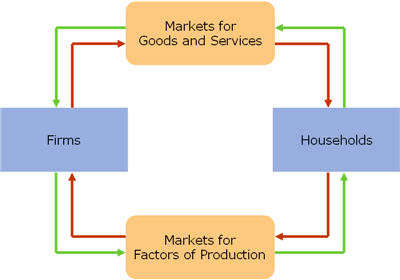
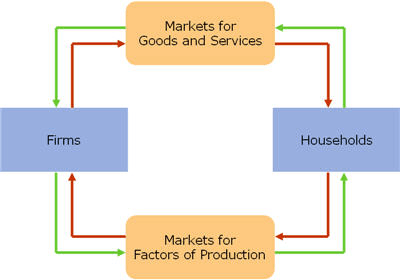
What is being represented by the "green flow lines"
a)
Flow of Money
b)
Flow of Goods and Services
23.
What is being represented by the "red flow line"
a)
The flow of money
b)
The flow of goods and services
24.

What do households provide to the resource market?

a)

land, labour, capital

b)

money

c)

people

d)

income

25.

Who is trying to open their own bank in Burnley?

a)

David Fisher

b)

Dawid Fishwick

c)

David Fishwick

d)

David Fishman

26.

Ceteris paribus, the quantities of money people are willing and able to hold

a)

Decrease as interest rates fall.

b)

Increase as interest rates fall.

c)

Increase as the money supply decreases.

d)

Decrease when the speculative demand increases.

27.

The Bank of England is responsible for making sure the financial system is .......... and ............. They provide critical services to the real economy in good times and bad.

a)

Working/Running well

b)

Good/Proper

c)

Safe/Sound

d)

Down/Out

28.
Trade is made easier because of this function of money that eliminates the need to barter (trade goods for goods).
a)
Store of Value
b)
Medium of Exchange
c)
Unit of Account
d)
Divisibility
29.

Which of the following is a form of narrow money?

a)

Gilts

b)

Corporate bonds

c)

Cash

d)

House

30.

Which of the following would signify the broadest form of money supply?

a)

M3

b)

M4

c)

M1

d)

M0

31.

Money supply that is liquid can be best described as

a)

Narrow Money

b)

Broad Money

c)

Means of exchange

d)

Store of value

32.

TRUE OR FALSE: Money supply becomes broader the more liquid the form of money is.

a)

True

b)

False

c)

I don’t have a clue!

d)

Evidence is inconclusive

33.
Holders of equity capital
a)
receive interest payments
b)
own the company
c)
have lent money to the company
d)
have a guaranteed right to income from the company
34.

A financial portfolio should include products that are:

a)

safe and sound

b)

profitable and liquid

c)

broad and narrow

d)

debt and equite

35.

Which of the following are assets for a bank? (select 2)

a)

Savings

b)

Current account balances

c)

Mortgages

d)

Overdrafts

36.

What is the return given to equity holders in a firm?

a)

Interest

b)

Shares

c)

Profit

d)

Dividends

37.
Which of the following was never used as currency?
a)
Beads
b)
Bananas
c)
Salt
d)
Gold
38.
An example of expansionary fiscal policy would be
a)
cutting taxes.
b)
cutting government spending.
c)
cutting production of consumer goods.
d)
cutting prices of consumer goods.
39.
National income must be at its equilibrium level when
a)
Imports equal exports
b)
Savings equal investment
c)
Injections equal withdrawals
d)
Government revenue equals government expenditure
40.

An increase in the money supply will

a)

Reduce interest rates and increase aggregate demand.

b)

Reduce interest rates and decrease aggregate demand.

c)

Raise interest rates and increase aggregate demand.

d)

Raise interest rates and decrease aggregate demand.

41.

Which of the following is NOT a factor of production?

a)

land

b)

labour

c)

capital

d)

goods and services

42.

Which of the following is a liability for a bank?

a)

Mortgages

b)

Overdrafts

c)

Loans

d)

Savings

43.
A good money can stand wear and tear and time
a)
durable
b)
lack of coincidence of wants
c)
portability
d)
recognized value
44.
A good money can be used easily for small purchases, medium purchases and large purchases. 
a)
durable
b)
lack of a coincidence of wants
c)
widely recognized
d)
divisible
45.
A budget deficit occurs when...
a)
The government brings in more revenue than it spends for a given year
b)
The government spends more money than it brings in for a fiscal year
46.

Issuing bank notes, monetary policy (setting interest rates) and financial stability is the role of .......

a)

TSB

b)

Bank of England

c)

HSBC

d)

All of these

47.

The Bank of England is responsible for keeping the UK’s economy on the right track. One of the ways they do this is through .............. ...........(raising or reducing interest rates).

a)

Economic Policy

b)

Fiscal Policy

c)

Monetary Policy

d)

None of these

48.
Which function of money encourages people to save money?
a)
Medium of Exchange
b)
Store of Value
c)
Unit of Account
d)
Acceptability
49.

The use of money and credit controls to change the macroeconomy is

a)

Monetary policy.

b)

Considered ineffective by most economists.

c)

No longer used in the United States.

d)

Fiscal policy.

50.
The study of the allocation of scarce resource that have alternative uses.
a)
Geology
b)
geography
c)
political science
d)
economics
51.
What is bartering?
a)
A product
b)
Giving money away
c)
Trading without  using money
52.
Which of the following is not a characteristic of money? 
a)
Durability 
b)
Invisibility
c)
Portability
d)
Divisibility 
53.

Which of the four characteristics of money can be defined as "easily moved"?

a)

Portability

b)

Durability

c)

Divisibility

d)

Homogenous

54.
During a recession, which of the following is likely to occur?
a)
an increase in real wages
b)
an increase in production
c)
and increase in the GDP growth rate
d)
an increase in the unemployment rate
55.
Which of the following is not a determinant of aggregate demand ?
a)
Change in Consumer Spending
b)
Change in Political Parties
c)
Change in Government Spending
d)
Change in investment Spending
56.
Which one of the following is an injection into the circular flow of income?
a)
Personal income tax
b)
Government purchases of factor services
c)
Imports
d)
Business tax
57.
What do businesses provide for consumers according to the circular flow model?
a)
goods and services
b)
only goods
c)
only services
d)
taxes