wayground logo

Free Printable Worksheets

NEW

Font size

S
M
L
XL
Worksheets

Review Force, Plate Tectonics and Rock cycle

Total questions: 40

Worksheet time: 1hrs 17mins

Name
Class
Date
1.
The physical layer of Earth made of solid rock and soil is called the ___________. 
a)
mesosphere
b)
lithosphere
c)
asthenosphere
d)
mantle
2.
Which of the following causes Earth's tectonic plates to move?
a)
Energy from the Sun
b)
Magnetic Pole Reversal
c)
Convection currents in the mantle
d)
Faults in Mountain Ranges
3.
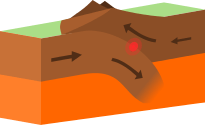
What type of plate boundary is this?
a)
Plate
b)
Divergent
c)
Convergent
d)
Transform
4.
What type of event will occur at this boundary?
a)
Earthquake
b)
Volcano Eruption
c)
Tornado
d)
Mountain Building
5.
A divergent boundary occurs when plates ....
a)
Pull apart
b)
Come together
c)
Slide past each other
d)
subducting
6.
Oceanic Trenches are formed by _______ plate boundaries
a)
Convergent
b)
Transform
c)
Plate
d)
Divergent
7.
Mountains are created when....
a)
Two continental plates collide
b)
Two oceanic plates pull apart
c)
An Oceanic plate subducts under a Continental Plate
d)
Two continental plates pull apart
8.
The Great Rift Valley in Africa and the Mid-Ocean Ridge were all created by this boundary
a)
Divergent
b)
Convergent
c)
Reform
d)
Transform
9.
What are the two types of crust
a)
continental and oceanic
b)
ocean and upper
c)
lower and upper
d)
pizza and subway
10.
Which best describes the asthenosphere?
a)
molten metal
b)
dense, solid metal ball
c)
solid that flows
d)
dry land and ocean floor
11.
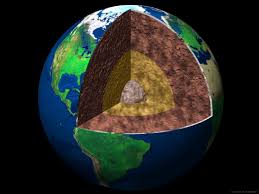
Which layer of Earth is located above the outer core?
a)
crust
b)
inner core
c)
mantle
d)
lithosphere
12.
Is the outer core a liquid or solid?
a)
liquid
b)
solid
13.
Temperature _____________________ as you go deeper into the earth.
a)
increases
b)
decreases
c)
goes up and down depending on the layer
d)
stays the same
14.
Pressure ______________________ as you go deeper into the Earth
a)
increases
b)
decreases 
c)
goes up or down depending on the layer
d)
stays the same
15.
Which layer has the highest density?
a)
Crust
b)
Mantle
c)
Core
d)
All the same
16.
It is possible to drill through the crust.
a)
Sure, they have already done it.
b)
Yeah, they will get it done soon.
c)
No way, it would make the world explode
d)
Nah, we've only drilled a little bit, like 1/100th of the way through.
17.
Layer 2 is the Earth's _____________.
a)
Inner Core
b)
Outer Core
c)
 Lower Mantle
d)
 Upper Mantle
18.

Layer 3 is the Earth's ______ .

a)

Core

b)

Lithosphere

c)

Mantle

d)

Asthenosphere

19.
If these boys are pulling with the same amount of force.  What will happen?
a)
The boy in blue will win.
b)
They will not move at all.
c)
The boy in red will win.
d)
Both will fall down.
20.
This is an example of what kind of force?
a)
Balanced Force
b)
Pushing Force
c)
Gravity Force
d)
Unbalanced Force
21.

What is motion?

a)

A push or a pull

b)

Any change in an animal or person's position.

c)

Motion is like acting

d)

Any change in an object or person's position.

22.
A measure of how fast something moves over a certain distance is ________________.
a)
motion
b)
speed
c)
work
d)
force
23.
What is a PUSH or PULL of an object?
a)
Motion
b)
Force
c)
Friction
d)
Gravity
24.
Calculate the net force of the object in the image shown.
a)
20N
b)
35N
c)
5N
d)
25N
25.
Which direction will the object move?
a)
Up
b)
Down
c)
Right
d)
Left
26.
What is the heat source for convection in the mantle?
a)
the Crust
b)
the Mantle
c)
the Core
27.

The part of the Earth that is a solid ball of iron

a)

inner core

b)

outer core

c)

mantle

d)

crust

28.
What is the thickest layer of the Earth?
a)
the crust
b)
the mantle
c)
the outer core
d)
the inner core
29.
What is the core made of?
a)
steel
b)
iron 
c)
aluminum
d)
iron and nickel
30.
How hot is the core?
a)
as hot as an iron
b)
as hot as an oven
c)
as hot as a humongous fire
d)
as hot as the sun
31.
The asthenosphere makes up the?
a)
Upper portion of the mantel
b)
The lower portion of the crust
c)
Just the Athenosphere
32.
a rock that formed from layers of sediments
a)
metamorphic
b)
igneous
c)
sedimentary
d)
magma
33.

rock that has been changed by heat and pressure.

a)

sedimentary

b)

metamorphic

c)

igneous

d)

fuels

34.
Fossils are often found in ____________ because it is formed from the remains of once living things.
a)
metamorphic
b)
magma
c)
igneous
d)
sedimentary
35.
Which type of rock is likely to be formed by a volcano?
a)
igneous
b)
metamorphic
c)
sedimentary
36.
Rocks that are weathered and eroded change into ____________.
a)
sedimentary
b)
sediment
c)
igneous
d)
metamorphic
37.
Sedimentary and igneous rocks go through _____________________________ to become metamorphic rocks.
a)
weathering and erosion
b)
heat and pressure
c)
compacting and cementing
d)
melting and cooling
38.

Fossils of a particular animal species have been found in both southern Africa and South America but nowhere else. Which of the following is MOST LIKELY the reason why?

a)

The fossils evolved into different organisms

b)

The climate changed and became much colder.

c)

In the past, Africa and South America were part of the same continent
39.

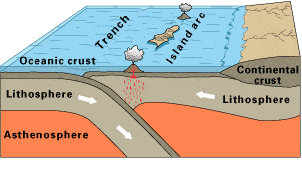
Observe this diagram of a plate boundary. One statement BEST describes what is happening. It is that

a)

the oceanic crust is melting.

b)

the denser oceanic crust is going under the less dense continental crust

c)

the tectonic plates are moving away from each other.
40.
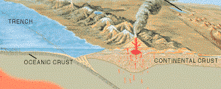
What geological forces might be responsible for this range of mountains?
a)
diverging tectonic plates
b)
erosion of the land by the ocean
c)
converging tectonic plates
d)
deposition of sediments by the ocean