
Font size
 Worksheets
AP Period 6: Russian Revolution, Cold War, Post War
Total questions: 200
Worksheet time: 2hrs 45mins
What was the name for kings or emperors in Russia?
count
kaiser
czar
sultan

Who am I?
Peter the Great
Ivan the Terrible
Rasputin
Nicholas II
What is the name of the 'renegade priest with police connections,’ who became the central figure in the 1905 revolution?
Father Rasputin
Father Georgiy Gapon
Father Felix Dzerzhinsky
Father Leo Tolstoy
What did the protesters plan on Sunday 9 January 1905?
To peacefully present the Tsar with a petition outlining their grievances.
To storm the Winterpalace and force Tsar Nicholas to accept their reforms.
To persuade the army to mutiny
To ask the Tsar to stop the hostilities against Japan.


What was the main purpose of the Trans Siberian Rail Road?
To transport goods from northern to southern Russia.
To transport all communists to the capital
To connect the eastern and western portions of Russia.
To transport all Siberian tigers to Sibera.
The event in which the czar's guards opened fire on a crowd of people. Made the Russian population unhappy with the czar.
Potemkin Mutiny
Bloody Sunday
March Revolution
The Duma
When was the Russo-Japanese war fought?
1901-1905
1903 - 1907
1904 - 1905
1914 - 1918
Which three main groups emerged in opposition to the tsarist regime, throughout the early stages of the new century?
reformist middle class, the peasants and the urban rich
artists and novelists, the peasants and the industrial workers
impoverished nobility, rural marxists and the industrial workers
reformist middle class, the peasants and the industrial workers
What is a zemstvo?
A unit of measurement in Imperial Russia, equal to 26.7 cm.
A local council set up by Alexander II
The name of the national assembly in Imperial Russia
The currency of Imperial Russia
What country won the Russo-Japanese War?
Russia
Japan
United States
What country lost the Russo-Japanese War?
Russia
Japan
United States
What country helped create the treaty for the Russo-Japanese War and did not fight in the war at all?
Russia
Japan
United States
How did the Russo-Japanese War begin?
The Japanese surprise attacked Port Arthur.
The Russians invaded Korea and moved toward Japan's border.
The Japanese took over Russia's railroad.
Russia had a Japanese leader assassinated.
Japan and Russia fought over Manchuria and the Korean Peninsula.
True
False
What European country helped Japan during the Russo Japanese War?
Great Britain
Germany
France
Austria-Hungary
Which of these was a reason for Russia losing the Russo Japanese War?
Long supply line
Czarina Alexandra was leading the country.
Russia was preparing to fight Germany
Russia signed the Treaty of Brest Litovsk
The Japanese destroyed Russia's?
Entire railroad
Naval Fleet
Farms
What treaty ended the Russo-Japanese War?
Treaty of Portsmouth
Treaty of Versailles
Treaty of Brest Litovsk
Treaty of Paris
What lands did Japan get?
Manchuria and Korea
Korea and North China
Manchuria and North China
The Bolshevik Revolution of 1917 was a major turning
point in history because
Russia became the first nation with a
Communist economic system
it was the last revolution in the 20th century
Russia ceased to be an important force in
world affairs
the royal family was exiled to Mexico
A key principle of the economic theory of Communism
is
restoration of a bartering system
organization of workers’ unions
government ownership of property
privatization of business
A major reason many Russian people supported the
Bolsheviks in the November 1917 revolution was that the
Bolsheviks called for
an immediate peace settlement with Germany
a heavy investment in industry
the collectivization of agriculture
the abolition of all religion
Which slogan is associated with the Bolshevik (Russian) Revolution?
"An eye for an eye"
"Liberty, Equality, Fraternity"
"Take up the White Man's Burden"
"Peace, Land, Bread"
". . . The replacement of the bourgeois by the
proletarian state is impossible without a violent revolution.
The abolition of the proletarian state, i.e., of all states, is
only possible through 'withering away.' . . ."
— V. I. Lenin, State and Revolution, 1917
This quotation is associated with the principles of...
imperialism
capitalism
communism
militarism
• Led the Russians in a second revolution (1917)
• Promised "Peace, Land, and Bread"
• Established the New Economic Policy (NEP)
Which leader is being described by these statements?
Czar Nicholas II
Nikita Khrushchev
Vladimir I. Lenin
Mikhail Gorbachev
Which leader based his rule on the ideas of Karl Marx and Friedrich Engels?
Neville Chamberlain
Adolf Hitler
Vladimir Lenin
Chiang Kai-shek
Heavy military losses in World War I, food and fuel shortages, and opposition to the czar led to the
French Revolution
Russian Revolution
Chinese Revolution
Cuban Revolution


Continue the 300-year old Romanov dynasty


Who was the leader of the Bolsheviks during the Russian Revolution?
Tsar Nicholas II
Vladimir Lenin
Joseph Stalin
Vladimir Putin
Rasputin
what was Tsar Nicholas II's child's name who had haemophilia?
Alexi
Olga
Tatiana
Anastasia
What was the Tsarina Alexandra's heritage?
Russian
German
Turkish
Scottish
When did the February and October revolutions occur?
1909
1905
1919
1917

Which Russian political party wanted a mass membership for the RSDP?
Marxists
Socialists
Bolsheviks
Mensheviks

Who was the 2nd leader of the USSR & killed over 20 million Russians during his reign?
Vladimir Lenin
Josef Stalin
Aleksandr Kerensky
Leon Trotsky

What is the name of the feared Soviet secret police?
OVRA
Gestapo
Cheka
KGB

Leader of the provisional government of Russia, the Russian Republic, after the czar stepped down
Aleksandr Kerensky
Grigory Rasputin
Aleksandr Samsonov
Grigory Rasputin

Communist war hero who contended to become the 2nd leader of the USSR, but was instead exiled
Leon Trotsky
Felix Dzerzhinsky
Aleksandr Kerensky
Valentin Trifonov

Moderate party who supported gradual change from czarism to a strong socialist state.
Menshevik
Soviet
Bolshevik
Yedinaya

What was the last family to rule Russia as a dynasty?
Rurik
Hapsburg
Romanov
Hohenzollern

What was the name of the Communist nation the Bolsheviks formed from Russia and 14 neighbors?
Soviet Union
Russian Empire
Russian Republic
Eurasian Union

Yuri served in the czar’s military as a commander prior to the revolution.
Red
White
Evgeny is a farmer in the Western countryside, he resents his low social status and earnings.
Red
White
Dragomir is an Eastern Orthodox priest who wishes to protect the church’s power in Russia.
Red
White
Mikhail is a factory worker who works long hours in poor conditions to make end’s meet
Red
White
Pavel is a Menshevik and fears radical change, as it may cause chaos and undermine a revolution
Red
White

In this economic system, prices and wages are determined by supply and demand.
Capitalism
Communism
Due to compensation, it would be best to be a fast food worker in this economic system.
Capitalism
Communism
In this economic system, the quantity of a good produced is determined by the government.
Capitalism
Communism
In this economic system, the quality of a good produced is determined by competition.
Capitalism
Communism

Who owns businesses in Capitalism?
People
The People
The Government
Nobles

Who owns businesses in Communism?
People
The People
The Government
Nobles

Which side won the Russian Civil War (1918-1921)?
Reds
Whites
No one! We all lose in wars
It was a tie.

What policy was created to give Russian farmers incentives to produce more food?
Glasnost
Great Patriotic Policy
New Economic Policy
Perestroika


Which statement best describes the political
situation in the Soviet Union immediately after
Lenin's death in 1924?
The nation adopted a constitutional
monarchy
Trotsky and his followers assumed full
control of the Communist Party
Popular elections were held to choose a
new General Secretary
A power struggle developed among
Communist Party leaders
A major goal of Joseph Stalin’s five-year plan was to...
encourage communist revolutions in the
colonies of the European powers
transform the Soviet Union into an
industrial power
expand the Soviet Union’s borders to
include warm-water ports
reduce the amount of foreign aid coming
from the Western Hemisphere
Totalitarian countries are characterized by
free and open discussions of ideas
a multiparty system with several
candidates for each office
government control of newspapers, radio
and television
government protection of people’s civil
liberties
-Collectivization
-Five-year plan
-Restrictions on the press
-Purges of Communist Party
Which title best completes these headlines?
Saddam Hussein and the Persian Gulf
War
Sun Yat-sen and the Defeat
of the Manchu Dynasty
Joseph Stalin and the Rise of a
Totalitarian State
Jawaharlal Nehru and the Modern
Industrial State of India
Which condition was a result of Joseph Stalin’s
command economy?
Peasants were encouraged to sell surplus
grain for personal profit.
The production of consumer goods
increased
National revenue increased allowing for
greater individual spending
The government controlled agriculture
through collective farms
The main purpose of the many purges and public
trials that took place in the Soviet Union in the 1930s
was to
force the Jewish people to leave the
Soviet Union
eliminate opposition to Joseph Stalin and
his government
establish a free and independent court
system in the Soviet Union
reform the outdated and inadequate
agricultural system
In the Soviet Union, Joseph Stalin governed by
means of secret police, censorship, and purges.
This type of government is called
democracy
limited monarchy
theocracy
totalitarian
"Collective Farms of the USSR (Soviet Union) 1929-1940"
is associated with which of the following:
Lenin's New Economic Policy
Brezhnev's policy of détente
Gorbachev's policy of glasnost
Stalin's five-year plans
What is Collectivization?
Stalin’s measure of allowing peasants to own their own farms
Stalin’s measure of merging small individual farms into larger collective farms (kolkhoz)
Stalin’s measure of focusing on building heavy industries
Stalin’s measure of allowing Kulaks to take over the farms of poorer peasants
A major goal of Joseph Stalin’s five-year plans was to
encourage communist revolutions in the colonies of the European powers
transform the Soviet Union into an industrial power
expand the Soviet Union’s borders to include warm-water ports
reduce the amount of foreign aid coming from the Western Hemisphere


Where was Korea divided?
18 parallel
34 parallel
38 parallel
15 parallel

The act of preventing nuclear attack by threatening retaliation is called
deterrence
domino theory
militarism
containment


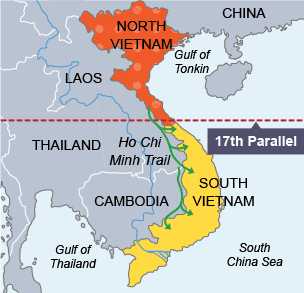
Images like this one refer to what theory about the spread of Communism in Asia (China, Korea, Vietnam)?
The Mar$hall Plan
The Domino Theory
Proxy Wars
Flexible Response
Which leader promoted communism in North Vietnam?
Ho Chi Minh
Mao Zedong
Who led the Nationalists in a civil war in China and was forced to retreat to Taiwan?
Chiang Kai-shek
Mao Tse-tung
US military spending rose after World War II when they entered which war?
World War I
Gulf War
Vietnam War
Korean War
Truman's policy of preventing the expansion of communism was -
containment
deterrence
militarism
perestroika

During the Cold War, what bill did the U.S. Congress pass to provide financial assistance to western European countries?
Truman Doctrine
Open Door Policy
Marshall Plan
Domino Theory

What policy implemented in the Cold War said the U.S. would give military aid to a country that needed to resist communism?
Marshall Plan
Truman Doctrine
Domino Theory
Open Door Policy
During the Cold War, what policy did the U.S. follow to stop the spread of communism?
Open Door Policy
Big Stick Policy
Containment Policy
Dollar Diplomacy
Which individual/group contributed to the Red Scare by accusing American citizens of being communist spies?
McCarthy/HUAC
NAACP/Farm Workers Union
Nativists/Muckrakers
Philanthropists/Entrepreneurs

In what year did the Russians launch the satellite Sputnik?
1941
1957
1969
1991

What happened as a result of the launch of Sputnik in 1957?
It started the space race between the USSR and U.S.
The U.S. government started NASA.
U.S. began to spend more money on math and science to maintain national security.
All of the above

During what Cold War event did the U.S. bypass a Soviet blockade in Germany without provoking a military conflict?
Berlin Airlift
Vietnam War
Watergate Scandal
Bataan Death March

During the Cuban Missile Crisis, what did President J.F. Kennedy do when he heard that the Soviet Union was constructing nuclear missile sites in Cuba.
He launched a nuclear missile at the Kremlin in Moscow.
He gave into the demands of the Soviet & Cuban government.
He ordered a naval blockade around Cuba to prevent Soviet ships from bringing the necessary materials.
He declared war on the Soviet Union & Cuba.

How did the Counter-culture movement of the 1960s impact the Vietnam War?
The hippies protested and organized mass demonstrations.
They helped turn public opinion against the war.
They helped get the 26th amendment passed.
All of the above
What theory caused the U.S. to enter the Vietnam War in order to stop the expansion of communism across Southeast Asia?
Marshall Plan
Domino Theory
Open Door Policy
Dollar Diplomacy

What amendment was passed to lower the voting age because it was unfair that 18-20 year olds could be drafted into the army but not vote?
17th amendment
21st amendment
22nd amendment
26th amendment

What body was created for the nations near the end of World War II to try to prevent future global wars?
League of Nations
Allied Powers
Axis Powers
United Nations

How did the conflict in Vietnam end?
Both sides won
Cease-fire agreement in which U.S. troops withdrew
Soviets removed the missiles in Cuba in response to a U.S. blockade
United States occupied Japan

How did the Cuban Missile Crisis end?
Soviets removed the missiles in Cuba in response to a U.S. blockade
United States responded by placing missiles of its own in China
United States declared war on the Soviet Union
Break up of the Soviet Union into independent countries

Berlin Wall Falls! What happened as a result of the event in the newspaper headline?
Communism spread in Europe
Missiles were removed from Cuba
Collapse of Communism in Europe
Vietnam War ended

President Wipes Out Segregation In The Armed Forces! The newspaper headline is about which President?
Franklin D. Roosevelt
Woodrow Wilson
Harry S. Truman
Herbert Hoover

United States President, John F. Kennedy and Soviet Union Premier, Nikita Khrushchev The political cartoon is about which conflict?
Cuban Missile Crisis
Desegregation
Korean War
Vietnam War

Led to increased educational, economic, and political opportunities for minorities and women; Which of the following is being described?
Prohibition
G.I. Bill
Civil Rights legislation
Desegregation of the armed forces

Extended educational, housing, and employment benefits to veterans; Which of the following is being described?
Civil Rights legislation
19th Amendment
G.I. Bill
Prohibition

Which of the following are factors that created changes in American society after World War II?
Strong economy with increased productivity
African Americans’ aspirations for equal opportunities
Less investments made in education
Women increasingly working outside the home

Eleanor Roosevelt - The First Lady shown in the picture played an important role in what?
passing the G.I. Bill
the Temperance Movement
writing the 19th Amendment
expanding human rights

How did the Baby Boom affect American society after World War II?
Child labor increased
Fewer schools were built
The economy slowed down
Led to changing demographics

Which term means the linking of nations through trade, information, technologies, and communication?
Servicing
Globalization
Outsourcing
Travel
1. Truman
2. Eisenhower
3. Nixon
4. Reagan
2. Containment
3. Domino Theory
4. Detente
2. Detente
3. Domino Theory
4. Reagan Doctrine
2. Domino Theory
3. Detente
4. Reagan Doctrine
2. Detente
3. Reagan Doctrine
4. Containment

Was the leader of the U.S.S.R after Stalin?
Khrushchev
Gorbachev
Was the leader of the Soviet Union at the end of the Cold War?
Khrushchev
Gorbachev
Established Destalinization in an effort to purge the Soviet society of everything Stalin.
Khrushchev
Gorbachev
Believed that the Soviet Union could beat the USA economically.
Khrushchev
Gorbachev
Established Glasnost and Perestroika in an effort to reform the Soviet Union.
Khrushchev
Gorbachev
Encouraged democracy and creative ideas in the Soviet Union.
Khrushchev
Gorbachev
Responsible for the fall of the Berlin Wall.
Khrushchev
Gorbachev
Grew up poor and joined the Red Army.
Khrushchev
Gorbachev
Instigated the Cuban Missile Crisis by placing missiles towards the USA 90 miles for its coast.
Khrushchev
Gorbachev
Worked to increase the stand of living in the Soviet Untion and relaxing freedoms but the nation was still plagued by food shortages.
Khrushchev
Gorbachev
How did the Space Race and arms race contribute to the collapse of the Soviet Union?
Both were expensive programs that put a strain on the country's economy.
There were not enough military bases to support the programs.
The US used espionage to steal the technology from both programs.
The USSR did not have the resources to develop the technology needed for the programs.


Which of the following treaties was the first agreement between the US and USSR to limit our nuclear arsenals by Nixon?
the SALT Treaty
the Halburton Treaty
the Treaty of Versailles
the Treaty of Guadalupe-Hidalgo

What was Ronald Reagan's 1984 re-election campaign slogan?
Make America Great Again
It's Time for a New Legacy
It's Morning Again in America
Yes America Can
Who proposed the Strategic Defense Initiative?
Ronald Reagan
George Bush
Barack Obama
Vladimir Putin

What was the nickname given to Reagan's Strategic Defence Initiative (SDI), which proposed nuclear defence from space?
Space Force
Star Wars
Star Trek
Ender's Game
Which statement BEST describes the goals of Mikhail Gorbechev's policies of perestroika and glasnost?
create greater openness within Soviet society and restructure the economy to increase the flow of ideas and goods
strengthen the military through a nuclear missile program and take stronger steps to control the media
brutally suppress political opposition and create a modern economic system based on socialist ideals
end hostilities with the United States and permit freedom for the Baltic republics
What was one way Reagan is foreign policy stances affected the Cold War?
Reagan helped end the Cold War by pointing out and exacerbating the weaknesses of the USSR’s economy.
Reagan helped end the Cold War by convincing USSR citizens to revolt against the aging communist government.
Reagan prolonged the Cold War by giving advice to USSR leaders that helped them maintain power for a longer period.
Reagan prolonged the Cold War by inciting USSR citizens, causing them to stay committed to communism for a longer time.


