
 Worksheets
Industrial Technology & Design
Total questions: 38
Worksheet time: 27mins

An Isometric Drawing shows objects in how many dimensions?
2 dimensions
3 dimensions
4 dimensions
1 dimension

What is the top view (or plan) of this object?


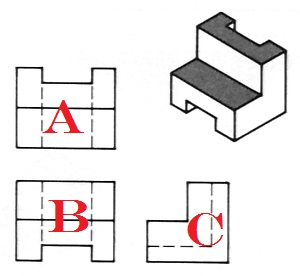
What view would go in position B of an orthographic sketch?
Top
Front
Right side
What is the purpose of sketching?
It can tell how and where the design will be used.
Sketching is appealing to people.
Sketching can provide details of an idea and lots of information all at once.
Color can be added to a sketch to show texture and appearance.


Which sketching technique follows these rules?
1. All vertical lines are parallel
2. All receeding lines are 30°
3. Always start with a claw foot
Isometric
Oblique
Orthographic
Perspective


A line that is light and thin and used to show the beginning of the sketch is called a _______________________.
Object Line
Hidden Line
Construction Line
Center Line


The point where objects seem to recede to on the horizon line.
Point Break
Boiling Point
Point of Parallels
Vanishing Point

What type of perspective do we see here?
Atmospheric Perspective
Two-Point Perspective
One-Point Perspective
Three-Point Perspective

Why is it a bad idea to wear very loose clothing during practical lessons?
It's not. You can wear what ever you want.
It may become caught in the tools or machinery.
Loose clothing is not in fashion at the moment.

What is the correct name of the tool shown?
Set Square
Tri Square
30/60 Square
Engineers Square


What type of manufactured wood is shown here?
MDF
Plywood
Particleboard
Hardboard

Plywood is stronger than natural wood.
True
False

Safety goggles are required when operating the disc sander and drill press.
True
False
Ferrous metals are metals that contain lots of this...
IRON
ALUMINUM
STEEL
ALLOYS
Aluminium is a relatively heavy metal to work with.
TRUE
FALSE
Which of the following should never be worn around tools and machines?
jewelry and loose fitting clothing
work aprons
closed-in shoes

In pencil sketching, what is the preferred pencil to use?
HB
2B
4H
4B

Define Hardness
The ability of a material to absorb force and flex in different directions, returning to its original position.
The ability of a material to resist scratching, wear and tear and indentation.
The ability of a material to be change in shape permanently.
The ability of a material to be reshaped in all directions without cracking
Once formed, it can be heated and reformed over and over again
thermoset
thermoplastic
elastomer
kevlar
True or False - Thermosetting plastics are commonly used in applications where they need to resist heat, such as - light-fittings, frying pan handles, nobs on ranges
True
False
The ability for a solid to be hammered without shattering
Density
Conductivity
Malleability
Viscosity

What property is being shown in the picture?
plasticity
elasticity
hardness
ductility

All our isometric sketches should start with a ...
Monkey's paw
Eagle's talon
Claw foot
Rabbit's foot

