
 Worksheets
(R) Unit 9: HW#1 Electric Potential & Electric Potential Energy
Total questions: 20
Worksheet time: 12mins
Two point charges are separated by a distance of 10 cm. Charge on point A =+9 μC and charge on point B = -4 μC.
[k = 9 x 10⁹ Nm2C−2, 1 μC = 10−6 C]
What is the electric potential energy between these two charges?
3.24 J
5.54 J
7.23 J
6.45 J
Two point charges are separated by a distance of 0.008 m. Charge on point A =-8 C and charge on point B = -7 C.
[k = 9 x 10⁹ Nm2C−2]
What is the electric potential energy between these two charges?
7.9 x 10¹³ J
5.7 x 10¹¹ J
6.3 x 10¹³ J
6.3 x 10¹¹ J
Calculate the Electric Potential of a +7.8 x 10⁹ C charge with Electric Potential Energy of 750 J
9.6 x 10⁻³ V
6.5 x 10⁻⁷ V
8.7 x 10⁹ V
9.6 x 10⁻⁸ V
What is the Electric Potential Energy of a 6.7 x 10⁹ C charge with an Electric Potential of 240 V?
1.61 x 10¹² J
2.42 x 10¹² J
1.34 x 10¹¹ J
2.7 x 10¹¹ J
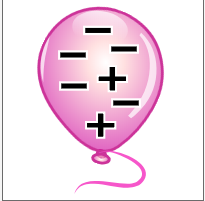
This model of the balloon shows ______ positive charges than negative charges. So this balloon is _____ charged.
fewer/positively
more/positively
fewer/negatively
more/negatively
Electric potential ____________ as distance increases.
Increases
Decreases
Remains Constant
Is 0
The magnitude of electric potential is ______ at an infinite distance.
0
negative infinity
positive infinity
200
The SI unit for electric potential is the ___________.
Volen
Vespa
Volt
Valspar

The direction of electric field lines shows the
direction of the force on a test positive charge.
size of the field.
strength of the field.
all of the above
__________ is stored energy.
Potential Energy
Kinetic Energy
None of the above
All of the above
If two negative charges are held close together and then released, the charges will
accelerate toward each other
accelerate away from each other
not move
move at a constant speed away from each other
Two parallel plates are oppositely charged. The right plate is negative and the left plate is positive. In which direction does the electric field point?
to the left
to the right
up
down
For a positive charged particle, the vectors point
away
toward
For a negative charged particle, vectors point
away
toward
Electric potential and electric potential energy are NOT the same.
True
False

