Wayground logo

Free Printable Worksheets

Font size

S
M
L
XL
Worksheets

Matter Review

Total questions: 30

Worksheet time: 19mins

Name
Class
Date
1.
Characteristic that can be observed such as color, state, or hardness
a)
physical property
b)
chemical property
c)
density
d)
mass
2.
Which units of measurement are used for volume?
a)
grams
b)
centimeters
c)
grams/milliliter
d)
milliliter
3.
What is the formula for density?
a)
density = mass x volume
b)
density = mass / volume
c)
density = mass + volume
d)
density = mass - volume
4.

What is matter?

a)

Anything that has mass

b)

Anything that occupies space

c)

Both, anything that has mass and takes up space

d)

I don't know

5.

What are some characteristics of matter?

a)

It has mass

b)

It occupies space

c)

Living and non-living have it

d)

ALL of them

6.
An example of a physical property is 
a)
flammability
b)
acidic
c)
color
d)
ability to rust
7.
The amount of space something takes up
a)
density
b)
volume
c)
mass
d)
matter
8.
I am the smallest whole particle of matter. 
a)
atom
b)
compound
c)
molecule
d)
mixture
9.
I am 2 or more elements chemically bonded.
a)
atom
b)
molecule
c)
compound
d)
mixture
10.
What units are used to measure Density?
a)
cm3/g
b)
g
c)
g/cm3
d)
cm3
11.
What do we know about the density of lamp oil, rubbing alcohol, and vegetable oil?  
a)
The density is greater than 1.0 g/mL
b)
The density is less than 1.0 g/mL
c)
The density is equal to 1.0 g/mL
d)
The density can not be determined
12.
Jack has a rock. The rock has a mass of 14 g and a volume of 2 cm3. What is the density of the rock?
a)
7 mL
b)
7 g/cm3
c)
28 g/cm3
d)
1/7 g/cm3
13.
The Modern Periodic Table of Elements is arranged by
a)
atomic mass
b)
atomic number
c)
valence electrons
d)
number of isotopes
14.
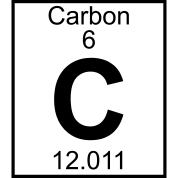
What does the 6 represent?
a)
atomic mass
b)
atomic number
c)
element name
d)
chemical symbol 
15.
Which item on this element square is the chemical symbol?
a)
Copper
b)
29
c)
Cu
d)
63.546
16.

Which is NOT a property of metals?

a)

brittleness

b)

conductivity

c)

ductility

d)

luster

17.

Where are most metals on the periodic table?

a)

on the left side only

b)

on the right side only

c)

in the middle only

d)

on the left side and in the middle

18.

Where are most nonmetals located on the periodic table?

a)

in the bottom row

b)

on the left side and in the middle

c)

on the right side

d)

in the top row

19.

This type of element makes up most (75%) of the periodic table.

a)

Metals

b)

Nonmetals

c)

Metalloids

d)

Noble Gases

20.

Characteristics of metals are....

a)

Good conductors of heat and electricity

b)

High melting point

c)

Easily loses electrons

d)

All of the above

21.
How are elements on the periodic table arranged by?
a)
in alphabetic order
b)
simular physical & chemical properties
c)
their symbols
d)
Just simular physical properties
22.
Periods on the periodic table are __________.
a)
Horizontal Rows
b)
Vertical Columns
23.
Groups on the periodic table are __________.
a)
Horizontal Rows
b)
Vertical Columns
24.

The volume of the water without the fish is 32mL. The volume of the water WITH the fish is 38mL. What is the the volume of just the fish (without the water)? Remember, a mL is equivalent to a cm3.

a)

6cm3

b)

70cm3

c)

32cm3

d)

38cm3

25.
_____________ is an example of a chemical property.
a)
Conductivity
b)
Malleability
c)
Viscosity 
d)
Flammability 
26.
Is salt NaCl a compound or a element?
a)
Element
b)
Compound
27.
Periodic table of the elements
a)
The rigid outer part of the earth
b)
A pure substance that cannot be broken down into different, simpler substances
c)
A table of all known elements arranged by properties and are represented by one or two letters known as chemical symbols
d)
All known elements are represented by one or two letters
28.
Chemical symbol
a)
A table of all known elements arranged by properties and are represented by one or two letters known as chemical symbols
b)
All known elements are represented by one or two letters
c)
A pure substance made of two or more kinds of atoms bound together
d)
All water on Earth: oceans, surface water, ground water, and glaciers; made of a limited number of elements and is primarily comprised of oxygen and hydrogen, the two elements in pure water
29.
which one can be found on the periodic table
a)
Compound 
b)
Element
30.
Element or Compound?
Au
a)
Element
b)
Compound