
 Worksheets
Fossil and Geologic Time
Total questions: 25
Worksheet time: 25mins


In which time period are we currently living?
Precambrian Time
Paleozoic Era
Mesozoic Era
Cenozoic Era
Dinosaurs, small mammals, and birds are found in this time period.
Precambrian
Paleozoic
Mesozoic
Cenozoic
What are fossils that are abundant, easily recognizable, short lived, and widespread called?
Preserved fossils
Index fossils
Imprints
Radioactive dating
The end of an era, and the end of life for groups of organisms, is called?
Death
Mass extinction
Transition
Turning point

Which fossil would make the best index fossil?
Beetle
Flower
Frog
Fish

Use relative age dating to put the rock layers in correct order from oldest to youngest.
B, D, A, E, C
C, E, D, A, B
A, C, E, D, B
C, E, D, B, A
Which of the following is the correct sequence of geologic time from smallest to largest unit?
era, eon, period, and epoch
epoch, eon, era, and period
epoch, period, era, and eon
era, eon, epoch, and period
The first three eons were: Hadean, Archaean, and Proterozoic. They are better known as:
PreCambrian Time
Phanerozoic
Mesozoic
Cenozoic
What was the earth like during PreCambrian time?
tropical climate with warm shallow seas
vegetation and tectonic movement
cooler temperatures because of nuclear winter
intense volcanic activity, very warm temperatures
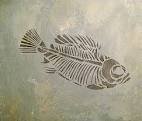
If scientists found this fossil, what could they infer?
what fish are like today
that this fish lacked oxygen
that water once covered the area where this fossil was found

Do no rush, examine the diagram. How has life evolved starting with the oldest fossils?
Life started in the ocean and over time organism became to appear with no common ancestors. Fish evolved first, then reptiles, then mammals and finally birds.
Life started in the ocean then slowly evolved through natural selection to life on land. Fish evolved first, then reptiles, then mammals and finally birds.
Life started on land and over time humans began to evolve into fish, then reptiles, and birds.
Life started in the ocean as four-legged amphibians which then evolved to palm trees, then to dinosaurs, and eventually into humans.

Which is the major difference between the Permian period and the Jurassic period?
Organisms evolved to from land animals to being able to fly
Organisms went from four legs to two
Organisms got fatter
Organisms stayed the same during these periods

The evolution of the horse is the most complete fossil record we have of a single organism. Using the picture, what can you conclude happened to the horse over time?
The horse grew larger and lost its toes
The horse shrank and lost its toes
The horse grew larger and gained toes
The horse shrank and gained toes
Which of the following is NOT something you could learn from a fossil?
The size of the animal
What the animal ate
The color of the animal
Where the animal lived

Why are there more animal fossils than plant fossils?
There weren’t as many ancient plants as there were animals
Animals don’t break down as quickly (due to bones) so they are more likely to fossilize
Animals eat plants
Plants are smaller than animals
Herbivores are animals that eat plants. Finding many fossils of large herbivores in rocks that are millions of years old would lead to what conclusion about the ancient environment of an area? A reasonable conclusion is that the area was once a -
rocky seashore
thriving grassland
frozen lake
muddy swamp

The tables here give information on animal and plant fossils. Based on the information in the tables, which two fossils would most likely be found together in the same rock?
Fish skull and cactus
Mouse skull and seaweed
Alligator toe bone and fern
Shark’s tooth and marsh grass

As you move up a geologic time scale, what happens to the organisms?
They become extinct.
They live longer.
They become more complex
They become simpler.

