
 Worksheets
NYS Earth Science Review
Total questions: 27
Worksheet time: 32mins

About how long does it take Earth to make one revolution around the Sun?
a day
a week
a month
a year

Which force causes the rock materials to move from A to B?
electricity
friction
gravity
magnetism

Letter C shows the process of erosion, because rock material is
moved by running water
chipped, with sharp edges
forming solid rock
soaked in ocean water

Letter D shows the process of deposition, because rock material is
broken up by the ocean bottom
settled on the ocean bottom
moved by ocean water
absorbed by ocean water
Which process occurs when ocean waves drop seashells on a beach?
condensation
deposition
classification
rotation
Which human activity is harmful to the environment?
riding a bicycle to work
recycling plastic bottles
burning trash in the yard
planting trees in a forest
What causes daytime and nighttime?
the Earth's revolution
the Earth's rotation
gravity
the different moon phases

What process in the water cycle is represented by the letter X?
condensation
evaporation
precipitation
freezing
What process in the water cycle occurs when liquid water becomes a gas?
evaporation
condensation
freezing
precipitation
How does the length of daylight in New York State change from summer to fall?
It decreases.
It increases.
It remains the same.
What two observations are both used to describe weather?
precipitation and runoff
temperature and sky conditions
wind speed and erosion
types of clouds and deposition

The diagram shows Earth revolving around the Sun. Letters A and B show two locations in Earth's orbit around the Sun. It takes Earth one year to revolve around the Sun. How long will it take for Earth to travel from point A to point B?
1 month
3 months
6 months
9 months
What is the main source of energy for the water cycle?
electricity
erosion
gravity
sunlight
How long will it take the Earth to complete one full rotation?
1 day
1 month
1 year
2 weeks
Which process occurs when rocks and soil slide down a mountain?
erosion
migration
recycling
maintenance

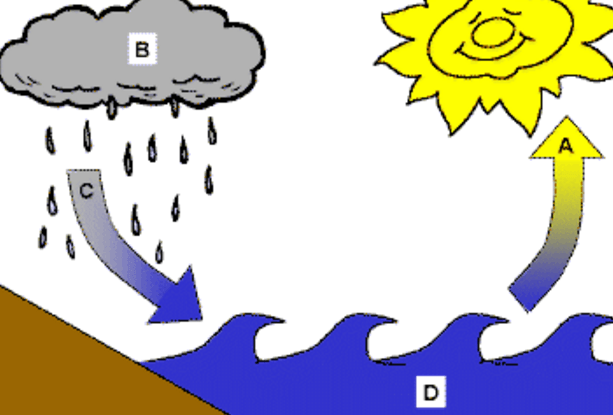

Letter A is representing what part of the water cycle?
Condenstation
Evaporation
Groundwater
Precipitation

Letter C is representing what part of the water cycle?
Condenstation
Evaporation
Accumulation
Precipitation
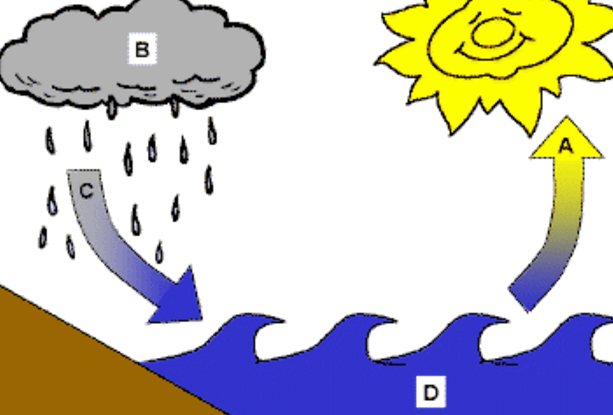
Letter D is representing what part of the water cycle?
Condenstation
Evaporation
Collection
Precipitation

