wayground logo

Free Printable Worksheets

Font size

S
M
L
XL
Worksheets

Study Session #3

Total questions: 100

Worksheet time: 2hrs 25mins

Name
Class
Date
1.
What are the two most common greenhouse gases?
a)
Water Vapor (H2O) and Methane (CH4)
b)
Carbon Dioxide COand Methane (CH4)
c)
Water Vapor (H2O) and Carbon Dioxide CO2
d)
Water Vapor (H2O) and Nitrous oxide (N2O)
2.
What type of waves get trapped inside the greenhouse?
a)
Sunlight
b)
Ultraviolet
c)
Microwaves
d)
Infrared
3.

What results from livestock and other agricultural practices and by the decay of organic waste in municipal solid waste landfills?

a)

Carbon Dioxide

b)

Methane

c)

Water Vapor

d)

Fluorinated Gases

e)

Nitrous Oxide

4.

Accounts for 81.6% of all U.S. greenhouse gas emissions from human activities.

a)

Water Vapor

b)

Fluorinated Gases

c)

Carbon Dioxide

d)

Methane

e)

Nitrous Oxide

5.

Chlorofluorocarbons and HCFCs are being phased out under an international agreement, called the __________.

a)

Paris Agreement

b)

Kyoto Protocol

c)

Montreal Protocol

d)

Endangered Species Act

6.
What is the greenhouse effect?
a)
The warming of a planet due to trapped radiation.
b)
The cooling of Earth due to air pollution.
c)
The heating of a solid, such as a rock.
d)
The urge for everyone in the neighborhood to paint their house green
7.
 Which of the following activities contributes the most to carbon emissions globally?
a)
Deforestation
b)
Agriculture
c)
Burning fossil fuels
d)
Respiration
8.
Which of the following is a proxy indicator to measure climate trends?
a)
A thermometer outside a classroom
b)
A CO2 meter in Hawaii
c)
Ice core samples
d)
A local weather report
9.
H2O + CO2 → H2CO3 is the formula for __________ which can make it difficult for corals to build their skeletons.
a)
ocean acidification
b)
coral bleaching
c)
global warming
d)
the greenhouse effect
10.

Methane is naturally produced by

a)

decomposition

b)

volcanic eruptions

c)

denitrification

d)

evapotranspiration

e)

forest fires

11.

Particulate matter can increase global warming by

a)

reacting with chlorofluorocarbons

b)

reducing surface absorption of ultraviolet radiation

c)

producing additional nitrous oxides

d)

reflecting radiation

e)

lowering surface albedo

12.

How much has the average global temperature increased in the last 120 years?

a)

0.6°F

b)

1.0°F

c)

1.4°F

d)

2.7°F

e)

3.2°F

13.

Which is an example of a negative feedback?

a)

higher air temperatures cause increased ocean evaporation

b)

higher air temperatures cause increased decomposition in soils

c)

lower concentrations of CO2 cause increased absorption of oceanic CO2

d)

low albedo causes decreased reflection of sunlight

e)

higher CO2 concentrations cause increased photosynthesis

14.

How might climate change increase the range of pests?

a)

higher intensity weather events

b)

changing precipitation patterns

c)

increasing number of heatwaves

d)

disruption of oceanic currents

e)

decreased duration of cold spells

15.
Large bodies of water affect climate because
a)
water heats up and cools more slowly than land
b)
water heats up and cools faster than land
c)
water and land cool at the same time
d)
water and land heat at the same rate
16.
The sun's rays are least direct
a)
near the poles
b)
near the equator
c)
at high altitudes
d)
far from the ocean
17.
Climates are classified according to two major factors:
a)
elevation and precipitation
b)
latitude and temperature
c)
elevation and latitude
d)
precipitation and temperature
18.
Which of the following has cause repeating 100,000-year cycles of ice ages in the past?
a)
an increase in sun spots
b)
several major volcanic eruptions
c)
changes in Earth;s orbit and tilt of its axis
d)
continental drift
19.
Which of the following have been linked to climate change? 
a)
droughts
b)
flooding
c)
melting of polar ice caps
d)
all of the above
20.
How do scientists collect evidence about climate? 
a)
using remote sensing from space with satellites
b)
by ground-based measurements of surface temperatures, carbon dioxide concentration and sea level
c)
by collecting “proxy data” from tree rings, ice cores, and historical records
d)
all of the above
21.
El Nino occurs when the tropical ocean waters are warmer in which ocean?
a)
Atlantic
b)
Indian
c)
Pacific
d)
Arctic
22.
Which of the following is a natural cause of long term climate change?
a)
Burning Fossil Fuels
b)
Milankovitch Cycles
c)
Deforestation
d)
All of them
23.
What is the largest carbon sink in the world?
a)
The Amazon
b)
The Oceans
c)
The Deserts
d)
The Forests
24.

Climate Change will cause...

a)

More intense tropical storms

b)

Less intense tropical storms

c)

no more storms

25.
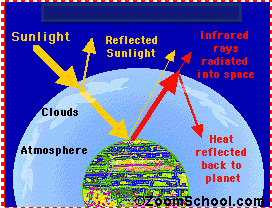
What does this diagram illustrate?
a)
Ozone Layer
b)
The Greenhouse Effect
c)
Ultraviolet Radiation
d)
Layers of the atmosphere
26.

An example of a climate change mitigation strategy is

a)

mandating more fuel efficient vehicles

b)

building structures to protect from rising sea levels

c)

species migration

d)

using drought resistant crops

27.
What causes urban heat islands?
a)
movement of people from farms to cities
b)
lots and lots of people heating their homes
c)
roads and buildings absorb and retain heat longer than vegetation does
d)
soil erosion
28.
The ozone layer is damaged by
a)
CFCs
b)
Increase in greenhouse gases
c)
Increased global temperatures
d)
Sulfuric and nitric acids
29.
CFCs alter the natural formation of ozone by: 
a)
breaking up ozone and reducing the amount of O2 needed to form ozone
b)
bonding with O3 
c)
preventing UV radiation to strike ozone 
30.

What is a major cause of coral bleaching?

a)

Too much carbon dioxide is dissolved in ocean water

b)

Not enough carbon dioxide is dissolved in ocean water

c)

Whales chewing on coral reefs

d)

Too much sunlight

31.

What is Arctic (or polar) amplification?

a)

the phenomenon that temperature near the poles is increasing at a higher rate than at lower latitudes

b)

the intensification of the polar jet stream due to melting ice caps

c)

the increased productivity of Arctic ecosystem due to increased upwelling

d)

the migration of the polar front due to stronger pressure contrasts

32.

Which of the following best describes the primary goal of the Paris Agreement?

a)

to create a fund to help countries deal with disaster relief

b)

to validate the science behind climate change for the global community

c)

to keep the global climate temperature increase to under 2 degrees Celsius

d)

to reduce deforestation worldwide

33.

Which of the following is a consequence of global warming? (Choose all that apply)

a)

Seas rising (flooding)

b)

Loss of habitat for animals.

c)

More severe storms and weather.

d)

Increased forest fires and drought.

34.

The main use of fossil fuels by humans is to use the thermal energy they contain to produce_________________________

a)

biodiesel

b)

ethanol

c)

electricity

d)

nuclear power

35.

Which of the following is NOT a problem with suburban sprawl?

a)

destruction of habitats

b)

loss of wetlands

c)

noise pollution

d)

air and water pollution

36.

The systematic removal of rock or other substance for financial gain.

a)

smelting

b)

mining

c)

urban farming

d)

forestry

37.

A mineral or group of minerals from which we extract metal.

a)

metal

b)

ore

c)

magma

d)

overburden

38.

Ore leftovers after valuable minerals have been removed

a)

tailings

b)

smelting piles

c)

extraction heap

d)

gravel

39.

Surface Mining and Control Reclamation Act

a)

mandates that miners give half of what they find to the government

b)

allows miners to place a stake on public land for $5 per acre

c)

mandates reclamation

d)

is meant to bankrupt mining companies

40.

Why mine tailings can be dangerous

a)

can cause miners to trip

b)

can be full of sharp objects

c)

can cause acid leaching into water bodies

d)

are full of conflict minerals

41.

Natural part of a forest ecosystem and may be required for seed germination

a)

floods

b)

tornadoes

c)

fire

d)

polar vortex

42.

Fire suppression has caused

a)

flooding

b)

bigger and more dangerous fires

c)

loss of biodiversity

d)

squirrels

43.

The National Forest Management Act

a)

prevents further building of roads in national forests

b)

was repealed by the Clinton administration

c)

requires national forests to have a management plan

d)

allows mining in national forests

44.

The first national park

a)

Yellowstone

b)

Yosemite

c)

Clinton State Park

d)

Central Park in NYC

45.

Has the most restrictive land use

a)

national park

b)

wilderness area

c)

national forest

d)

national monument

46.
Which of the following is a negative effect of deforestation?
I. Increased flooding
II. Increased biodiversity
III. Increased soil erosion
a)
I only
b)
I and II only
c)
I and III only
d)
I, II, and III
47.

Which of the following is a primary reason for deforestation?

a)

to graze cattle

b)

to grow crops

c)

to develop the land

d)

all of these

48.
Which of the following type of tree harvesting is the most detrimental to the environment?
a)
Strip Cutting
b)
Selective Cutting
c)
Clear Cutting 
d)
Partial Harvest
49.
The maximum sustainable yield of a population usually occurs
a)
at the maximum population size 
b)
at the minimum growth rate
c)
at half the carrying capacity
d)
at twice the maximum growth rate
50.
The creation of a walkable neighborhood is 
a)
a result of urban sprawl
b)
one goal of the Federal Housing Administration
c)
discouraged by multi-use zoning
d)
a principal of smart growth
51.

The "Tragedy of The Commons" is...

a)

An economic issue where people do not have enough money to buy basic needs so they resort to stealing and breaking the law.

b)

A type of play where someone tragically dies or gets killed.

c)

Economic issue where individuals tend to take advantage of the natural resource and it becomes unavailable for everyone.

52.

Sustainability

a)

The process of maintaining resources so they are not depleted or permanently damaged.

b)

The process of using resources by individuals to meet needs.

c)

The ability to save resources for years and years

53.
All the following are advantages of clear-cutting EXCEPT
a)
high profits in the short-term
b)
increased water pollution
c)
high timber yields
d)
can reforest with fast-growing trees
54.
Prescribed burns are fires that
a)
are caused by lightning.
b)
are set by humans.
c)
never get out of control.
d)
increase the risk of injury.
55.

The Taylor Grazing Act of 1934 was passed to

a)

allow more grazing on public lands.

b)

limit grazing on public land by using a permit system.

c)

limit grazing on public lands through large scale fencing systems.

d)

prevent grazing on public lands.

56.
A management system that includes prescribed burns will likely lead to:
I. Large quantities of biomass accumulating on the forest floor.
II. A decrease in the likelihood of uncontrolled natural fires.
III. An increase in fire-dependent species.
a)
I only
b)
I and II
c)
I and III
d)
II and III
57.
Type of surface mining that uses explosives, massive shovels, and even larger machinery called drag lines to expose seams of coal underneath
a)
mountaintop removal
b)
area strip mining
c)
contour strip mining
d)
open-pit mining
58.
 Which type of mining is associated with disturbing more land?
a)
Surface mining 
b)
Sub-surface mining
c)
Mining in the oceans
59.

Which type of mining is usually most directly harmful to miners?

a)

Mountaintop removal

b)

open-pit mining

c)

place mining

d)

subsurface mining

e)

strip mining

60.

What are National parks mostly managed for

a)

Extraction of resources

b)

Mining

c)

hunting

d)

Scientific, educational, and recreational use, its beauty or unique landforms

61.

Which is NOT an example of an externality?

a)

use of public forests by private companies

b)

use of atmosphere for air pollution

c)

use of forest watershed for aquifer purification

d)

use of tax fees for road maintenance

e)

use of oceans for stormwater drainage

62.
Growing more than one crop in a field, especially in alternating rows. 
a)
Alley Cropping
b)
PolyCulture
c)
Interplanting
d)
Intercropping
63.
Which is not an environmental concern from mining?
a)
Arsenic contamination 
b)
mercury poisoning
c)
sulfuric acid leaching into the water
d)
dihydrogen monoxide poisoning 
64.
A major problem with farmed salmon
a)
high levels of PCB's
b)
They have more fat than wild caught salmon
c)
There are no problems with farmed salmon
d)
both higher levels of PCB's and they are more fatty. 
65.
Tropical forests in the Amazon Basin and other South American countries are primarily being cleared or burned for
a)
cattle grazing and soybean plantations
b)
biodiesel  for motor vehicles
c)
coffee and spice plantations
d)
oil palm and paper pulp plantations
66.
Overgrazing, excessive plowing, and high pressure irrigation systems all speed up what?
a)
desertification
b)
soil enrichment
c)
composting
d)
soil conservation
67.
In biological pest control, what is used to control pests?
a)
living organisms
b)
chemical fertilizers
c)
human beings
d)
x-rays
68.
What is the term for the technology in which genetic material in a living cell is modified for medical an industrial use?
a)
biological pest control
b)
organic farming
c)
genetic engineering
d)
selective breeding
69.
Integrated Pest Management (IPM) is likely to use all of the following techniques EXCEPT:
a)
crop rotation
b)
intercropping
c)
planting herbicide resistant crops
d)
increased use of traditional pesticides
70.
Worldwide, the largest component of the human diet is:
a)
grain products
b)
meat products
c)
dairy products
d)
fruits and vegetables
71.
An integrated pest management approach to pest control emphasizes which of the following?
a)
Eradication of the pest problem
b)
Reliance on spraying broad-spectrum pesticides
c)
Reduction of crop damage to an economically tolerable level
d)
Using plant monocultures to simplify spraying
72.
A deficiency in this will lead to blindness and then death.
a)
Vitamin A
b)
Iodine
c)
Iron
d)
Protein
73.
Organic Farming bans all of the following EXCEPT
a)
Pesticides
b)
GMOs
c)
Synthetic Fertilizers
d)
Equipment that uses fossil fuels
74.
what are the unintended marine organisms that are caught in commercial fishing nets called?
a)
Waste fish
b)
Chum
c)
Bycatch
d)
Lunch
75.
CAFOs make meat more economical, but may have some negative environmental impacts.  These include all of the following EXCEPT
a)
high concentrations of animal waste.
b)
increase in nutrients in stormwater runoff.
c)
increase in sediments in stormwater runoff.
d)
increased use of land area over other types of animal farming.
76.
Which of the following is NOT a component of an Integrated Pest Management program?
a)
natural predators, parasites, disease organisms
b)
altering planting times
c)
use of naturally produced insecticides and herbicides.
d)
Use of broad-spectrum pesticides.
77.
Soil sample that is 60% clay, 30% silt, and 10% sand has which texture? 
a)
clay
b)
clay loam
c)
sandy loam
d)
silt 
78.

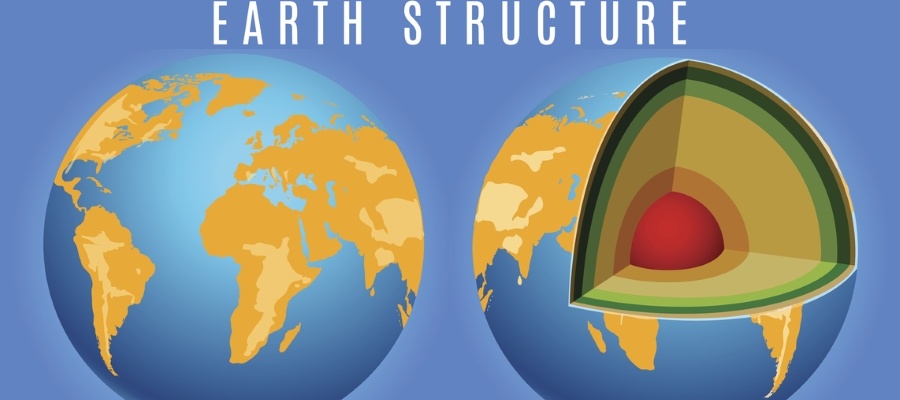
The surface of the earth, otherwise known as the ______, is broken into seven major pieces and sits atop a liquid layer called the _______

a)

lithosphere, asthenosphere

b)

astenosphere, mantle

c)

crust, litosphere

d)

asthenosphere, lithosphere

79.

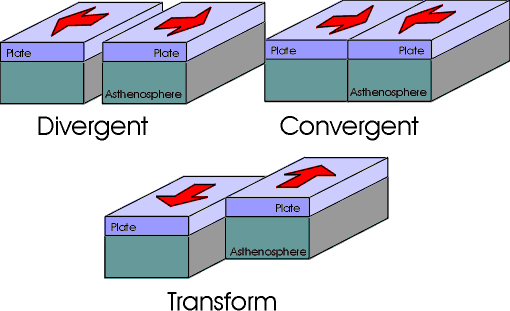
Plate boundaries that come together, causing the younger oceanic plate to sink under the older continental plate is called the

a)

convergent plate boundary

b)

divergent plate boundary

c)

transform plate boundary

d)

continental plate boundary

80.
The San Andrea's Fault in California is which type of boundary?
a)
Convergent
b)
Divergent
c)
Subductive Zone
d)
Transform
81.
At which type of plate boundary does seafloor spreading occur?
a)
Tranform
b)
Convergent
c)
Divergent
d)
Subductive Zone
82.
Which type of rock results from melting and cooling of magma?
a)
Igneous
b)
Metamorphic
c)
Sedimentary
d)
Extrusive
83.
Which type of rock forms from extreme heat and pressure?
a)
Igneous
b)
Sedimentary
c)
Organic
d)
Metamorphic
84.
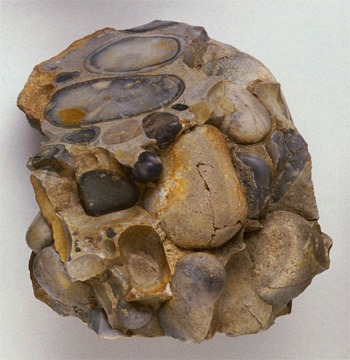
This rock was formed by smaller pieces of rock that settled at the bottom of a lake millions of years ago. What type of rock is this?
a)
Sedimentary
b)
Igneous
c)
Metamorphic
85.
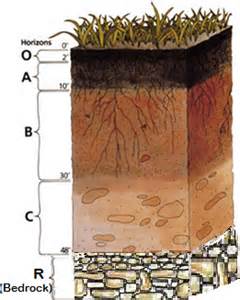
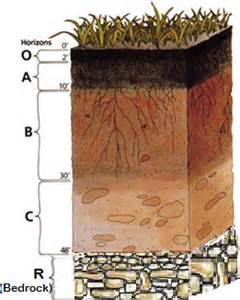
The layer of soil which the topsoil is found.
a)
Horizon A
b)
Horizon B
c)
Horizon C
d)
Horizon D or R
86.
Decayed organic material in soil is called______.
a)
Litter
b)
Silt
c)
Humus
d)
Clay
87.
Which horizon is made up of partially weathered rocks?
a)
Horizon A
b)
Horizon B
c)
Horizon C
d)
Horizon D or R
88.
In which horizon is most of the HUMUS?
a)
Horizon A
b)
Horizon B
c)
Horizon C
d)
Horizon D or R
89.
Most of the freshwater around the world is used for the following purpose.
a)
industry
b)
residential
c)
agriculture
d)
recreation
90.
The Coriolis effect is a result of the Earth's 
a)
gravitation
b)
temperature
c)
rotation
d)
curvature
91.
Sea surface temperature changes great than .5oC for greater than 5 months across the centeral ropical Pacific OCean are known as
a)
the arctic effect
b)
the get stream 
c)
a typhoon
d)
El Nino-Southern Oscillation 
92.

The huge increase in yields obtained through modern cultivation techniques has become known as the

a)

GMOs

b)

Cross-pollination methods

c)

Aquaculture dilemma

d)

Genetic revolution

e)

Green revolution

93.

Hormones that stop larval growth, combined with mechanical vacuuming of bugs from plants, are examples of

a)

Plant desertification

b)

Low input agriculture

c)

Integrated pest management

d)

Crop rotation

e)

Cross discipline activation

94.

Genetically modified (GM) organisms are those that

a)

Have genes of several different members of the same species.

b)

Have genes of several members of a different species.

c)

Have genes that have been artificially created in a laboratory.

d)

Have genes that have bacterial genes for increased resistance, plus the most desirable genes of the species.

e)

Have genes that code for desirable traits from one species that are modified and so they can then be inserted into another species, thus displaying the desired trait.

95.

Which of the following best explains how a pest develops resistance to a chemical pesticide?

a)

The pest develops adaptations to deal with adverse effects in its environment.

b)

Mutation and genetic recombination occur naturally.

c)

Genetically modified organisms are usually best adapted to be resistant.

d)

Industrial agribusiness practices of using large amounts of herbicides encourage pest resistance.

e)

Natural selection takes place.

96.

Wilderness areas

a)

Allow hunting as long as proper permits are acquired.

b)

Are biosphere reserves managed by UNESCO.

c)

Were set up under the wise-use and maximum sustainable yield approach.

d)

Are off-limits to development but are open to low-impact recreation.

97.

The globe on the left shows warmer water in the Pacific Ocean off the coast of South America. This represents a(n)

a)

El Niño

b)

La Niña

c)

Hurricane

d)

None of the above

98.

The globe on the right shows cooler water in the Pacific Ocean off the coast of South America. This represents a(n)

a)

El Niño

b)

La Niña

c)

Hurricane

d)

None of the above

99.

This animation represents which of the Milankovitch Cycles?

a)

Eccentricity

b)

Precession

c)

Obliquity

100.

This animation represents which of the Milankovitch Cycles?

a)

Eccentricity

b)

Precession

c)

Obliquity