Worksheets
Unit 1 Study Guide
Total questions: 100
Worksheet time: 1hrs 2mins
___________ is the next best alternative given up as a result of a decision.
___________ is limited resources with unlimited wants.
___________ are all the alternatives given up when choosing one option over another.
___________ is when fewer resources are used than the economy is capable of.
_____________ is a system combining market freedom and government regulation.
Market Economy
Traditional Economy
Mixed Economy
Command Economy
_____________ is an economic system in which decisions on the 3 key economic questions are based on voluntary exchange in markets
Market Economy
Traditional Economy
Mixed Economy
Command Economy
_____________ is an economic system in which the government makes all decisions on the 3 key economic questions
Market Economy
Traditional Economy
Mixed Economy
Command Economy
_____________ is an economic system that relies on habit, custom, or ritual to decide the 3 key economic questions
Market Economy
Traditional Economy
Mixed Economy
Command Economy
___________ is where firms purchase factors of production from households
Factor Market
Free Market
Product Market
Command Market
___________ is where households purchase goods and services from firms
Factor Market
Free Market
Product Market
Command Market
The more you produce of one good, the more you must give up of the other
Law of Increasing Opportunity Cost
Law of Increasing Cost
Marginal Cost
Marginal Benefit
the cost of producing one more unit of a good
Law of Increasing Opportunity Cost
Law of Increasing Cost
Marginal Cost
Marginal Benefit
the extra benefit of adding one more unit
Law of Increasing Opportunity Cost
Law of Increasing Cost
Marginal Cost
Marginal Benefit
the human-made objects used to create other goods and services
physical capital
human capital
labor
services
the knowledge & skills a worker gains through education & experience
physical capital
human capital
labor
services
the effort people devote to tasks for which they are paid
physical capital
human capital
labor
services
the actions or activities that one person performs for another
physical capital
human capital
labor
services
the effort people devote to tasks for which they are paid
physical capital
human capital
labor
services
the process of selling businesses or services operated by the government to individual investors, and then allowing them to compete in the marketplace
Invisible Hand
Privatization
Competition
Innovation
a term to describe the self-regulating nature of the marketplace
Invisible Hand
Privatization
Competition
Innovation
the struggle among producers for the dollars of consumers
Invisible Hand
Privatization
Competition
Innovation
the process of bringing new methods, products, or ideas into use
Invisible Hand
Privatization
Competition
Innovation
Which of the following is NOT a factor of production?
Land
Labor
Money
Capital
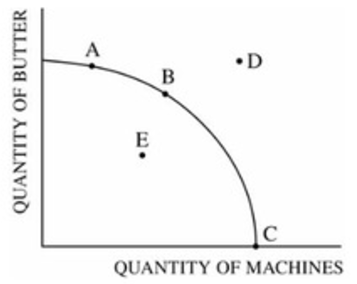
What does a point outside the PPC represent?
Underutilization
Efficiency
Government Regulation
Unattainable
A factory producing fewer goods than it is capable of is experiencing:
Underutilization
Privatization
Efficiency
Specialization
The purpose of an incentive is to:
prevent competition
specialize in certain fields
encourage specific behaviors
eliminate risk
What do households provide in a factor market?
privatization
land
labor
money
True or false: There is a high level of competition in a Command Economy.
True
False
Increased opportunity cost along a PPC is the result of reallocating resources that are not equally efficient in producing both goods
True
False
Marginal benefit must always outweigh marginal cost for a decision to be considered rational.
True
False
A point outside the production possibilities frontier represents maximum efficiency using all available resources.
True
False
Profit motive can lead to innovation, but also may cause firms to undercut ethical or environemntal standards without government regulation.
True
False
Consumer sovereignty ensures that all consumer demands will be met in a free market.
True
False
Trade-offs only occur when individuals make decisions, not when businesses or governments do.
True
False
Consumer sovereignty ensures that all consumer demands will be met in a free market.
True
False
What is consumer sovereignty?
When producers decide what’s sold
When the government makes all economic decisions
When consumers drive what gets produced
When consumers answer the 3 basic economic questions in an economy
A business owner who takes risks to create new products is called a(n):
Capitalist
Entrepreneur
Investor
Manager
What does a PPC curve illustrate?
Budgeting decisions
How supply affects prices
Trade-offs and opportunity costs
Consumer wants
Which is an example of physical capital?
A truck used for deliveries
A college degree
A farm worker
A forest
Specialization increases productivity because:
It makes workers happy
It reduces training time
People focus on what they do best
It eliminates all trade-offs
What does the term 'factor payment' refer to?
a government regulation tax
money received for providing land, labor, or capital
money received for providing a final good or service
the amount of money a business receives in excess of its expenses
Profit motive is an incentive for entrepreneurs.
True
False
Households purchase goods and services in the:
Factor Market
Resource Market
Command Market
Product Market
The term ‘thinking at the margin’ means:
Making decisions in extreme situations
Considering all options to increase production
Weighing the cost and benefit of one more unit
Buying the cheapest item
An example of human capital is:
A bulldozer
a college education
a credit card
a farm
A situation where demand exceeds supply at a given price is called:
Surplus
Scarcity
Shortage
Specialization
Which term refers to how resources are used to meet needs and wants?
Shortage
Resource Allocation
Specialization
Product Allocation
The hope of reward or fear of penalty that motivates behavior is called:
Incentive
Regulation
Specialization
Privatization
What is the definition of scarcity in economics?
The unlimited availability of resources
The basic economic problem of having limited resources to meet unlimited wants
The process of producing goods and services
The use of money in an economy
Which of the following is NOT considered a factor of production?
Land
Labor
Money
Entrepreneurship
Which term describes the next best alternative foregone when a choice is made?
Marginal benefit
Opportunity cost
Scarcity
Profit
Which economic system is characterized by government control over all major economic decisions?
Market economy
Mixed economy
Command economy
Traditional economy
What are the three basic economic questions every society must answer?
What to produce, how to produce, for whom to produce
How to save, how to invest, how to spend
Who to hire, what to sell, where to sell
What to import, what to export, what to consume
Which of the following best describes marginal cost?
The total cost of producing all units
The additional cost of producing one more unit of a good or service
The cost of the first unit produced
The cost of labor only
Which factor of production includes tools, machinery, and factories?
Land
Labor
Capital
Entrepreneurship
In a market economy, who primarily decides what goods and services will be produced?
The government
Consumers and producers
The military
Religious leaders
Which of the following is an example of a natural resource?
A computer
A factory worker
Oil
A business plan
What does a production possibilities curve (PPC) illustrate?
The relationship between price and quantity demanded
The maximum combinations of two goods that can be produced with available resources and technology
The total revenue of a business
The cost of labor
Which economic system combines elements of both market and command economies?
Traditional economy
Mixed economy
Market economy
Command economy
Which of the following best describes consumer sovereignty?
The government controls all production
Consumers determine what goods and services are produced through their purchases
Producers set all prices
Only one company controls the market
How does scarcity influence the allocation of resources?
It allows unlimited production of goods
It forces individuals and societies to make choices about how to use limited resources
It eliminates the need for decision-making
It increases the supply of resources
Which of the following is an example of a trade-off?
Buying both a car and a bike with the same money
Choosing to spend time studying instead of going out with friends
Producing unlimited goods with limited resources
Consuming more than you produce
If a business decides to produce more of one product, what is the opportunity cost?
The profit made from the product
The resources used to produce the product
The amount of the other product that cannot be produced
The total revenue from all products
How does a production possibilities curve demonstrate opportunity cost?
By showing the total profit of a business
By illustrating the trade-offs between two goods when resources are limited
By indicating the price of goods
By showing the number of workers needed
Which scenario best illustrates the concept of marginal benefit?
The total satisfaction from all units consumed
The additional satisfaction from consuming one more unit of a good
The cost of producing the first unit
The total cost of all units produced
In a command economy, how are goods and services allocated?
By consumer demand
By government decision
By private ownership
By market competition
How does government regulation typically differ between market and command economies?
Market economies have more regulation
Command economies have more regulation
Both have the same level of regulation
Neither has any regulation
Which of the following best explains why businesses must consider both marginal cost and marginal benefit when making production decisions?
To maximize total production
To ensure that the additional benefit of producing one more unit outweighs the additional cost
To minimize the use of resources
To increase government control
A country has to choose between producing more military goods or consumer goods. Using a production possibilities curve, explain what this choice represents.
The country can produce unlimited amounts of both goods
The country faces a trade-off and must consider opportunity costs
The country does not need to make any choices
The country will always produce more consumer goods
Which of the following is a characteristic of a traditional economy?
Decisions are based on customs and traditions
Prices are set by supply and demand
The government owns all resources
Profit motive drives production
A business is considering hiring one more worker. The marginal cost of hiring is 100 per day, and the marginal benefitis 120 per day. Should the business hire the worker? Explain your reasoning.
No, because the marginal cost is higher than the marginal benefit
Yes, because the marginal benefit exceeds the marginal cost
No, because the total cost is too high
Yes, because the worker will increase total production
How do mixed economies address the question of "for whom to produce"?
Only the government decides
Only the market decides
Both government policies and market forces influence distribution
It is determined by tradition
A government must decide whether to allocate more resources to healthcare or education. Using economic reasoning, explain how scarcity and opportunity cost influence this decision.
The government can allocate unlimited resources to both sectors
Scarcity forces the government to choose, and the opportunity cost is the benefit forgone from the sector not chosen
There is no opportunity cost in government decisions
Scarcity does not affect government choices
Suppose a country is operating inside its production possibilities curve. What does this indicate about its use of resources, and what could be a possible reason for this situation?
Resources are fully employed; the country is efficient
Resources are underutilized; possible reasons include unemployment or inefficiency
The country is producing beyond its capacity
The country has no opportunity costs
Analyze how an increase in opportunity cost might impact the rational decision-making of a business when choosing between two projects.
The business will always choose the project with the highest cost
The business will ignore opportunity costs
The business will reconsider its choice if the opportunity cost of one project becomes too high compared to the benefit
Opportunity cost does not affect business decisions
Evaluate how different economic systems (market, command, mixed) address competition and profit motive.
All systems encourage competition and profit equally
Market economies encourage competition and profit motive, command economies restrict them, and mixed economies balance both
Only command economies allow profit motive
Mixed economies eliminate competition
A country is considering shifting from a command economy to a mixed economy. What are some potential effects on private ownership and consumer sovereignty?
Both would likely increase
Both would decrease
There would be no change
Only government ownership would increase
Given a production possibilities curve for two goods, explain how a technological advancement in the production of one good would affect the curve and opportunity costs.
The curve would shift inward, and opportunity costs would increase
The curve would shift outward for that good, and opportunity costs would decrease
The curve would not change
Opportunity costs would remain the same
What is the primary reason individuals and societies must make choices about how to use their resources?
Resources are unlimited
Scarcity requires prioritizing needs and wants
All goods are free
There is no need for planning
Which of the following best illustrates the concept of opportunity cost?
Producing more of one good means producing less of another
All resources can be used for any purpose
There is no limit to production
Prices remain constant regardless of choices
In which type of economy do customs and traditions primarily determine the allocation of resources?
Market economy
Mixed economy
Command economy
Traditional economy
Which of the following is considered a human resource in the factors of production?
Oil reserves
Company profits
Factory machinery
Skilled workers
What does the concept of marginal benefit refer to in economic decision-making?
The total benefit received from all units produced
The cost of producing the first unit
The average benefit per unit
The additional benefit gained from producing or consuming one more unit
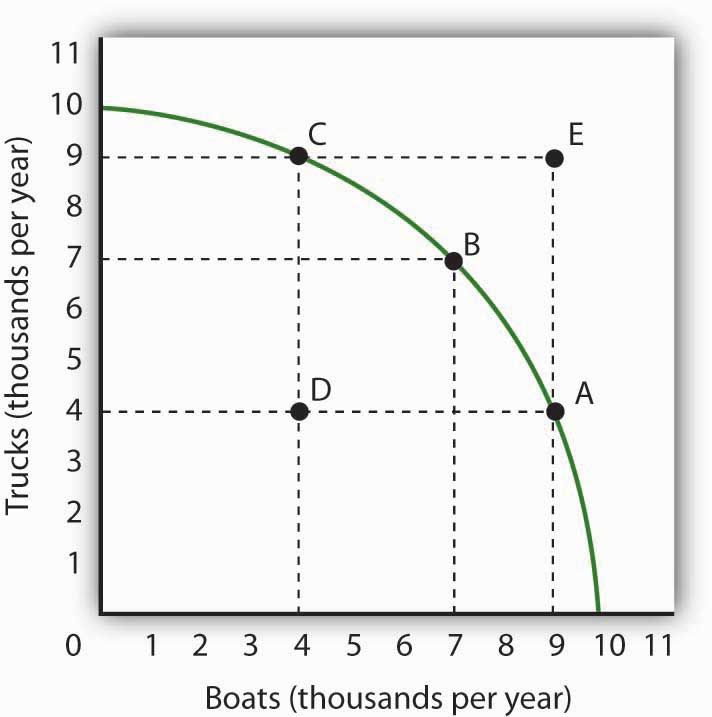

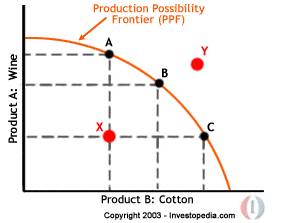
If there is improved technique of Production in both the goods , how will the PPC be affected?
Leftward shift of PPC
Rightward shift of PPC
Rotation of PPC
None of the above

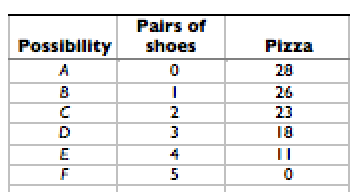
The table shows the production possibilities for a country. Based on the table, which of the following production combinations is a possibility?
28 pizzas and 5 pairs of shoes
3 pairs of shoes and 23 pizzas
2 pairs of shoes and 20 pizzas
4 pairs of shoes and 15 pizzas